Receiving a Singapore Permanent Residency (PR) rejection can be disappointing, particularly after spending months preparing documents and waiting for an outcome.
One of the biggest challenges is that the Immigration & Checkpoints Authority (ICA) generally does not provide detailed reasons for rejecting PR applications. As a result, many applicants are left wondering what went wrong and whether they should appeal or submit a fresh application.
Having reviewed and assisted with numerous PR applications, appeals, and reapplications over the years, we have seen applicants rejected across a wide range of profiles. Some had strong salaries. Some had lived in Singapore for many years. Some were convinced their approval was straightforward.
We have also seen applicants who were initially unsuccessful later obtain PR approval through a subsequent application and, in more limited situations, through an appeal
7 Reasons Why Your Singapore PR Application Was Rejected
ICA does not usually disclose the specific reasons for a rejection. However, based on our experience reviewing unsuccessful applications, the following factors commonly arise when assessing potential weaknesses within a profile.
1. Employment Stability and Career Progression
Employment history often forms an important part of a PR application.
Frequent job changes, short employment periods, extended employment gaps, or limited evidence of career progression may sometimes affect how a profile is assessed.
This does not mean changing jobs automatically leads to rejection. However, applicants should consider whether their employment history demonstrates stability and a sustainable long term career path in Singapore.
2. Income and Economic Contribution
Salary is one of the most discussed aspects of PR applications.
However, ICA does not publish a minimum salary requirement for PR approval. For a broader discussion of ICA’s assessment criteria, you may also wish to review our guide on Singapore PR Requirements.
Income is generally considered together with factors such as employment history, qualifications, tax contributions, industry, and overall economic participation in Singapore.
For this reason, applicants should be cautious about assuming that salary alone explains a rejection.
3. Limited Length of Residence in Singapore
Applicants who have spent longer periods living and working in Singapore may sometimes be in a stronger position to demonstrate long term commitment compared to those who have only recently arrived.
That said, there is no fixed number of years that guarantees approval.
Length of residence is simply one factor within ICA’s broader assessment.
4. Family Circumstances and Local Ties
Marriage, children, family members residing in Singapore, and broader evidence of long term settlement may all contribute to how an application is viewed.
Every family situation is different, and ICA assesses each case on its own merits.
5. Business Ownership and Self Employment Considerations
Business owners and self employed applicants can obtain PR.
However, these applications often require ICA to assess additional factors such as business activity, financial performance, local hiring, economic contribution, and overall sustainability.
As a result, these applications may require more extensive supporting documentation than traditional employment based applications.
6. Inconsistencies Within the Application
One area applicants sometimes overlook is consistency.
Employment records, salary declarations, family information, educational qualifications, and supporting documents should generally align with official records and the information declared throughout the application.
Significant inconsistencies may create questions that affect the overall assessment.
7. The Overall Profile Was Not Competitive Enough At That Point In Time
In practice, PR applications are rarely approved or rejected based on one factor alone.
ICA assesses the overall profile, taking into account employment history, family circumstances, economic contribution, supporting documents, and broader long term plans in Singapore.
A profile that may not be competitive enough at one stage of an applicant’s journey may become significantly stronger later following further career development, family developments, business growth, or additional evidence of long term commitment to Singapore.
Next Steps To Take: Should You Appeal or Reapply?
One of the first questions applicants ask after receiving a rejection is whether they should appeal or submit a fresh application. Applicants who are still unsure about their overall profile strength may also wish to use our Singapore PR Eligibility Calculator.
Many assume that an appeal should automatically be the next step.
In practice, this is often not the case.
Based on our experience, fresh applications are generally far more common than successful appeals.
This is also broadly consistent with ICA’s published guidance, which states that applicants may consider submitting a fresh application where there are changes to their circumstances.
An appeal is generally only appropriate where there is substantial new information or developments that could materially affect ICA’s assessment of the original application.
In many cases, a fresh application may be the more practical option, particularly where the applicant wishes to present updated information, supporting documents, or a stronger overall application.
Importantly, ICA has also stated that where there are no changes to an applicant’s circumstances and the same information and documents are submitted, the outcome is likely to remain the same.
However, one common misconception is that applicants must wait years or experience a dramatic life event before considering a fresh application.
In practice, we have seen successful reapplications where the profile itself was not radically different.
Sometimes the difference lies in how the applicant’s achievements, contributions, family circumstances, and long term commitment to Singapore are documented and presented.
The key question is therefore not simply whether time has passed.
The more important question is:
“Will ICA be assessing materially stronger information than before?”
If the answer is yes, a fresh application may be worth considering.
Real Examples of PR Rejections, Appeals and Reapplications
Every PR application is assessed on its own merits, and no two cases are identical.
However, one of the biggest misconceptions we encounter is the belief that applicants must wait for a major salary increase, promotion, or life changing event before considering a fresh application.
In practice, this is not always the case.
We recently assisted an applicant whose previous PR application had been unsuccessful.
While there had been some developments since the earlier submission, the profile itself was not dramatically different. There had been no extraordinary increase in salary, no major change in family circumstances, and no significant shift in the applicant’s overall background.
What became apparent during our review was that several aspects of the applicant’s profile had not been fully documented or explained in the original submission.
The subsequent application provided a clearer picture of the applicant’s professional achievements, career progression, industry contributions, and long term plans in Singapore. Additional supporting information was also included to better explain the applicant’s background and circumstances.
The fresh application was approved approximately four months after submission.
This highlights an important point.
A stronger reapplication does not always require a completely different profile. In some situations, the difference lies in whether ICA is being presented with a fuller, clearer, and better supported picture of the applicant’s circumstances.
We have also seen successful outcomes in other situations, including a PR appeal that was approved following significant new developments after the original application, as well as a separate PR reapplication where long term commitment, family circumstances, and stronger supporting documentation helped present a more complete picture to ICA.
Frequently Asked Questions About Singapore PR Rejections
1. Can I apply for Singapore PR again after a rejection?
Yes.
A previous rejection does not prevent future approval. Each application is assessed based on the applicant’s circumstances, supporting documents, and overall profile at the time of review.
Many successful applicants have previously received one or more PR rejections before eventually obtaining approval.
Applicants who are unsure whether their profile is currently competitive may also wish to use our Singapore PR Eligibility Calculator before deciding on their next step.
2. How long should I wait before reapplying for Singapore PR?
ICA has historically encouraged applicants to allow some time before submitting a fresh application.
However, the more important consideration is not simply how much time has passed, but whether there is now materially stronger information for ICA to assess.
This may include updated employment records, stronger income history, additional family ties, improved business performance, new qualifications, or other developments that were not reflected in the previous application.
Applicants should also note that ICA has stated that where there are no changes to an applicant’s circumstances and the same information and documents are submitted, the outcome is likely to remain the same.
Before reapplying, it is often useful to ask whether ICA will be assessing a materially stronger application than before. Applicants preparing a fresh submission may also find it useful to review our guide on how to apply for Singapore PR to ensure that all relevant information and supporting documents are properly prepared.
3. Can I appeal a rejected Singapore PR application?
Appeals are generally the exception rather than the norm.
Based on ICA’s published guidance, applicants are generally encouraged to submit a fresh application where there have been changes to their circumstances.
In practice, appeals are usually only worth considering where there is substantial new information or developments that could materially affect ICA’s assessment of the original application.
Where such grounds do not exist, a fresh application is often the more practical option.
4. What can I do to strengthen my next PR application?
Applicants often assume that they must wait for a major promotion, substantial salary increase, or significant life event before reapplying.
In practice, strengthening a future application may involve both improving the profile itself and presenting the profile more effectively.
Examples may include:
• stronger employment history or career progression
• improved income or business performance
• marriage or the birth of a child
• additional qualifications or professional achievements
• stronger evidence of long term commitment to Singapore
clearer presentation of achievements, contributions, and supporting documents.
We have also seen situations where the applicant’s profile was not dramatically different from the previous submission, but the reapplication provided a much clearer and more complete picture of the applicant’s overall circumstances.
5. How do I identify potential gaps in my previous PR application?
Because ICA generally does not provide detailed reasons for rejection, it is often impossible to know exactly why an application was unsuccessful.
Rather than focusing on a single factor, applicants may wish to consider:
• whether there is stronger information available today than when the previous application was submitted
• whether important achievements, contributions, or supporting documents were omitted
• whether any unusual circumstances required further explanation
The key question is whether ICA would be assessing a materially stronger application if a fresh application were submitted today.
6. Does community involvement help a PR application?
Community involvement may help demonstrate integration and long term commitment to Singapore.
Depending on an individual’s circumstances, this may include volunteer work, participation in professional associations, industry groups, religious organisations, clubs, or broader involvement within the local community.
Community involvement is generally viewed as one factor within a broader assessment of the applicant’s overall profile rather than a standalone requirement for PR approval.
7. Can self-employed applicants and business owners obtain Singapore PR?
Yes.
Business owners and self-employed applicants may apply for PR.
Depending on the circumstances, ICA may consider factors such as business activity, financial performance, economic contribution, local hiring, and the applicant’s overall profile.
8. Should I engage a professional before reapplying?
Applicants may submit PR applications independently.
However, where there have been previous rejections, business ownership structures, complex family circumstances, or uncertainty regarding the next step, some applicants choose to seek professional guidance before deciding whether to appeal or reapply.
A professional review may help identify potential weaknesses, assess whether an appeal is realistic, and determine whether a future application can be strengthened before submission.
Applicants who are considering professional assistance may also wish to understand the differences between working with a Singapore immigration agency and an immigration lawyer in Singapore before deciding which type of support best suits their circumstances.
How Transform Borders Can Help
A PR rejection does not necessarily mean the end of your PR journey.
The more important question is whether an appeal is appropriate, whether a fresh application would be stronger, and what steps should be taken before moving forward.
At Transform Borders, we advise applicants on PR appeals, reapplications, and broader PR strategy based on their individual circumstances.
If you would like to discuss your situation, you may book a 20-minute consultation with our team.
For many foreigners, Singapore quickly becomes more than just a place to work, it can feel like home.
Applying for Permanent Residency (PR), however, can feel overwhelming. Each year, applicants from different nationalities and professional backgrounds are assessed under a highly selective and discretionary framework.
Example of a Singapore Permanent Resident card issued by the Immigration & Checkpoints Authority (ICA).
The permanent resident card serves as the official identification document for Singapore PRs.
Permanent Residency grants you the right to live, work, and study in Singapore without time restrictions. It is an immigration status granted by the Singapore Government that reflects your long term commitment to the country’s economy and community.
CPF (Central Provident Fund) contributions and retirement savings, which provide family protection through combined social security benefits like healthcare, retirement, and housing support.
Ability to buy selected HDB flats and enjoy lower property taxes.
To summarise, Singapore Permanent Residency gives foreigners the stability to live, work, and contribute long-term without relying on work pass renewals.
Singapore’s HDB apartments represent the stability and community many PR applicants seek.
Holding PR status brings long-term stability and peace of mind.
Top reasons to apply:
No more work pass renewals or dependency on employers.
Key residency privileges: With PR status, you have the right to live, work, and study in Singapore without any time limits.
Eligibility for public housing and home loans.
Access to CPF for healthcare, housing, and retirement.
Freedom to switch jobs easily.
Ability to include your spouse (who must be in a legal marriage with you) and children under 21 in your PR application.
Option to apply for long-term visit passes for parents.
Opportunities to start a business and benefit from Singapore’s low-tax environment.
PR status is often the first step toward eventually becoming a Singapore citizen, with access to subsidised healthcare, CPF savings, and long-term housing stability along the way.
How to Apply for Singapore PR: Step-by-Step Process
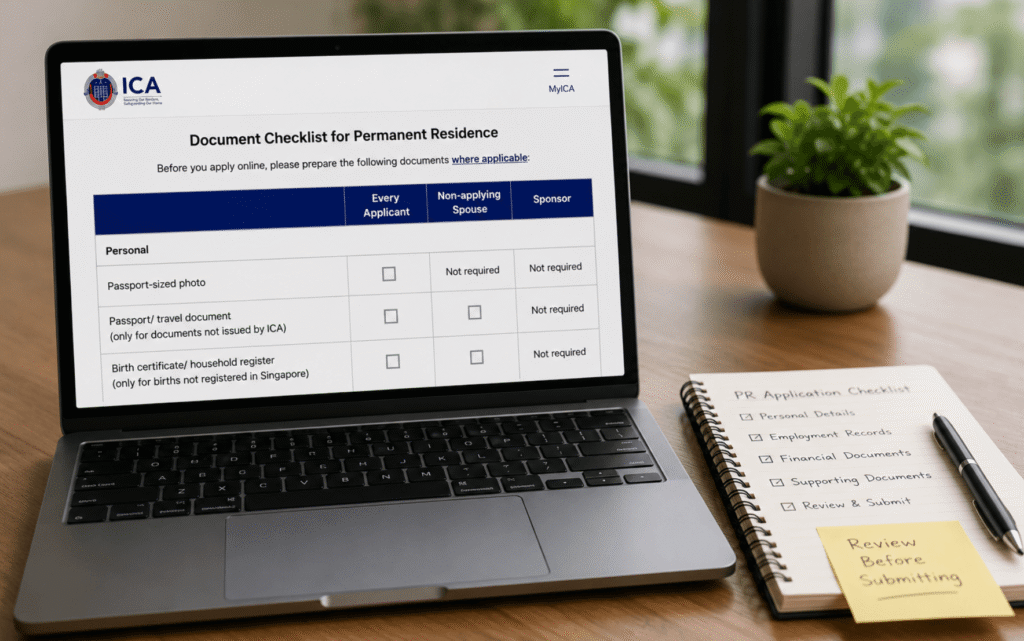
Step 1: Gather Required Documents
Preparing your PR documents helps avoid rejection
Before you begin your PR submission, collect key documents confirming your identity, employment history, and financial stability. Preparing these clearly helps avoid delays or rejection.
In practice, ICA’s PR application process now goes significantly beyond basic identity and salary documents alone. Depending on the applicant’s profile, additional sections may involve detailed employment history, overseas residential history, family background information, business ownership records, achievements, memberships, or broader supporting profile details.
Note: All documents must be consistent with ICA’s records and your previous work pass filings. Missing or mismatched details may delay processing or prompt ICA to request further clarification.
Step 2: Online Submission via ICA e-Service
The official ICA e-Service portal where applicants submit their PR applications online.
The official ICA e-Service portal is where you can submit your application as an online application.
Eligible applicants can now submit their PR applications online through the ICA e-PR system. Log in with Singpass on ICA e-Service and upload all supporting documents. Depending on the applicant’s profile and application type, additional profile information and supporting documents may also be required during the online submission process.
Applications for permanent residency are submitted online via ICA’s e-Service portal. In normal cases no in-person interview or visit to the ICA building is required. However, in exceptional cases ICA may contact the applicant or sponsor to provide further documents or clarifications.
For a full breakdown of supporting documents required, please refer to ICA’s official PR application form and submission guide.
Step 3: Fill in Particulars and Upload Documents Within 7 Days
Applicants must review ICA’s pre-submission checklist before starting their Singapore PR application.
Review ICA’s pre-submission checklist carefully. Make sure every detail, especially your personal particulars, is filled in accurately.
ICA’s system gives you seven days to complete this step — if you miss the window, you will need to restart your application.
In practice, the PR application form can become significantly more detailed than many applicants initially expect.
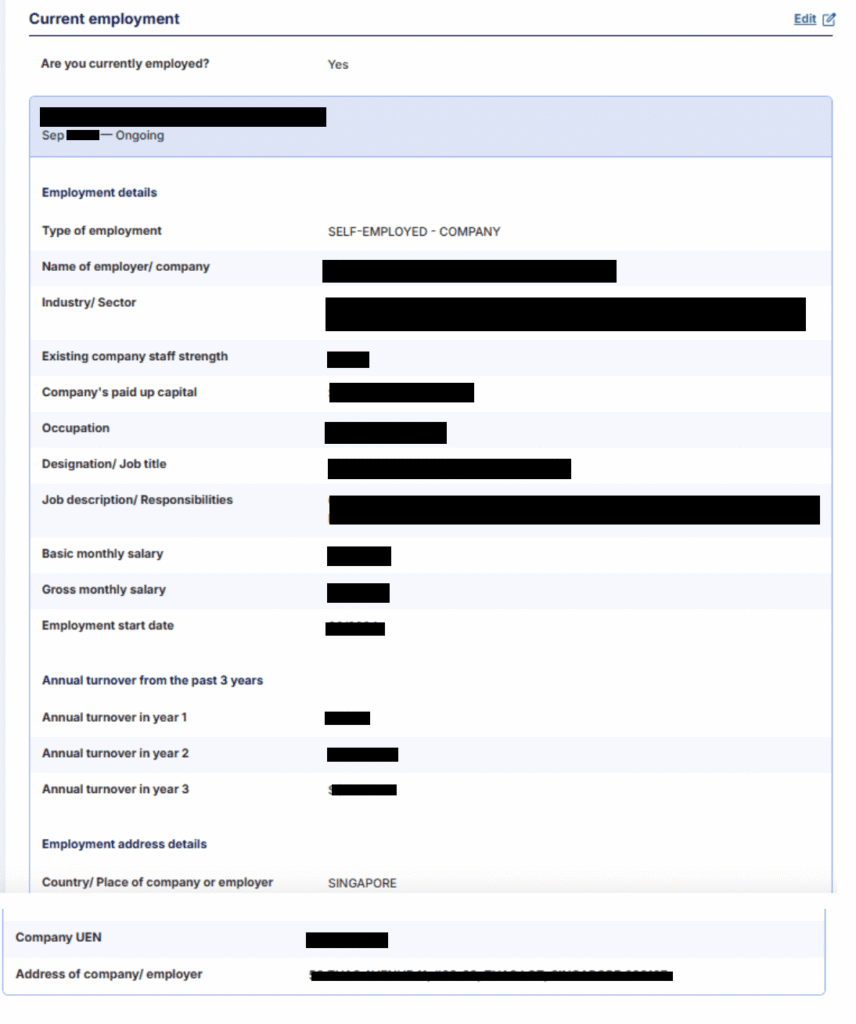
Depending on the applicant’s profile, ICA’s PR application may require detailed declarations relating to employment history, salaries, business ownership, company information, turnover, and professional responsibilities.
Depending on the applicant’s profile, ICA’s forms may contain extensive sections relating to family background, overseas addresses, previous employment history, education records, business activities, achievements, memberships, and other supporting profile information.
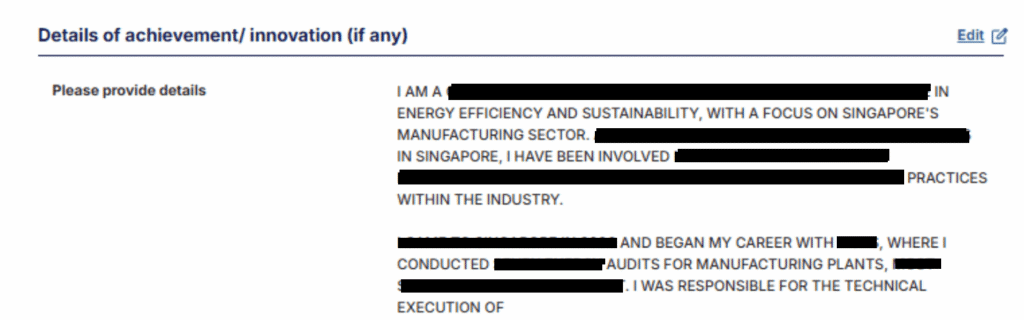
Depending on the applicant’s profile, ICA’s PR application may contain broader sections relating to achievements, innovation, memberships, or professional background information.
Certain sections within the application may also require applicants to prepare longer written explanations or profile summaries relating to their professional background, achievements, or broader circumstances. Where spouses or family members are included within the same PR application, similar achievements and profile-related sections may also need to be completed for accompanying applicants as part of the overall submission.
Step 4: Review and Declare the Application Within 7 Days
Applicants must log in with Singpass to access the ICA e-Service for PR applications.
Log in to ICA’s PR e-Service using Singpass. Each applicant, including your spouse and children, must log in to review and confirm their own details. Before submitting, complete the declaration confirming that the details provided are accurate and true.
If Singpass is not applicable (e.g., for applicants overseas or under 15 years old), ICA will provide unique login credentials for this purpose. If you are eligible and do not have an account, you can register online or visit a counter.
Need help preparing your PR application?
Speak with our team to better understand your profile, documentation strategy, and next steps before submission.
Applicants must pay a non-refundable S$100 processing fee for each PR applicant before submission.
Once the application is submitted, you will need to pay a non-refundable processing fee of SGD 100 per applicant. This payment can be made online via credit card.
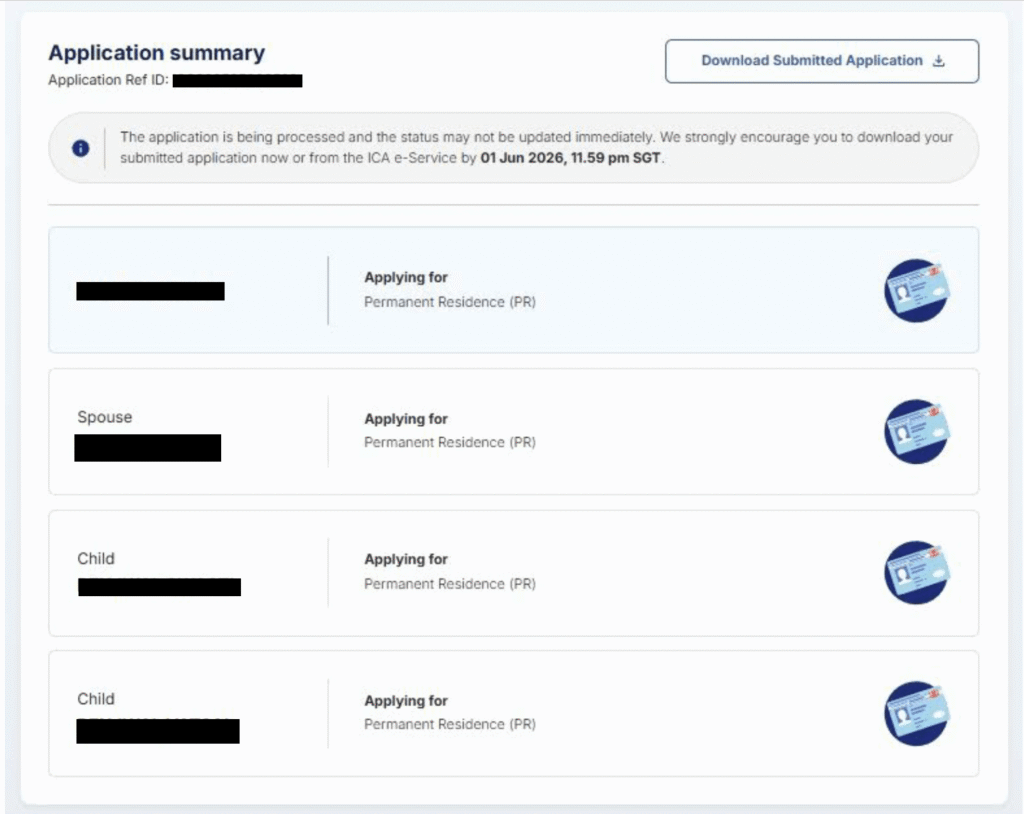
After successful submission and payment, applicants will generally receive an acknowledgement email from ICA confirming that the application has been lodged. Applicants may also log in to MyICA or ICA’s e-Service portal to monitor the application status during the processing period, where the application will typically reflect as processing while under review. A downloadable copy of the submitted application is also usually available through the portal for future reference.
After submission, applicants may view their application summary through ICA’s e-Service portal, monitor the processing status, and download a copy of the submitted PR application for reference.
Step 6: After You Submit – What Happens Next?
The processing time for Singapore PR applications is generally expected to take around 6 months, although some applications may take longer depending on the complexity of the profile and whether ICA requires further clarifications.
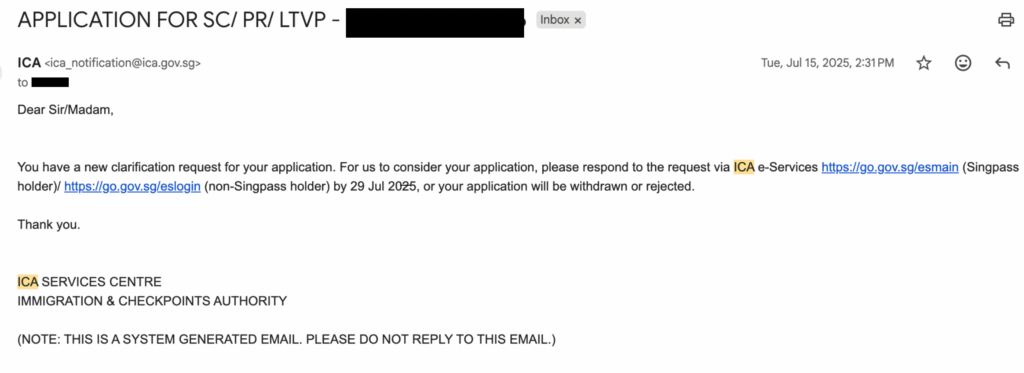
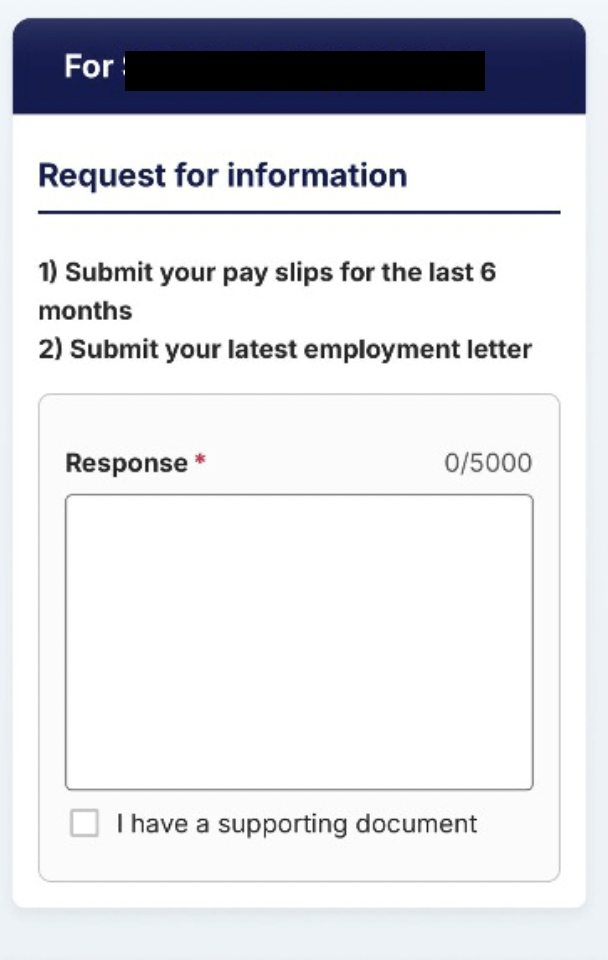
During the review period, ICA may issue clarification requests or request additional supporting documents through ICA’s e-Service portal. Applicants will generally receive an email notification directing them to log in to the portal to review and respond to the request within the stated timeline.
Applicants may receive clarification requests from ICA during the processing period requesting further documents or supporting information through ICA’s e-Service portal.
Clarification Requests
Examples of documents or information that ICA may request during processing can include:
updated employment letters or recent payslips
clarification relating to employment or family background
curriculum vitae or profile information for family members
updated financial or business-related documents
further supporting documents relevant to the overall application
Clarification requests are typically managed directly through ICA’s e-Service portal, where applicants may upload documents and provide additional explanations during processing.
However, not all updates during the processing period originate from ICA.
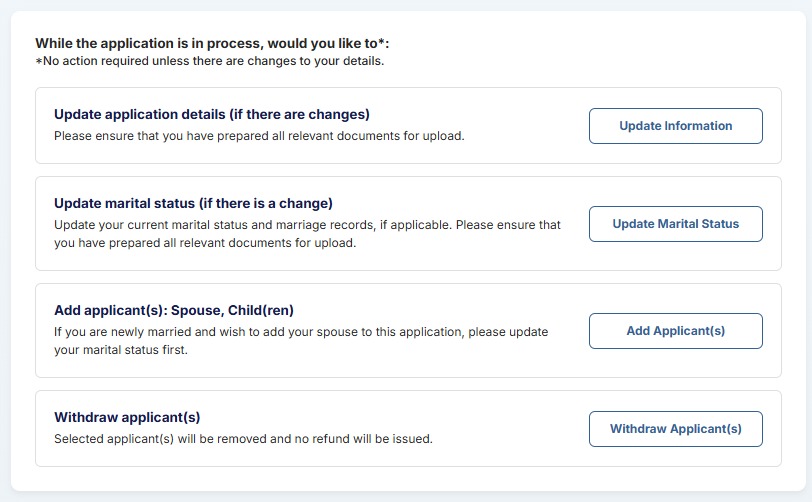
During the processing period, applicants may update ICA where there have been material changes since the original submission. Depending on the nature of the change, this may be done directly through ICA’s online portal or through the appropriate ICA enquiry channels.
Applicants may update certain application details, marital status, or family member information directly through ICA’s online portal while the PR application remains under review.
7: What to Do After Receiving Your PR Approval Letter
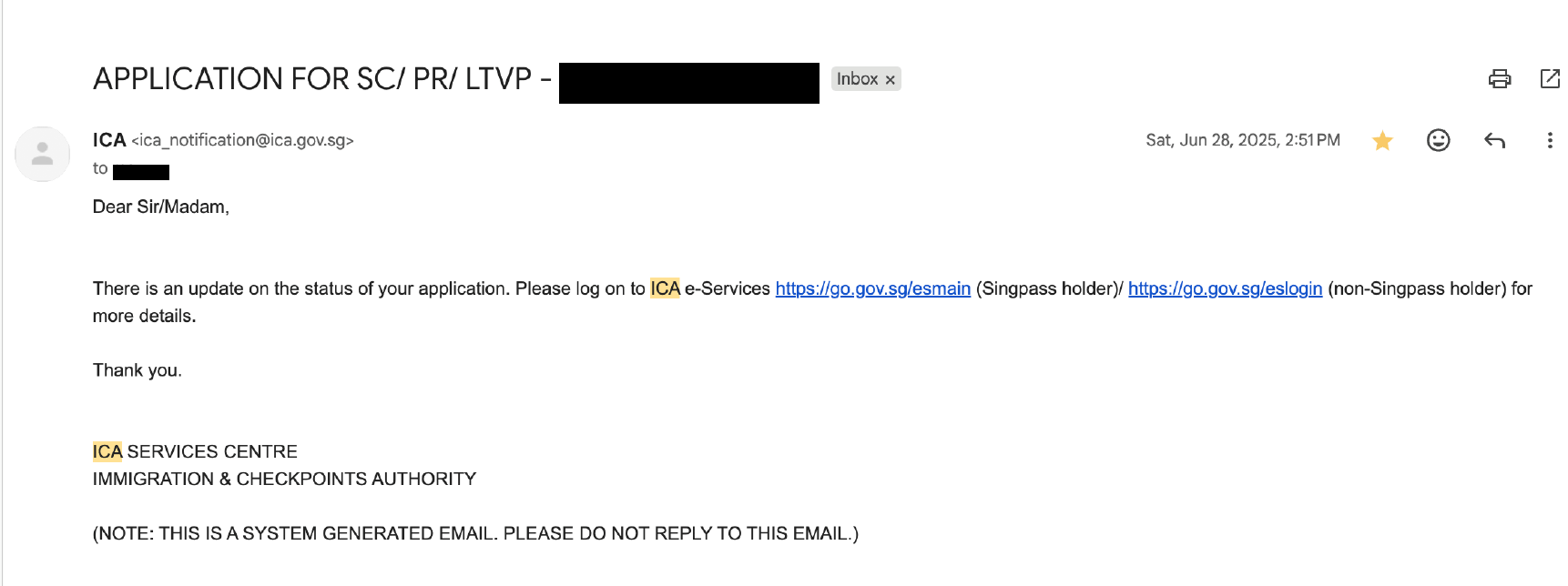
If your Singapore PR application is approved, ICA will generally send an email notification informing applicants that there has been an update to the application status.
Applicants are typically notified by email when there is an update to the outcome of their Singapore PR application.
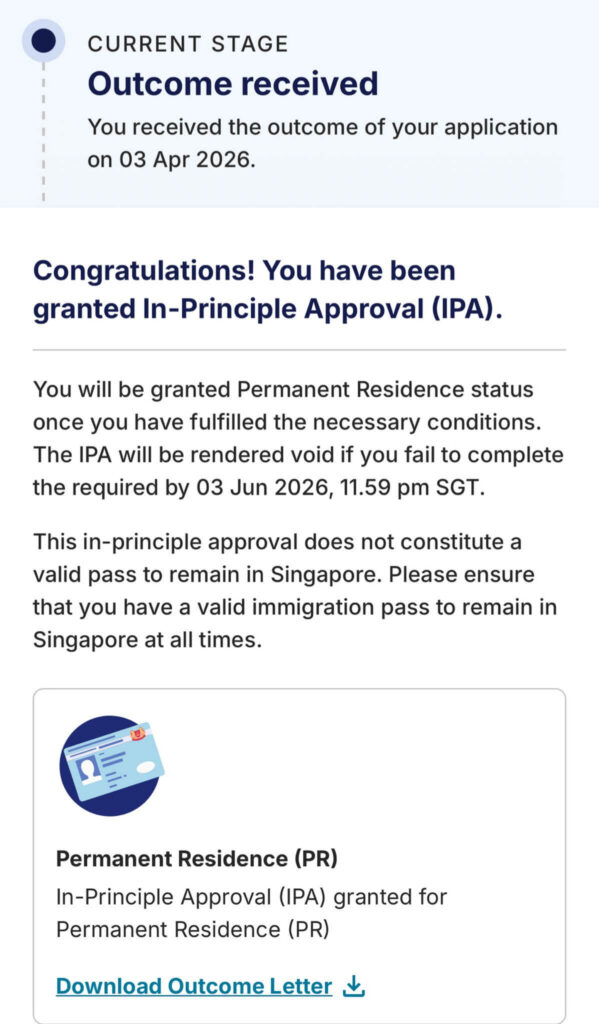
Once logged into ICA’s e-Service portal, applicants may view the approved outcome, download the In-Principle Approval (IPA) letter, and review the next steps required to complete the PR formalities.
Successful applicants may view their approved PR outcome, IPA validity timeline, and IPA letter directly through ICA’s e-Service portal.
Following approval, applicants will generally need to complete the required PR formalities within the validity period stated in the IPA. This commonly includes booking the ICA appointment, reviewing the required supporting documents, completing the relevant declarations and health-related procedures, and preparing for collection of the PR card and Blue IC.
Applicants may also be required to complete the Singapore PR Journey requirements as part of the post-approval process. The IPA and ICA e-Service portal will generally contain instructions relating to appointment booking, required documents, declaration procedures, timelines, and the formalities that must be completed before the IPA validity period expires.
Step 8: If Your PR Application is Not Successful
A reminder that a rejected PR application is not the end — you can always strengthen your case and try again.
A rejected PR application does not necessarily mean that future applications will also be unsuccessful. In many cases, applicants may strengthen their profile over time through improved employment stability, updated qualifications, stronger family circumstances, or broader long-term integration in Singapore.
Following a rejection, applicants may generally consider either:
submitting an appeal where there are meaningful clarifications, new supporting information, or exceptional circumstances that may not have been fully reflected in the original application; or
reapplying at a later stage once the overall profile has strengthened further.
The appropriate timing for an appeal or reapplication often depends on the applicant’s individual circumstances, the nature of the profile, and whether there have been any material improvements since the previous submission.
For guidance on whether an appeal or reapplication may be more appropriate, and how to strengthen the overall profile strategically, see our Singapore PR Rejection & Reapplication Guide.
For the latest updates and detailed requirements, always refer to ICA’s official website.
What Are the Key Tips to Strengthen Your PR Submission?
A well-prepared Singapore PR application is not just about documents, but also clarity, consistency, and presenting a credible long-term profile to ICA.
A strong Singapore PR application is not simply about uploading documents and waiting for the outcome.
In practice, ICA reviews the overall clarity, consistency, and credibility of the application as a whole. A well-prepared submission should make it easy for the reviewing officer to understand your background, employment history, family profile, and long-term circumstances in Singapore.
Here are some practical considerations before submission.
1. Keep all information consistent
Ensure that your employment history, salary details, addresses, family information, and educational records remain consistent across the application form and supporting documents.
Even relatively small inconsistencies may result in clarification requests or unnecessary delays during processing.
This becomes particularly important for applicants with:
overseas employment history,
self-employed or business backgrounds,
multiple previous employers, or
complex family circumstances.
2. Organise the application clearly
A well-organised submission is significantly easier for ICA to review.
Documents should be labelled properly and arranged logically, especially where there are:
multiple applicants,
overseas records,
lengthy employment histories,
asset or investment records, or
business ownership structures involved.
Clear organisation also reduces the likelihood of important information being overlooked during assessment.
3. Explain unusual circumstances carefully
If there are employment gaps, salary fluctuations, business ownership arrangements, overseas family situations, or other circumstances that may not be immediately obvious from the supporting documents, a short and factual explanation may sometimes help provide context.
The explanation should remain concise, consistent, and properly supported where relevant.
4. Do not overlook the profile and achievements sections
Many applicants focus heavily on payslips and employment documents, but ICA’s PR application process now requests significantly broader background information than in previous years.
Depending on the applicant’s profile, ICA may also request or assess:
professional memberships,
leadership roles,
publications,
volunteer activities,
business ownership,
asset or investment records,
awards or achievements,
professional certifications, or
community involvement.
Where relevant, these sections should be completed carefully and consistently with the overall application narrative.
A strong PR submission is often one that presents a coherent long-term profile rather than isolated documents in separate sections.
5. Use recent and updated records
Employment letters, salary documents, and business records should generally be recent and clearly dated.
Where there have been material changes shortly before submission, such as:
salary adjustments,
promotions,
business incorporation,
changes in employment, or
updated family circumstances,
it is often prudent to ensure the application reflects the latest position accurately.
6. Review the entire application carefully before submission
Before paying the application fee and submitting the application, review every section carefully.
Small mistakes involving:
names,
passport details,
employment dates,
salary declarations, or
family information
can sometimes create avoidable complications later during processing.
Applicants should also ensure uploaded documents are complete, readable, and properly labelled before final submission.
7. Continue monitoring the application after submission
Submission is not always the final stage of the process.
During the review period, ICA may request:
clarification documents,
updated records,
additional supporting information, or
updates relating to changes in circumstances.
Applicants should continue monitoring both MyICA and their registered email address throughout the processing period.
Where there are material changes after submission, such as:
change of employer,
salary adjustment,
marriage,
birth of a child,
business incorporation, or
changes in family circumstances,
it may be prudent to update ICA through the appropriate ICA feedback channel together with supporting documents where relevant.
8. Seek professional guidance where appropriate
Singapore PR applications are often more nuanced than many applicants initially expect, particularly where the profile involves:
self-employment or business ownership,
overseas employment history,
prior rejections,
family-based applications,
complex financial structures, or
uncertainty around overall profile strength.
Professional guidance may help applicants better understand:
how ICA is likely to assess the overall profile,
whether the timing of the application is appropriate,
what potential weaknesses may exist, and
how the application can be presented more clearly and strategically.
Applicants who are unsure whether their current profile may presently be viewed as relatively weak, average, or strong may also wish to first use our Singapore PR Eligibility Calculator before proceeding with submission.
The calculator provides an indicative assessment based on common PR assessment factors and practical application trends observed across different applicant profiles.
Common Application Mistakes (and How to Avoid Them)
Even strong Singapore PR applications may face issues where there are inconsistencies, incomplete information, or poorly organised supporting documents.
One of the most common misconceptions about Singapore PR applications is that approval depends purely on salary alone.
In reality, many applications encounter difficulties because of avoidable issues involving inconsistent records, rushed preparation, incomplete declarations, or unclear supporting information.
Over the years, ICA’s PR application process has also become significantly more detailed and documentation-driven. As a result, even relatively strong applicants may run into unnecessary complications if the application is poorly prepared.
Below are some of the more common mistakes seen in practice.
1. Treating the application as “just a form submission”
Some applicants assume the process simply involves uploading payslips and completing an online form.
In practice, ICA often assesses the overall consistency and credibility of the applicant’s background, including employment history, family profile, long-term residence, and supporting declarations.
A rushed or incomplete submission may leave important parts of the profile unclear.
2. Submitting inconsistent information
One of the most common issues involves inconsistencies across:
employment history,
salary declarations,
residential addresses,
family information, or
previous immigration records.
Even where discrepancies are accidental, they may still result in clarification requests or unnecessary delays.
Consistency across the entire application matters more than many applicants initially realise.
3. Underestimating how detailed the PR application has become
Many applicants are surprised by the level of detail now requested within ICA’s PR forms.
Depending on the applicant’s profile, ICA may request or assess:
historical employment records,
family background information,
educational history,
business ownership details,
asset or investment records,
achievements,
memberships,
publications,
supporting explanations relating to family or employment circumstances, or
broader profile information beyond basic employment documents.
Applications involving overseas employment, self-employment, or complex family structures often require particularly careful preparation.
4. Ignoring the achievements or profile sections
Applicants sometimes leave sections relating to achievements, leadership roles, memberships, or community involvement largely incomplete even where relevant information exists.
While these sections alone do not determine approval, they may help ICA better understand the applicant’s broader background and long-term profile in Singapore.
5. Providing too many unrelated documents
Submitting excessive or unrelated documents does not necessarily strengthen an application.
In some cases, applicants upload large volumes of records that add little value or create unnecessary confusion during review.
A clearer and more focused submission is often more effective than an overly bulky submission.
6. Failing to update ICA after significant changes
Some applicants experience major changes after submission but do not update ICA accordingly.
This may include:
change of employment,
salary revisions,
marriage,
birth of children,
relocation,
business incorporation, or
changes in sponsorship or family circumstances.
Where relevant, material updates should generally be communicated to ICA appropriately during the processing period.
7. Relying entirely on generic online advice
PR applications are often far more nuanced than simplified online discussions or “approval formulas” suggest.
Every application is assessed based on its own overall circumstances, and ICA retains broad discretion throughout the process.
Applicants should therefore be cautious about relying entirely on generic assumptions regarding salary, nationality, industry, or timelines without considering the wider context of their own profile.
Applicants who are unsure how their current profile may generally be viewed may also find it useful to first use our Singapore PR Eligibility Calculator before proceeding with submission.
In summary, many PR applications are weakened not by one major issue alone, but by a combination of smaller problems involving inconsistencies, unclear presentation, rushed preparation, or incomplete disclosures.
A carefully prepared application is usually clearer, more credible, and easier for ICA to assess.
Quick Summary: How to Apply for Singapore PR in 2026
If you prefer a quick overview, here’s the PR application process summarised in 8 key steps. (Estimated time: ~4 hours — varies with document readiness and Singpass access.)
Log in with Singpass on ICA e-Service, complete the form and upload all supporting documents.
Step 3: Fill in Particulars and Upload Documents Within 7 Days
Finish your particulars and uploads within 7 days of starting the draft or you’ll need to restart the application.
Step 4: Review and Declare the Application Within 7 Days
All applicants (main, spouse, children) must review and declare via Singpass; ICA provides login credentials where Singpass is not applicable.
Step 5: Pay the Application Fee
Pay the non-refundable S$100 fee per applicant online before final submission.
Step 6: Wait for the Outcome
Processing typically takes up to 6 months; respond promptly if ICA requests additional documents (e.g., CVs, updated payslips, or business records).
Step 7: What to Do After Receiving Your PR Approval Letter
Follow your IPA instructions: book your ICA appointment, complete the health declaration, and collect your Blue IC as scheduled.
Step 8: If Your PR Application is Not Successful
Consider whether an appeal or later reapplication is more appropriate, depending on whether there are meaningful clarifications, new supporting information, or material improvements to the profile.
Frequently Asked Questions About PR Application in Singapore
1. How long does ICA take to process PR applications?
Processing typically takes up to six months, though timelines vary depending on the completeness of your submission and ICA’s workload.
2. Can I appeal a rejected PR application?
Yes. Appeals should be filed within six months of the rejection. However, it is often better to reapply after strengthening your profile with updated achievements and documents.
3. Do I need a local sponsor for my PR application?
Not necessarily. Employment Pass, S Pass, and PEP holders can apply directly. Sponsors are required for family-based categories such as spouses, parents, and children of Singapore Citizens or PRs.
4. What happens if ICA requests additional documents after submission?
ICA may request updated employment records, clarification documents, or further supporting information during processing. Applicants should respond clearly and within the stated deadline, ensuring the documents remain consistent with the original application.
5. Should I apply myself or engage an immigration professional?
Applicants may submit PR applications independently through ICA’s e-Service platform. However, many individuals choose to seek professional assistance where the application involves complex employment history, self-employment, family considerations, prior rejections, or strategic presentation concerns.
6. Will a previous PR rejection affect my new application?
A previous rejection does not automatically prevent future approval. ICA assesses each application based on its current merits, profile strength, supporting documents, and overall circumstances at the time of submission.
“No fancy stories, no marketing spiels — just great professional standards and flexibility.
Transform Borders guided us through our successful SPR journey after we had a few disappointments previously.
A special shout-out to Yuan, our RM, who provided exceptional service during the whole process.
Highly recommended!”
Applying for Singapore PR can feel overwhelming, particularly given the level of detail now required by ICA, including employment history, family background information, supporting documents, and profile-related declarations.
At Transform Borders, every application is personally overseen by a law professional and handled through a structured, compliant, and personalised process. As a Singapore-based immigration consultancy, we assist individuals, families, and professionals with Singapore PR applications, appeals, Employment Pass matters, and long-term residency planning.
We focus on:
Accuracy & Strategy Presenting your profile, supporting documents, and circumstances clearly and consistently in line with ICA’s assessment framework.
Personalised Guidance Practical advice tailored to your work pass status, family circumstances, professional background, and long-term plans in Singapore.
End-to-End Support From application preparation and document review to appeals and post-submission guidance, we remain involved throughout the process.
Learn more about our Singapore PR Services or speak with our team to discuss your circumstances.
Written by: Sulochana Uthirapathi |
Last updated on: April 2026
Quick Summary
This guide explains how immigration agencies in Singapore work, the services they provide, typical fees, red flags to avoid, and how to choose the right consultancy. It also compares three well-known agency models and outlines 2025–2026 immigration trends including COMPASS scoring, documentation standards, PR/Citizenship integration factors, and work pass developments.
WHO THIS GUIDE IS FOR
This guide is designed for foreign professionals, HR teams, families, employers, Dependant Pass holders, and PR or Citizenship applicants seeking structured and clear immigration guidance in Singapore.
KEY TAKEAWAYS (2026)
Immigration agencies support Work Pass, PR, Citizenship, Dependant Pass and LOC applications.
Typical consultancy fees range from SGD 800 to 4,000 depending on the pass type.
Avoid agencies that guarantee approvals or use pressure tactics.
COMPASS, sector salary benchmarks and integration factors shape 2025–2026 outcomes.
Choosing the right agency depends on your needs: legal-guided, corporate-driven or documentation-focused.
Moving to Singapore can look simple at first, but once you start digging into PR, citizenship, or work pass requirements, things tend to get confusing pretty quickly. It’s not just about filling forms either. Small details, missing context, or even applying at the wrong time can affect the outcome more than people expect. And honestly, that’s where most people get stuck.
That’s usually when people start looking at agencies, not for guarantees, but just to have someone tell them if they’re even doing this right. Below is a breakdown of 5 of the best immigration agencies in Singapore, what they actually help with, and what you might end up paying, so you can decide what fits your situation
Guide Contents
1. We Contacted Immigration Agencies In Singapore (Real Consultations & Pricing Insights)
To understand how these immigration agencies actually work beyond what’s listed on their websites, we reached out to each of them directly for a quote and consultation.
Instead of sending a generic enquiry, we shared a real scenario based on a family currently living in Singapore. In this case, the husband is a Singapore PR who has been working in Singapore for over 15 years, while the wife is on an LTVP, and their child lives with them. They’ve applied for PR multiple times and faced rejections, including for their child.
Our goal was to see how each agency would assess a case like this, what gaps they would identify, and whether they would suggest applying again or waiting.
Here’s what we looked for during these interactions:
How they looked at the profile before suggesting anything
If they actually pointed out gaps, or just stayed vague
If they advised applying immediately or recommended waiting
How transparent they were about pricing and overall process
The level of detail in their responses (generic vs tailored)
These interactions gave us a clearer sense of how each agency actually works, and those insights are reflected in this list of top 5 immigration agencies in Singapore below.
5 Best Immigration Agencies in Singapore
1. Transform Borders
Sulochana Uthirapathi, founder of Transform Borders, a Singapore immigration consultancy in Singapore.
Transform Borderstakes a slightly different approach compared to most immigration agencies. Instead of jumping straight into paperwork, the focus is on understanding whether your profile is even in a strong position to apply.
A big part of what they do is help you figure out timing, gaps, and overall positioning before anything actually gets submitted. In some cases, that even means advising clients to wait instead of applying immediately.
So instead of just pushing paperwork through, it’s more about pausing for a second and asking if applying right now even makes sense. Not every agency works this way, which is why this approach stands out a bit.
Key Services
Singapore PR applications
Citizenship applications
Work passes (EP, S Pass)
Global immigration and relocation support
Profile assessment and documentation guidance
Pricing: Though Pricing depends on each client’s profile and the support they need, here’s a general price guideline:
Fragomenis a global immigration firm with a presence in Singapore, known for handling more structured and complex cases. It’s usually brought in when things aren’t straightforward and need a more structured, compliance-heavy approach.
This is usually what companies turn to when they’re moving employees across countries.
Key Services
Singapore PR applications
Employment Pass and work visa support
Corporate immigration and compliance
Relocation and business expansion support
Documentation review and application filing
Pricing :Fragomen’s pricing reflects its more detailed, hands-on approach.
Government fees (around SGD 100+) are charged separately
Pros
Strong global experience and structured process
Detailed support across documentation and filing
Better suited for more complex cases than straightforward ones
Very process-driven
Cons
May feel more formal than smaller consultancies
Might not be an ideal choice if you’re looking for a budget option
Best For: Professionals or families who want a more thorough, guided approach, especially for complex or high-stakes applications.
Location: 38 Beach Rd, #05-11 South Beach Tower, Singapore
3. Prime Immigration Consultancy
Prime Immigration Consultancy leans more towards getting the details of your application right, especially when it comes to documentation and how everything is presented.
It’s less about long-term planning and more about getting the details right so nothing looks off in your application.
Key Services
Singapore PR applications
Citizenship applications
Employment Pass and S Pass
Document preparation and review
Application submission and follow-up support
Pricing: Pricing is typically shared after an initial consultation, but for reference, PR family packages are generally in the range of SGD 2,000-3,500. Costs may vary depending on the number of applicants and the level of support required.
Pros
Focus on documentation and application quality
Suitable for both first-time and reapplications
Good option for individuals and families
Cons
Less specialised positioning compared to larger firms
Best For: Individuals or families looking for steady, guided support through the PR or citizenship process.
One Visa is more practical in its positioning, especially for professionals, founders, or companies dealing with hiring and relocation. This usually makes more sense if your move is tied to work, hiring, or setting up something in Singapore.
Key Services
Employment Pass (EP) and S Pass applications
Singapore PR applications
EntrePass and business setup
Company incorporation and corporate services
Employee relocation support
Pricing: Pricing depends on your profile and application type. More complex cases may require additional support and are typically priced higher. Fees are usually shared after an initial discussion, once your eligibility and requirements are assessed.
In some cases, if the profile does not meet key criteria, the team may advise against proceeding.
Pros
Handles both immigration and business setup
Experience with corporate and HR requirements
Good client feedback on responsiveness and communication
Cons
More business-focused than some smaller consultancies
Best For: Professionals, entrepreneurs, and companies looking for help with both visas and business setup in Singapore.
Majestic Immigration Singapore is often considered by applicants who have more complicated situations, including previous rejections.A lot of their work goes into reworking applications, especially when something didn’t go right the first time.
Employment Pass, S Pass, and Work Pass applications
Reapplication support for previously rejected cases
End-to-end documentation, submission, and follow-up
Pricing: Pricing is not publicly disclosed upfront and is only shared during an in-office consultation. Fees vary depending on: Type of application, number of applicants, and level of documentation and strategy support required
Pros
Strong focus on structured documentation and ICA compliance
Experience handling rejected and complex cases
Positive client feedback on communication and support
Cons
Requires consultation before understanding full cost
Less globally positioned compared to large international firms
Best For: Individuals or families who want guided, hands-on support with PR or citizenship applications, especially those looking to strengthen or rework their profile.
Location: Capital Square Level 7, 23 Church Street, Singapore
There isn’t one immigration agency that works for everyone. It really comes down to how much support you need, how complex your case is, and whether you’re ready to apply right now. Some firms will just take your documents and file them. Others will tell you to hold off, fix a few things, and come back stronger. That call can matter more than what you pay.
After actually speaking with these immigration agencies, the biggest difference wasn’t pricing, it was how they think. Some were quick and surface-level. Others took time to point out gaps, question timing, and explain what could realistically improve a case, especially for reapplications.
If you are deciding, don’t rush it. Speak to a couple of these agencies that we have listed, see how they respond, and pay attention to who is actually trying to understand your situation, not just move you forward.
2. Overview of Immigration Services in Singapore
Immigration consultants commonly support the following categories, including assistance with various work visas and other visa types in Singapore:
Work Passes:
Employment Pass (EP)
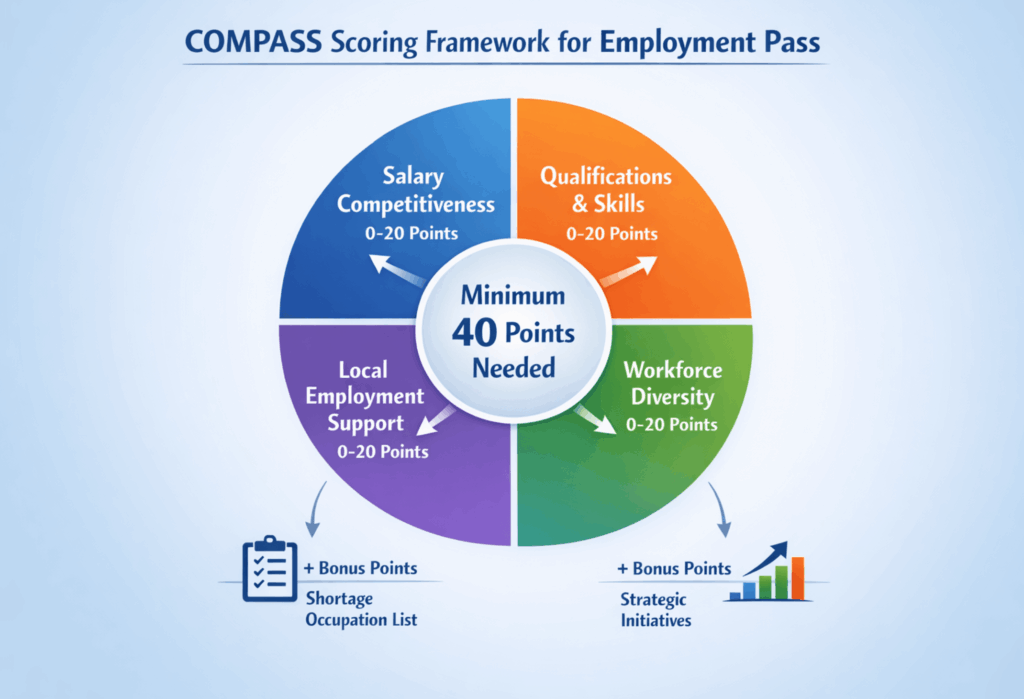
The Employment Pass is a work authorisation for foreign professionals, managers and executives, applied for by the employer. Candidates must meet the minimum fixed monthly salary of S$5,600 (higher for senior or specialised roles), alongside relevant qualifications and experience. Salary benchmarks, COMPASS considerations and documentation expectations are outlined in our Employment Pass application overview and our Singapore Work Pass Services.
S Pass
The S Pass is for mid-level skilled employees. Eligibility includes meeting the fixed monthly salary starting from S$3,300 (rising with age and industry), relevant qualifications, and employer quota availability. Employers often perform a careful pre-check using MOM guidelines before filing to avoid quota or salary-related rejections.
Personalised Employment Pass (PEP)
The Personalised Employment Pass is designed for high-earning professionals with a fixed monthly salary of S$22,500. It is not tied to any employer, giving greater flexibility, but pass holders must meet annual income requirements to remain eligible. Key conditions are summarised in the Personalised Employment Pass eligibility criteria.
Training Employment Pass (TEP) & Training Work Permit (TWP)
Training passes support short-term attachments for foreign students or overseas trainees.
The Training Employment Pass is for structured professional attachments, requiring at least S$3,000 salary or a training programme tied to the applicant’s academic course.
The Training Work Permit supports hands-on practical training and is subject to quota and levy.
Specialist / Innovation Passes
Singapore also offers several specialised passes designed for founders, global talent and innovation leaders, including the EntrePass, ONE Pass and Tech Pass, which support entrepreneurship, global mobility and sector-specific expertise. Founders and senior professionals exploring innovation-driven ventures typically begin with the EntrePass application pathway.
Family and Dependant Pathways:
Dependant Pass (DP)
The Dependant Pass allows eligible spouses and children of eligible EP or S Pass holders to live in Singapore. Eligibility is tied to the main pass holder’s income and family relationship.
Letter of Consent (LOC)
The LOC allows Dependant Pass holders to run or work for a sole proprietorship, and can also be issued to LTVP holders who are spouses of Singapore citizens or PRs when an employer applies on their behalf. It is additionally used in specific cases for secondary directorship approvals for eligible work pass holders.
Long-Term Visit Pass (LTVP)
The LTVP supports spouses, children or parents of Singapore citizens, PRs and work pass holders. Case-specific factors such as relationship stability and financial support play a role in ICA’s assessment, illustrated in our LTVP application case study.
Agencies support PR applications under the PTS Scheme, as well as Family and Student-based routes, by helping applicants prepare consistent, well-structured submissions aligned with ICA expectations. A step-by-step explanation of the application process, eligibility criteria and ICA submission flow is covered in our How to Apply for Singapore PRguide.
Applicants who are unsure whether their current profile may be suitable for PR may also first use our Singapore PR Eligibility Calculator for a general profile strength assessment before proceeding further.
PR Appeals
Many applicants engage agencies after receiving a rejection, especially to review gaps in their earlier submission or plan a strategic re-application. Real examples of how strengthened documentation can change outcomes are illustrated in this PR appeal case study and this PR rejection-to-approval scenario.
Citizenship
Consultants also support PR holders preparing to apply for Singapore Citizenship by guiding them through documentation, family profiles, and the integration-related factors that ICA typically considers. A full breakdown of the eligibility criteria and submission steps is available in the Singapore citizenship application guide, which explains how applicants can structure their documents and present a clear profile to ICA.
Corporate Immigration
Corporate clients often engage agencies for compliance-aligned filings, including COMPASS scoring, hiring advisory for foreign professionals, work pass renewals and S Pass quota checks, particularly when companies are expanding or restructuring. A practical example of how renewal risks are managed can be seen in this Employment Pass renewal lapse case study, which shows how strategic planning helps companies stay compliant.
Agencies also assist HR teams with aligning documentation to MOM standards and maintaining proper governance frameworks required under Singapore’s manpower regulations.
Appeals and Re-Applications
Consultants frequently support EP and S Pass appeals, PR re-applications and LTVP appeal submissions, ensuring issues such as incomplete records, inconsistencies or weak supporting evidence are resolved before refiling. A real example of how a rejected application can be strengthened is shown in this successful LTVP appeal case study, demonstrating how clear explanations and proper documentation can shift an outcome.
Agencies typically review the applicant’s full submission trail, identify documentation gaps and prepare more coherent, well-supported responses when addressing MOM or ICA clarifications.
Considering a Work Pass, PR or Citizenship application?
Transform Borders offers clear, structured and legally guided support for individuals, families and employers navigating Singapore immigration.
If you are specifically considering Singapore Permanent Residency and would first like a general indication of how your profile may currently be viewed, you may also use our
Singapore PR Eligibility Calculator.
Immigration agency fees in Singapore typically range from SGD 800 to 1,800 for Work Passes, SGD 1,000 to 1,800 for family passes and SGD 2,000 to 4,000 for PR or Citizenship applications.
Service Type
Typical Fees (SGD)
Processing Time
Employment Pass
800–1,800
3–6 weeks
S Pass
700–1,500
3–6 weeks
Dependant Pass / LTVP
1,000–1,800
2–8 weeks
Letter of Consent
800–1,800
Around 3 weeks
PR (PTS Scheme)
2,000–4,000
6–12 months
Citizenship
2,000–4,000
6–12 months
Appeals
1,500–2,500
Varies
Timelines are set by MOM and ICA and cannot be expedited by agencies.
4. Roles and Functions of Immigration Agencies
A professional immigration agency provides:
Clear eligibility assessments
Organised documentation
Policy clarity (COMPASS, ICA expectations)
Accurate submissions
Monitoring and clarifications
Long-term pathway planning
Realistic and ethical guidance
Expert guidance throughout the process
A structured process helps reduce uncertainty, increases the likelihood of success, and benefits clients by providing clarity and support at every stage.
Trustworthy firms provide clarity, structure and realistic guidance, ensuring clients feel engaged throughout the process and encouraged to engage with their team for the best possible outcomes.
6. Common Challenges and How Agencies Help
Common challenges include:
Confusion about eligibility
Misunderstanding salary or COMPASS criteria
Inconsistent documentation
Poor PR timing
Employer-employee mismatches
Agencies help by:
Organising documents
Ensuring consistency
Reducing errors
Planning long-term pathways
Setting realistic expectations
Assisting clients to ensure a smooth immigration process
At this stage, it is crucial to accurately complete all required forms as part of your application. Ensuring that each form is filled out correctly and thoroughly will help prevent delays and improve your chances of a successful outcome.
Submission
Monitoring
Clarifications
Outcome
Renewal planning
8. Singapore Immigration Trends for 2025–2026
Singapore’s immigration landscape continues to evolve, influenced by COMPASS scoring, sector-based salary benchmarks and the Government’s long-term talent strategy. Work pass trends show strong demand for global professionals, particularly through initiatives such as the ONE Pass and enhanced pathways for specialists in technology, culture, academia and sports. At the same time, more families are exploring DP-to-LOC business routes, while companies strengthen documentation and compliance to meet renewed MOM expectations.
For PR and Citizenship, ICA continues to apply a holistic, long-term approach, placing greater emphasis on genuine integration. Beyond salary and qualifications, factors such as family stability, time lived in Singapore, children’s schooling, and everyday community engagement increasingly influence outcomes. Applicants who demonstrate rootedness, the kind that shows up in neighbourhood ties, consistent contribution and steady presence, tend to align more closely with ICA’s long-term evaluation criteria.
Investor-related routes, such as the Global Investor Program (GIP), remain active but form only a niche pathway compared to mainstream work pass and PR routes. Across all categories, the emphasis continues to centre on economic contribution, integration potential and transparent, well-prepared submissions.
A deeper analysis of these shifts is available in the latest Singapore immigration trends report, which outlines patterns businesses and individuals should be aware of as they plan their next steps.
Do I need an immigration agency for my application?
No. You can apply directly to MOM or ICA. However, many applicants engage an agency for clearer guidance, structured documentation and to avoid avoidable errors that commonly cause delays or rejections.
What do immigration agencies in Singapore help with?
Immigration Agencies typically support with:
1. Eligibility assessments 2. Document organisation and formatting 3. Document preparation 4. Accurate and compliant submissions 5. Clarifications and document updates 6. Long-term planning (EP → PR → Citizenship) 7. Reducing errors and delays, and assist clients at every stage
Can an agency speed up my approval?
No. Processing times are strictly controlled by MOM and ICA. A consultancy can help you prepare a cleaner submission, but it cannot influence speed or outcomes.
How long does a Singapore PR application take?
Most PR applications take six to twelve months, depending on ICA’s assessment and overall volume of cases. Complex profiles or incomplete submissions may take longer.
How long does an Employment Pass (EP) take to process?
EP applications typically take three to six weeks, but MOM may request additional documents if clarification is needed.
Can an agency guarantee approval?
No. Any agency offering guaranteed approvals should be avoided. Only MOM and ICA make the final decision.
Is a Self-Assessment Tool (SAT) result enough to know if I qualify?
SAT gives a basic indication, but it does not consider context, job scope alignment, employer profile or sector benchmarks. Applicants often seek a professional assessment for a more accurate evaluation.
Does Transform Borders offer a free consultation?
Yes. We offer a complimentary 20-minute consultation for new enquiries, subject to suitability. If your matter is complex or requires detailed document review, we may recommend a paid consultation instead.
Can I apply for PR or Citizenship immediately after getting my work pass?
No. You cannot apply for PR if you have held your work pass for less than six months. ICA requires at least six months of employment history before you are eligible to submit a PR application.
Citizenship is not available immediately after PR, most applicants apply only after holding PR for 2years or more, as ICA evaluates long-term contribution, stability and integration.
What if my PR or LTVP was rejected?
ICA does not disclose the specific reasons for a PR rejection. However, applicants may appeal or reapply only when there is meaningful new information, clearer documentation or an improved profile. Submitting a weak or premature appeal often leads to time wastage without improving the chances of success. Many applicants choose to work with a consultant to review their profile, identify potential gaps and prepare a stronger, more coherent submission before appealing or reapplying.
Choosing the right immigration consultancy can significantly influence the clarity, structure and confidence behind your application. A reliable agency is defined not by bold claims, but by the quality of its guidance and the professionalism of its processes.
Key qualities of a trustworthy agency:
1. Clear, calm explanations
The agency should help you understand your eligibility, timelines and documentation requirements without overwhelming jargon.
2. Transparent pricing and scope
Reputable consultancies provide clear fee structures and outline what is included — with no hidden add-ons or vague packages.
3. Senior oversight on every case
Applications benefit greatly when reviewed by experienced practitioners who understand MOM and ICA expectations.
4. Strong documentation standards
A good agency organises, reviews and formats documents consistently to reduce mistakes and avoid unnecessary delays.
5. Realistic, balanced guidance
Instead of making promises, the agency should set grounded expectations and advise when to file, when to wait, and when not to appeal.
6. Responsiveness and communication
You should feel supported throughout the process, with timely updates and clear instructions.
7. Up-to-date policy understanding
Singapore’s immigration framework evolves regularly. A competent agency monitors MOM and ICA updates closely and adapts its guidance accordingly.
Book a Consultation
A reputable immigration agency in Singapore typically adopts a personalised approach tailored to the applicant’s profile, documentation needs and long-term objectives.
Applicants who wish to understand how a legally guided consultancy approach differs from other models may explore Transform Borders’ immigration services in more detail.
Considering professional immigration support?
If you are planning an Employment Pass, PR, Citizenship or related application and would like structured, legally guided assistance, you may contact Transform Borders to understand how professional support may apply to your situation.
About the Author:Sulochana Uthirapathi
is the Founder of
Transform Borders,
a Singapore immigration consultancy established in 2017. She specialises in Employment Pass (EP),
Permanent Residency (PR) and Citizenship applications, supporting professionals, families and
corporate clients with legally guided and structured immigration processes.
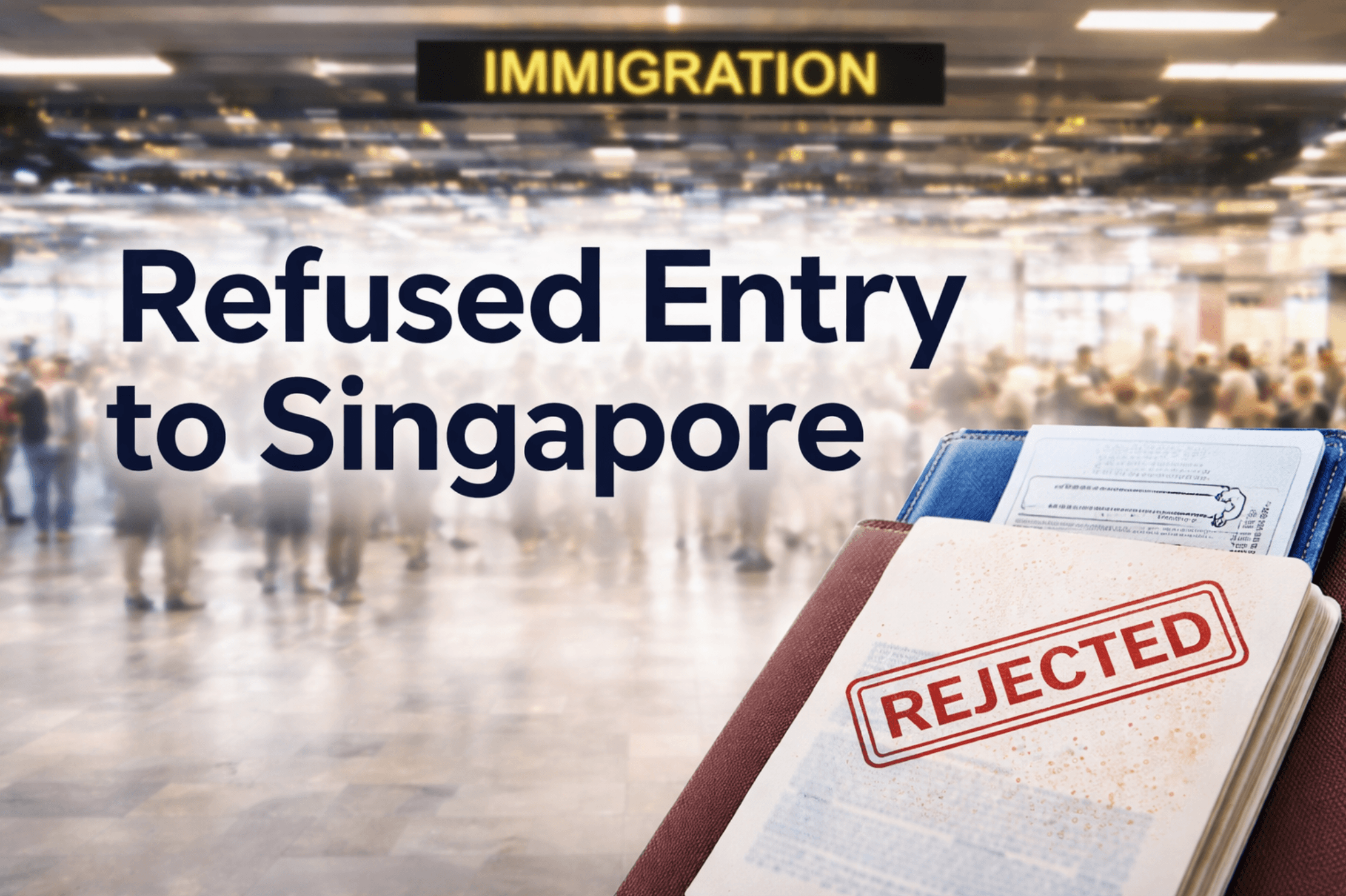
Being refused entry to Singapore can be an unexpected and distressing experience. In many cases, individuals only become aware of the issue at the checkpoint, without prior indication that their entry may be denied.
If this has happened to you, it is important to understand that you cannot simply return on your next trip. Any future attempt to enter Singapore will generally require prior approval from the Immigration and Checkpoints Authority.
This is typically done through an application supported by Form 14 and a local sponsor. The process usually takes about eight weeks, and outcomes are not guaranteed.
This article explains how the process works, what matters in practice, and how such situations are typically assessed.
What You Need to Know If You Were Refused Entry
You cannot re-enter Singapore without prior approval
An application for permission to enter must be submitted to ICA
A local sponsor is required
Processing typically takes about eight weeks
Each case is assessed based on its specific circumstances
Singapore has adopted a more proactive approach to border control. The Immigration and Checkpoints Authority increasingly relies on advance traveller information to assess travellers before arrival.
As a result, decisions are based on a broader view of your travel history and circumstances.
Travellers whose intentions are not clearly understood may be refused entry or required to seek approval before travelling again.
The application may be submitted by the applicant or by a local sponsor. The general processing timeline is approximately eight weeks.
A strong application is not just about submitting documents. It is about ensuring that your situation is clearly understood. In many cases, the key issue is not the absence of documents, but whether the overall circumstances are clearly understood.
A local sponsor is required for this application. This may be a Singapore Citizen, Permanent Resident, or a Singapore registered company.
The sponsor is not merely procedural. The relationship between the applicant and the sponsor, as well as the credibility of the sponsor, may influence how the application is assessed.
A clear and well supported explanation of this relationship can help provide context.
For individuals who do not have a local sponsor, the application cannot proceed until a suitable sponsor is identified. This is often one of the more challenging aspects of the process.
In one situation, the applicant travelled to Singapore to assist a family during childbirth.
Multiple visit pass extensions were approved, and there was no overstay.
However, the applicant was refused entry upon return.
From a compliance perspective, the applicant had followed the rules. However, the sequence of events may not have been fully understood.
The application required clarification of the circumstances and structured documentation to present a complete picture.
In similar situations, where individuals require extended stays, you may refer to this short term visit pass extension case study for context on how such applications are typically assessed.
Example of Travel Patterns Leading to Refusal
In some situations, refusal arises from travel patterns.
Frequent entries within a short period may create the impression that visits are not consistent with the stated purpose.
In one case, multiple entries contributed to such concerns.
In such situations, it becomes important to clearly explain the travel history and context.
Many of these issues also arise in other immigration applications, such as employment pass rejection cases, where clarity and consistency are critical.
Applications are typically processed within approximately eight weeks.
It is important to note that these applications can be challenging, particularly where the reasons for refusal are not clearly understood.
Outcomes are not guaranteed and depend on the specific circumstances of the case, including the applicant’s background, travel history, and how the information is presented and supported.
Can I return to Singapore after being refused entry
You will generally need prior approval from the Immigration and Checkpoints Authority before attempting to enter again.
Is refusal of entry permanent
Not necessarily. Each case is assessed individually, and it may be possible to apply for permission to enter again.
Is a local sponsor required
Yes. A local sponsor is required for this application.
How long does the process take
The general processing timeline is approximately eight weeks.
About the Author:Sulochana Uthirapathi
is the Founder of
Transform Borders,
a Singapore immigration consultancy established in 2017. She specialises in Employment Pass (EP),
Permanent Residency (PR) and Citizenship applications, supporting professionals, families and
corporate clients with legally guided and structured immigration processes.
One of the first things people want to know before engaging an immigration lawyer in Singapore is straight-forward: how much is this going to cost? And honestly, it is a fair question.
Immigration lawyer costs in Singapore are not always easy to pin down because it depends heavily on what you need done, how complex the situation is, and whether you are dealing with a first-time application or a rejection.
This guide breaks it all down clearly. You will find a fee breakdown by application type, an explanation of what drives costs up or down, and what is typically included in the fees you are quoted.
Guide Contents
The table below gives you a realistic starting reference for 2026, including what we charge here at Transform Borders, because transparency is something we truly believe in. Transform Borders is a Singapore-based immigration consultancy founded by Sulochana Uthirapathi in 2017.
Immigration Lawyer Fees In Singapore (2026 Breakdown)
Service / Application Type
Estimated Lawyer Fee (SGD)
Transform Borders (SGD)
New Employment Pass (EP) Application
1,000 to 2,500SGD
1500 SGD
Employment Pass (EP) ,Renewal
500 to 1,500SGD
800 to 1000SGD
Employment Pass (EP) ,Appeal (after rejection)
1,000 to 5,000SGD
1000SGD
S Pass ,New Application
800 to 1,500 SGD
1200SGD
ONE Pass ,Application
1,500 to 3,500
1500SGD
EntrePass , Application
1,500 to 3,500 SGD
2000 SGD
Singapore PR ,New Application
1,500 to 3,500SGD
2500SGD
Singapore PR ,Reapplication (after rejection)
2,500 to 6,000SGD
2500SGD
Singapore Citizenship , Application
2,000 to 5,000SGD
2500SGD
Singapore Citizenship ,Appeal
1,000 to 8,000SGD
1000SGD
Dependant Pass / LTVP, Application
500 to 1,500 SGD
800SGD
ICA Clarification Letters / Follow-up
500 to 1,500 SGD
800SGD
Letter of Consent (LOC)
500 to 800SGD
750SGD
Important: These are estimated professional fees only. They do not include government processing fees charged by MOM or ICA, which are usually paid separately. Government application fees MOM/ICA are typically around SGD 105 to SGD 225 and apply across most applications. Always ask for a clear, itemised quote before engaging in any legal service.
What Affects the Cost of an Immigration Lawyer in Singapore?
Not everyone pays the same. Here are the main factors that influence what you will actually end up paying:
1. Whether It Is a First Application or a Rejected One
Rejection cases are almost always more expensive. When you have already been turned down by MOM or ICA, the lawyer needs to understand why, restructure your profile, and prepare a stronger resubmission or formal appeal. That takes significantly more time and legal expertise than a clean first-time application.
2. Case Complexity
A straightforward Employment Pass application for a well-paid professional with a complete document set is very different from a case involving business ownership, multiple dependents, gaps in employment history, or prior immigration issues. The more complex the case, the more time a lawyer needs to invest, and the higher the fee.
3. Your Document Readiness
Turning up to a consultation well-prepared with your payslips, tax records, employment contracts, and company documents already organised will generally reduce billable time. Some firms charge by the hour for complex or non-standard cases, so the more work they have to do to reconstruct your profile, the higher the cost.
4. The Type of Firm You Engage
A large law firm that handles many different legal services usually charges higher fees than a smaller firm that focuses only on immigration. This doesn’t mean the big firm is better. For most immigration cases, a specialist immigration agency or consultancy can often provide the same help at a lower cost and better value.
5. The Experience Level of the Lawyer
A senior immigration lawyer with a strong track record will charge more than a junior one. For complex cases involving citizenship appeals, COMPASS scoring challenges, or ICA dispute letters, experience matters a great deal. For straightforward renewals or simple EP applications, a competent junior consultant may be more than adequate.
What Is Usually Included in the Fee?
When you engage an immigration lawyer or legally guided consultancy in Singapore, a standard fee typically covers:
A detailed eligibility and risk assessment of your profile
Advice on the right pass or application type to pursue
Review and organisation of supporting documents
Preparation and submission of the application to MOM or ICA
A cover letter or legal representation letter, if required
Follow-up communication with MOM or ICA on your behalf
Advice on what to do if the application is rejected
Usually, some costs are not included in the main service fee. These include government fees charged by MOM or ICA, which you have to pay separately. Other things like translating documents that are not in English, notarising documents, or extra work needed if the application gets rejected are also normally not part of the original price. If those situations happen, they are usually charged separately as an additional service.
Hidden Costs to Watch Out For
Most reputable immigration lawyers in Singapore are upfront about their fees. That said, here are a few things to always clarify before you sign anything:
Are government fees charged by MOM or ICA included or billed separately?
Is there a fixed fee for the entire engagement, or will you be billed hourly if complications arise?
What happens if MOM or ICA issues an additional query or Request for Further Information? Is that covered or a separate charge?
If your application is rejected, is an appeal handled under the same fee or a new one?
Always ask for a written scope of work and a clear fee breakdown before engaging. A trustworthy firm will have no hesitation giving you this.
Frequently Asked Questions
How much does an immigration lawyer cost in Singapore?
Fees range from roughly SGD 800 for simple agency-handled work passes to SGD 12,000 or more for complex legal cases involving citizenship appeals or highly contested rejections. For most standard applications like an Employment Pass or a Singapore PR, you can expect to pay between SGD 1,500 and SGD 5,000 for a legally guided consultancy.
2. Can I do my immigration application myself without a lawyer?
Yes, you can self-file most standard applications. However, for PR, citizenship, or any case involving a prior rejection, professional guidance significantly increases your chances of a successful outcome. Mistakes in an immigration application can be very costly.
3. Are immigration lawyer fees in Singapore tax deductible?
For companies handling employee work passes and EP applications as a business expense, these costs may be deductible. For individuals, this is typically not applicable. Consult a tax professional for advice specific to your situation.
4. What is the difference between a fixed fee and an hourly rate for immigration work?
Most immigration matters in Singapore are handled on a fixed or flat fee basis, which gives you certainty on cost upfront. Some lawyers, particularly for complex appeal cases or ongoing advisory work, may bill by the hour. Always confirm the billing model before engaging.
5. What happens if my application is rejected after I have paid the lawyer fee?
This depends on the terms of your engagement. Most firms do not refund fees for rejections, as the fee covers the work done to prepare and submit the application. An appeal or reapplication is typically a separate engagement. Always clarify the firm’s policy on rejections upfront.
About the Author:Sulochana Uthirapathi
is the Founder of
Transform Borders,
a Singapore immigration consultancy established in 2017. She specialises in Employment Pass (EP),
Permanent Residency (PR) and Citizenship applications, supporting professionals, families and
corporate clients with legally guided and structured immigration processes.
Understanding the likely processing time for an Employment Pass application is important for both employers and foreign professionals planning relocation, onboarding, or business operations in Singapore.
In many straightforward cases, the Ministry of Manpower processes online Employment Pass applications or gives an update within about 10 business days. However, the actual timeline can vary depending on the employer’s profile, the complexity of the application, the quality of the documents submitted, and whether additional checks are required.
This guide explains the standard Employment Pass processing timeline, what commonly causes delays, how appeal timelines differ from fresh applications, and what employers can do to avoid unnecessary waiting.
For a broader explanation of the full application process, documentation requirements, and approval factors, you may also refer to our guide on how to apply for an Employment Pass in Singapore.
Employment Pass Processing Time: Quick Summary
Most online Employment Pass applications are processed or given an update within 10 business days.
New company or higher-scrutiny cases may take longer.
Employment Pass appeals are typically assessed within around 6 weeks.
Delays often arise from incomplete documents, qualification checks, or employer-profile concerns.
Key takeaway: While many Employment Pass applications are processed or given an update within around 10 business days, the actual timeline can vary depending on the employer profile, documentation quality, and whether additional checks are required.
For most online Employment Pass applications, the Ministry of Manpower states that the application will be processed or given an update within 10 business days. This generally applies to applications submitted through the myMOM Portal.
That does not necessarily mean every case will be approved within that period. In some cases, MOM may issue a request for further information or indicate that additional checks are required before a final decision is made.
The table below summarises the typical Employment Pass processing timelines for common scenarios.
Several factors can affect how quickly an Employment Pass application is processed.
Common factors include:
• whether the application documents are complete and internally consistent
• whether qualifications need further verification • whether additional external verification may apply depending on the applicant’s background or nationality
• whether the declared salary is aligned with the job scope and employer profile
• whether the employer’s business profile attracts closer review
• whether the role falls within a higher-scrutiny category under the broader Employment Pass framework
In practice, the cleaner and more coherent the initial submission, the lower the likelihood of delays caused by clarification requests.
In some situations, applications may also be subject to additional external verification before a final decision is issued. Where such checks are required, the overall processing timeline may extend beyond the standard timeframe.
This is one reason many employers review the full application profile before filing, especially where Employment Pass salary requirements, qualifications, or company readiness may raise questions.
Applications submitted under newly incorporated companies may take longer than standard cases.
This is because the Ministry of Manpower may review additional aspects of the employer profile, including the company’s business activity, operational readiness, and ability to sustain the proposed role and salary.
For founders and employers applying under a recently incorporated entity, this often means that the application timeline is influenced not only by documentation completeness, but also by how clearly the company can demonstrate operational readiness.
Some Employment Pass applications take longer because additional review is required after the initial submission.
Examples include:
• educational qualification checks
• requests for clarification on salary or job scope
• review of the employer’s financial or operational profile
• closer scrutiny of applications from newly established businesses
• concern that the declared salary may not align with the role or company profile
In some cases, additional external vetting may also affect the processing timeline. For certain nationalities, applications may be subject to further background or security checks before a final decision is issued. Where such external verification is required, the overall processing time may extend beyond the standard timeline and can occasionally take several weeks or longer.
In practice, delays are often linked to the same issues that may later lead to rejection if they are not addressed properly.
Employment Pass appeals take longer than standard fresh applications.
According to MOM, 85% of Employment Pass appeals are processed within 6 weeks.
This is one reason timing becomes an important practical consideration after a rejection. In some situations, a revised fresh application may move more quickly than an appeal, particularly where the necessary corrections are limited and can be made before resubmission.
Employment Pass renewals submitted through the myMOM Portal are generally processed or given an update within 10 business days. For EP sponsorship cases, the timeline may be longer.
In practice, renewal cases can still take longer if the application attracts questions relating to salary progression, employer profile, or supporting documentation.
Where the pass is nearing expiry, it is advisable to renew early enough to allow time for possible requests from MOM.
If you have already encountered complications with renewal timing, you may also find our case study on an Employment Pass renewal lapse helpful.
How long does an Employment Pass application take in Singapore?
For most standard online cases, MOM states that Employment Pass applications are processed or given an update within 10 business days.
Why is my Employment Pass application taking longer than expected?
Applications may take longer where MOM requires additional checks on qualifications, salary alignment, employer profile, or supporting documents.
How long does an Employment Pass appeal take?
Most Employment Pass appeals are processed within around 6 weeks, although more complex cases may take longer.
Do new companies face longer Employment Pass timelines?
In some cases, yes. Newly incorporated businesses may face additional review of their operational readiness, employer profile, and whether the role is credible within the company’s current stage of operations.
How long does an Employment Pass renewal take?
Renewals submitted through the myMOM Portal are generally processed or given an update within 10 business days, although some cases may take longer.
If you are unsure whether your proposed Employment Pass application is likely to proceed smoothly, it may be helpful to review the application before submission.
Processing delays often arise where salary alignment, role justification, qualifications, or employer profile require closer review by the Ministry of Manpower.
In more complex situations, employers may benefit from guidance from an immigration lawyer in Singapore familiar with the Employment Pass framework.
About the Author:Sulochana Uthirapathi
is the Founder of
Transform Borders,
a Singapore immigration consultancy established in 2017. She specialises in Employment Pass (EP),
Permanent Residency (PR) and Citizenship applications, supporting professionals, families and
corporate clients with legally guided and structured immigration processes.
Understanding the Employment Pass salary requirements is one of the most important aspects of preparing a successful Employment Pass application in Singapore.
The Ministry of Manpower (MOM) sets minimum qualifying salary thresholds for Employment Pass applicants. These thresholds vary depending on the applicant’s age, industry sector, and overall profile.
Meeting the minimum salary requirement is only the first step. MOM also considers factors such as the role’s seniority, the employer’s profile, workforce composition, and COMPASS scoring when assessing whether an Employment Pass should be approved.
This guide explains the current Employment Pass qualifying salary requirements, how the salary threshold increases with age, and how salary is evaluated in practice when submitting an Employment Pass application.
Minimum Employment Pass salary starts from S$5,600 per month.
Salary requirements increase progressively with age.
Financial services sector has a higher qualifying salary starting from S$6,200.
Salary thresholds will increase from 1 January 2027.
High salary applicants earning S$22,500 and above are generally exempt from
COMPASS.
Key takeaway: Meeting the minimum Employment Pass salary does not automatically guarantee approval. The Ministry of Manpower also evaluates the applicant’s experience, the employer’s profile, and COMPASS-related factors when assessing whether an Employment Pass should be granted.
The sections below explain how Employment Pass salary requirements work in practice and how employers can evaluate whether a proposed salary meets MOM’s expectations.
The Employment Pass qualifying salary depends on the applicant’s age and industry sector. The Ministry of Manpower sets a minimum salary threshold which increases progressively with age.
From 1 January 2027, the qualifying salary thresholds will increase for both new applications and renewal cases.
The table below summarises the current minimum Employment Pass qualifying salary thresholds set by MOM.
Sector
Current Minimum Salary
From 1 Jan 2027
All sectors except financial services
$5,600
$6,000
Financial services
$6,200
$6,600
These figures represent the base qualifying salary for younger applicants. For older applicants, the required salary increases progressively.
Employment Pass Salary by Age
The Employment Pass qualifying salary increases progressively as the applicant’s age rises. This reflects the expectation that more experienced professionals should earn a higher salary relative to younger candidates.
For applicants outside the financial services sector:
Age
Current EP Qualifying Salary
23 or below
$5,600
30
$7,223
35
$8,382
40
$9,541
45+
$10,700
Note: These figures apply to applicants outside the financial services sector. Salary thresholds are higher for financial sector roles.
The qualifying salary increases progressively with age, reflecting the expectation that more experienced professionals should command higher salaries.
From 1 January 2027, the salary thresholds will increase further, with the qualifying salary for applicants aged 45 and above rising to approximately $11,500.
Salary for Financial Services Sector
Applicants working in the financial services sector are subject to higher salary thresholds.
This reflects industry salary benchmarks and the expectation that financial sector professionals command higher compensation levels.
For younger applicants in the financial sector, the minimum qualifying salary currently starts from $6,200 per month, increasing progressively with age.
By age 45 and above, the qualifying salary may reach approximately $11,800, rising further to $12,700 from 2027.
In practice, the exact qualifying salary is usually determined through the MOM Self Assessment Tool.
Employers and applicants sometimes conduct a structured eligibility review before submission to determine whether the proposed salary and role positioning meet MOM’s expectations. You may read an example in our case study on an Employment Pass eligibility check approved in Singapore.
The salary threshold can vary depending on several factors including:
• the applicant’s age and professional experience
• academic qualifications declared in the application
• the industry sector of the employer
• the workforce profile of the sponsoring company
Generally, older applicants are expected to command higher salaries reflecting seniority and experience.
Where formal academic qualifications are not declared, the salary required may also be higher.
Using the MOM Self Assessment Tool (SAT)
Before submitting an Employment Pass application, employers can use the MOM Self Assessment Tool (SAT) to estimate whether a candidate may meet the Employment Pass requirements.
The SAT considers several factors including:
• the proposed salary
• the applicant’s qualifications
• the job role
• the employer’s industry sector
While the SAT can provide a useful preliminary indication, it does not guarantee approval.
Many employers therefore review the full application profile carefully before submission to ensure that the salary level, job scope, and employer profile align with MOM’s expectations.
Salary Eligibility vs Actual Approval
Meeting the minimum Employment Pass qualifying salary does not automatically mean that an application will be approved.
In practice, the Ministry of Manpower evaluates the salary in the context of the overall application. This includes:
• whether the salary is consistent with the applicant’s experience
• whether the employer can realistically sustain the salary
• whether the job scope matches the level of compensation
• whether the overall profile satisfies the COMPASS framework
In some situations, an application that technically meets the minimum salary requirement may still be refused if the salary appears misaligned with the role or the employer’s commercial profile.
For founders or businesses applying under newly incorporated companies, salary expectations may also be evaluated alongside the company’s operational readiness. You may also find our guide on Employment Pass for new companies in Singaporehelpful.
Can an Employment Pass Application Be Submitted Below the Minimum Salary and Appealed Later?
In practice, this strategy rarely succeeds.
The minimum Employment Pass qualifying salary is a strict eligibility requirement set by the Ministry of Manpower. If the declared salary falls below the required threshold, the application will usually be refused and an appeal is unlikely to change the outcome.
For this reason, employers generally ensure that the proposed salary meets the qualifying threshold before submitting an Employment Pass application.
Does Meeting the Minimum Salary Guarantee Approval
Meeting the minimum Employment Pass qualifying salary does not guarantee approval.
In practice, MOM evaluates whether the declared salary aligns with the role, the applicant’s experience, and the employer’s business profile.
For example, a salary that appears artificially inflated relative to the company’s financial capacity or the role’s responsibilities may raise concerns.
What is the minimum salary for Employment Pass in Singapore?
The minimum Employment Pass salary currently starts from S$5,600 per month, increasing progressively with age.
Does higher salary increase the chance of approval?
Not necessarily. While salary is an important factor, MOM also considers COMPASS scoring, employer profile, and role justification.
Can an Employment Pass be approved without a degree?
In some cases yes, although the salary requirement may be higher if formal qualifications are not declared.
Can I submit an Employment Pass application with a lower salary and appeal later?
In practice this strategy rarely succeeds.
The minimum Employment Pass qualifying salary is a strict eligibility requirement. If the declared salary falls below the required threshold, the application will usually be refused and an appeal is unlikely to change the outcome.
For this reason it is generally advisable to ensure the proposed salary meets the qualifying threshold before submission.
If you are unsure whether your proposed salary meets the Employment Pass requirements, it may be helpful to conduct an eligibility review before submission.
Salary positioning, role alignment, and employer profile are often evaluated together when MOM assesses an Employment Pass application.
In more complex situations, employers may benefit from guidance from an immigration lawyer in Singapore familiar with the Employment Pass framework.
Alternatively, you may book a 20 minute consultation to review your Employment Pass eligibility and application strategy.
About the Author:Sulochana Uthirapathi
is the Founder of
Transform Borders,
a Singapore immigration consultancy established in 2017. She specialises in Employment Pass (EP),
Permanent Residency (PR) and Citizenship applications, supporting professionals, families and
corporate clients with legally guided and structured immigration processes.
Applying for an Employment Pass in Singapore can be a critical step for foreign professionals, founders, and companies hiring overseas talent. While many applications are approved, some are rejected due to issues relating to salary alignment, employer profile, COMPASS scoring, qualifications, or documentation under the COMPASS framework for Employment Pass approval in Singapore.
A rejection does not always mean the end of the process. In appropriate cases, an Employment Pass appeal can be submitted to the Ministry of Manpower to clarify the application, address the concerns raised, and provide additional supporting information.
Understanding when an appeal is worth filing is important. A strong appeal does not simply repeat the original submission. It should respond directly to the reasons for rejection and show why the application satisfies the Employment Pass criteria.
In many cases, yes. An Employment Pass rejection may be appealed after the Ministry of Manpower refuses the original application.
An appeal allows the employer to submit further clarification or supporting material through the relevant system. The purpose is not to repeat the original application, but to address the specific issues that led to the rejection.
In practice, an appeal is usually appropriate where the rejection appears to arise from matters such as salary justification, role positioning, employer profile, company readiness, or supporting documentation.
However, not every rejected case should be appealed. In some situations, the underlying weaknesses are substantial enough that a revised application may be the better route.
Common Reasons Employment Pass Applications Are Rejectedin Singapore
Before deciding whether to appeal, it is important to identify why the application was refused. You may wish to review our guide on Employment Pass rejection in Singapore, which explains the most common reasons EP applications are refused and how MOM evaluates borderline cases.
Common reasons include:
Salary does not align with the role
A salary that appears artificially high for the job scope, company profile, or level of seniority may raise concerns.
Weak COMPASS outcome
Where the application does not score strongly enough across salary competitiveness, qualifications, workforce diversity, or support for local PMET employment, approval may be affected. For a more detailed explanation, see our guide on the COMPASS framework for Employment Pass approval in Singapore.
Employer profile concerns
Newly incorporated companies, businesses with limited operational history, or employers with weak workforce indicators may face greater scrutiny.
Qualification or verification issues
Where qualifications are claimed, missing verification proof or unclear academic credentials may weaken the application.
Inconsistent supporting documents
Differences between the declared salary, job title, responsibilities, and company records can create avoidable concerns.
Where a rejection has arisen from one or more of these issues, the appeal strategy should respond directly to those points rather than restate the original application.
An appeal may be appropriate where the rejection appears to be capable of clarification or improvement through additional evidence.
Examples include:
where the role was not fully explained in the original submission
where salary alignment needs stronger commercial justification
where the company can now provide additional financial or operational evidence
where supporting documents were incomplete or unclear
where the candidate’s qualifications, industry experience, or role necessity require clearer framing
A useful way to think about it is this: an appeal is strongest where the core application remains viable, but the presentation or supporting evidence was insufficient.
The right supporting documents depend on the reason for rejection.
Depending on the case, helpful documents may include:
a revised job description
a clarification letter addressing the reasons for rejection
updated company financials or operational documents
client agreements, invoices, or commercial contracts
educational verification documents
updated organisational charts
further evidence of the company’s need for the role
salary benchmarking or commercial justification where relevant
In some situations, employers may first conduct an Employment Pass eligibility assessment before preparing an appeal to determine whether the underlying application remains viable. You may read an example in our case study on an Employment Pass eligibility check approved in Singapore.
The objective is not to flood the appeal with unnecessary material. The better approach is to provide targeted documentation that responds clearly to the concerns raised in the rejection notice.
In most cases, an Employment Pass appeal takes around six weeks to be assessed by the Ministry of Manpower.
However, the timeline may be extended if MOM requests additional documents or clarification during the review process. The speed and quality of the response can affect how quickly the appeal is resolved.
Because appeals are fact-specific, employers should avoid assuming that all cases move at the same pace. Straightforward cases may progress more efficiently, while matters involving company profile concerns, salary alignment issues, or new business structures may take longer.
When a Fresh Application May Be Better Than an Appeal
In some situations, a stronger outcome may come from revising the application before filing a new submission. This may be preferable where:
• the salary needs to be restructured
• the company requires more time to show operational readiness
• the job scope needs substantial revision
• workforce indicators are currently weak
• the role may benefit from clearer supporting documentation
A practical distinction is this:
• Appeal when the existing application remains sound but needs clarification or additional supporting evidence.
• Reapply when the application itself requires structural improvement.
Employment Pass Appeal Timeline
Appeals should usually be filed within 3 months of the rejection.
MOM typically takes around 6 weeks to assess an appeal.
The timeline may be extended if additional documents or clarification are requested.
A fresh Employment Pass application is often processed in around two to three weeks.
Timing may also be a practical consideration. A fresh Employment Pass application is often processed within around two to three weeks, whereas an appeal may take approximately six weeks for assessment.
Where the necessary adjustments are relatively minor and the application can be strengthened quickly, some employers may prefer submitting a revised application rather than waiting for the appeal process to conclude.
This distinction is particularly relevant for founders, small businesses, and companies applying under newly incorporated entities.
Appeals can succeed where the issues raised in the rejection are properly addressed.
In one example, a previously refused Employment Pass application was strengthened through clearer role positioning, improved supporting material, and a more structured response to the employer-side concerns. You may read the full details in our Employment Pass appeal approved after initial refusal case study.
That example also illustrates an important point: a successful appeal is not usually about repeating the original submission. It is about correcting what was unclear, weak, or incomplete the first time.
How long do I have to file an Employment Pass appeal?
An appeal should usually be submitted within three months of the rejection decision.
How long does an Employment Pass appeal take?
In most cases, MOM takes around six weeks to assess an Employment Pass appeal. The process may take longer if additional documents or clarification are requested.
Does filing an appeal guarantee approval?
No. Filing an appeal does not guarantee approval.
An Employment Pass appeal is reviewed based on whether the new submission sufficiently addresses the reasons given for the rejection. Appeals that simply repeat the original application without providing additional clarification or supporting documentation are unlikely to succeed.
A stronger appeal typically explains the concerns raised by the Ministry of Manpower and provides additional evidence or context that was not included in the original submission.
How many times can an Employment Pass rejection be appealed?
In most cases, up to two appeals may be submitted after an Employment Pass rejection.
Appeals should generally be filed within three months of the rejection decision. Each appeal should provide additional clarification or documentation addressing the reasons for refusal.
Submitting repeated appeals without strengthening the application may reduce the likelihood of success, so it is advisable to review the underlying issues carefully before proceeding.
Can I submit a fresh application instead of appealing?
Yes. In some situations, a new application may be the better route if the underlying issues need more substantial correction.
Does a rejection affect future Employment Pass applications?
A rejection does not permanently prevent a future application, but repeated unsuccessful submissions may result in closer scrutiny. It is therefore important to identify the correct strategy before proceeding again
Should a new company appeal or wait and reapply later?
This depends on the reason for rejection. Where the company simply needs to provide clearer evidence, an appeal may still be viable. Where the business requires more time to demonstrate operations, workforce strength, or salary sustainability, a revised application later may be more appropriate.
If your Employment Pass application has been rejected, it is important to review the reasons for refusal before deciding whether an appeal is the appropriate next step.
Because Employment Pass applications are submitted by the sponsoring employer, appeals are generally filed by the company or by an authorised representative acting on the company’s behalf. Where the applicant wishes to pursue an appeal independently, the cooperation and authorisation of the employer will typically be required.
Some cases benefit from a structured appeal that directly addresses the concerns raised by the Ministry of Manpower. Others may be better handled through a revised application after the underlying issues have been corrected. Reviewing the rejection grounds carefully before filing an appeal can help avoid repeated refusal.
In more complex situations, applicants may benefit from structured guidance from an immigration lawyer in Singapore who is familiar with the Employment Pass framework and appeal process.
If you would like guidance on an Employment Pass appeal or a fresh application strategy, you may explore our Singapore Work Pass services.
About the Author:Sulochana Uthirapathi
is the Founder of
Transform Borders,
a Singapore immigration consultancy established in 2017. She specialises in Employment Pass (EP),
Permanent Residency (PR) and Citizenship applications, supporting professionals, families and
corporate clients with legally guided and structured immigration processes.
Applying for an Employment Pass in Singapore is no longer assessed purely based on salary thresholds. Most applications are now evaluated under the Complementarity Assessment Framework (COMPASS), a structured system used by the Ministry of Manpower (MOM) to assess whether a foreign professional complements Singapore’s workforce.
Under COMPASS, applications are evaluated across several criteria including salary competitiveness, qualifications, workforce diversity within the company, and the employer’s support for local professionals. The framework is designed to ensure that Employment Pass holders bring meaningful skills and value to the Singapore economy.
Understanding how COMPASS works is therefore essential when preparing an Employment Pass application. Even where the minimum qualifying salary is met, the application will still be assessed in the context of the candidate’s profile and the sponsoring company’s workforce structure.
For employers and HR managers, this means that preparing an Employment Pass application now requires a broader understanding of both the candidate’s profile and the company’s workforce structure.
For a broader explanation of the full application process, documentation requirements, and submission steps, you may also refer to our guide on how to apply for an Employment Pass in Singapore.
COMPASS quick summary
COMPASS applies to most EP applications unless exempt.
Typical benchmark: applications must generally score at least 40 points across the core criteria.
Core criteria: salary competitiveness, qualifications, workforce diversity, support for local PMET employment.
Borderline cases often improve with clearer role positioning and stronger employer readiness.
COMPASS stands for the Complementarity Assessment Framework introduced by the Ministry of Manpower. The framework is used to assess how a foreign professional complements the local workforce rather than simply evaluating whether the applicant meets a salary threshold.
In practice, COMPASS looks at both the candidate profile and the employer’s workforce structure. The framework considers whether the candidate brings relevant skills, whether the company maintains a balanced workforce, and whether the role fits within the company’s operations.
The framework also helps ensure that companies continue to support opportunities for local professionals while allowing businesses to hire global talent where appropriate.
Because COMPASS evaluates multiple factors together, applications are usually strongest when there is clear alignment between the candidate’s experience, the job role, the salary offered, and the company’s workforce composition.
Most Employment Pass applications submitted in Singapore are assessed under the COMPASS framework, which evaluates both the candidate’s profile and the employer’s workforce composition.
To qualify for an Employment Pass under COMPASS, the application must generally score at least 40 points across the core criteria, while also meeting the prevailing qualifying salary requirements.
However, certain categories of applicants may be exempt from the COMPASS assessment.
Exemptions from the COMPASS Framework
Applicants may be exempt from COMPASS if they fall within specific categories defined by the Ministry of Manpower. Examples include:
• High salary applicants earning a fixed monthly salary of at least SGD 22,500
• Overseas intra-corporate transferees, such as senior staff transferred within multinational companies
• Short term assignments, where the candidate will work in Singapore for one month or less
Where an exemption applies, the application will still be assessed under the Employment Pass framework, but the COMPASS points system will not apply.
In practice, however, the majority of standard Employment Pass applications submitted by companies in Singapore are evaluated under COMPASS.
Employers should therefore avoid assuming that meeting the minimum qualifying salary automatically guarantees approval. The overall profile of the candidate and the employer may still be considered during the assessment process.
In practice, the COMPASS framework evaluates both the candidate’s profile and the employer’s workforce composition.
While applicants often focus primarily on their salary or academic qualifications, the sponsoring company’s workforce structure and hiring practices are also considered. As a result, two candidates with similar qualifications may receive different outcomes depending on the company submitting the Employment Pass application.
In general, the Ministry of Manpower assesses an application from three broad perspectives:
Candidate profile
The candidate’s salary competitiveness, qualifications, and professional experience relative to the role.
Employer workforce profile
The company’s workforce diversity and its level of support for local PMET employment.
Commercial credibility of the role
Whether the job scope, salary level, and company operations align in a commercially credible way.
Applications are typically assessed based on the overall coherence of the submission. The candidate’s experience, the responsibilities of the role, the salary level, and the company’s business activities should align in a logical and commercially credible manner.
Where the application clearly demonstrates the necessity of the role and the candidate’s suitability for the position, the assessment process is generally more straightforward.
Diagram: COMPASS Scoring Overview
The COMPASS framework assesses Employment Pass applications based on salary competitiveness, qualifications, workforce diversity, and support for local employment.
Applications must generally score at least 40 points across the relevant criteria in order to qualify.
Using the MOM Self Assessment Tool Before Applying
Before submitting an Employment Pass application, employers and employment agents may use the Self Assessment Tool (SAT) provided by the Ministry of Manpower.
The SAT allows companies to perform a preliminary check on whether a candidate is likely to meet the Employment Pass requirements.
The tool considers factors such as:
• the proposed salary
• the candidate’s qualifications
• the job role
• the company profile
Although the SAT result does not guarantee approval, it can help employers identify potential issues before submitting the application.
Employers must also continue to comply with the Fair Consideration Framework (FCF) job advertising requirement before submitting new Employment Pass applications.
In practice, the SAT is often used as an initial screening step before preparing the full Employment Pass submission.
The COMPASS framework evaluates multiple criteria together. In practice, applications may still meet the required score even where one criterion is weaker.
For example:
Scenario 1 – Balanced profile
A candidate with competitive salary, recognised qualifications, and a company with a balanced workforce profile may achieve the required COMPASS score across the core criteria.
Scenario 2 – Strong salary but weaker workforce profile
In some cases, a candidate may earn higher points under the salary criterion, which offsets weaker scores under other criteria such as workforce diversity.
Scenario 3 – Shortage occupation bonus
Certain specialised roles listed under Singapore’s Shortage Occupation List may earn additional points, allowing the application to meet the required COMPASS score even where some foundational criteria are weaker.
These examples illustrate how COMPASS evaluates the overall complementarity between the candidate and the employer’s workforce rather than relying on a single factor.
The COMPASS framework evaluates Employment Pass applications across four main criteria, taking into account both the candidate’s profile and the employer’s workforce composition.
Applications must generally obtain at least 40 points across the criteria in order to qualify.
In addition to the four core criteria, COMPASS may also award bonus points in certain situations, such as where the role falls under Singapore’s Shortage Occupation List or supports strategic economic priorities.
Each criterion assesses a different aspect of how the candidate and the employer complement Singapore’s workforce.
COMPASS Criterion
Type
Salary
Candidate attribute
Qualifications
Candidate attribute
Workforce Diversity
Employer attribute
Support for Local Employment
Employer attribute
Salary Competitiveness
The salary criterion evaluates how the candidate’s proposed salary compares with local professionals in similar roles and sectors.
This is different from the minimum Employment Pass qualifying salary, which is the basic eligibility threshold for the pass. Under COMPASS, the proposed salary is benchmarked against the salaries of local Professionals, Managers, Executives and Technicians (PMETs) within the same industry.
In general, higher salaries relative to sector benchmarks may earn more points under this criterion.
However, salary alone does not determine the outcome of an application. The salary must also align with the job scope, seniority of the role, and the company’s commercial activities.
Qualifications and Skills
This criterion evaluates the candidate’s academic qualifications or recognised professional credentials.
Certain qualifications may earn higher points under COMPASS. These may include:
• degrees from highly ranked universities
• degrees from Singapore’s autonomous universities
• qualifications from institutions recognised within specific industries
Other qualifications that are comparable to a bachelor’s degree may still contribute points depending on their recognition.
Candidates without degree-equivalent qualifications can still pass COMPASS if they earn sufficient points from other criteria.
Where qualification points are claimed, employers may be required to provide verification proof from an approved background screening company when submitting the Employment Pass application.
Workforce Diversity
Workforce diversity evaluates whether the company maintains a balanced mix of nationalities among its professional employees.
COMPASS awards more points where the candidate’s nationality represents a smaller share of the company’s existing PMET workforce. Conversely, where a company’s workforce is heavily concentrated in one nationality group, fewer points may be awarded under this criterion.
The intention of this criterion is to encourage companies to build teams that combine local and international talent from diverse backgrounds.
This criterion evaluates the extent to which a company supports opportunities for local professionals at the PMET level.
Companies with a relatively higher proportion of local PMET employees compared with industry peers may receive more points under this criterion.
This does not mean that companies must hire locals solely to satisfy the COMPASS framework. Rather, the framework assesses whether the company’s workforce structure demonstrates a balanced approach to hiring both local and foreign professionals.
For newer companies or smaller businesses, the final outcome will usually depend on the overall profile of the application, including the candidate’s salary, qualifications, and the commercial credibility of the role.
Many Employment Pass rejections occur not because of a single issue, but due to several factors combined.
Some common scenarios include:
• Salary meets the minimum requirement but appears misaligned with the job scope.
• The candidate has strong qualifications but the employer workforce profile weakens the overall score.
• A newly incorporated company submits an application before establishing sufficient operational evidence.
• The application documentation does not clearly explain the commercial rationale for the role.
Where an application is rejected, the underlying factors should be reviewed before deciding whether to appeal or reapply.In some situations, addressing the structural issues within the application can lead to a successful outcome, as illustrated in this Employment Pass eligibility check case study.
If an application is close to the COMPASS threshold, strengthening the overall profile may improve the chances of approval.
Common improvements include:
Clarifying the role scope
Ensuring the job responsibilities clearly reflect the seniority and expertise required.
Reviewing salary positioning
Aligning the compensation package with market expectations for the role.
Strengthening employer readiness
Providing clearer evidence of the company’s operations, staffing structure, and commercial activity.
Timing the application appropriately
Submitting the application once the company profile and documentation are strongest.
These adjustments often make a meaningful difference when applications are close to the assessment threshold.
In practice, restructuring the application and clarifying the role justification can sometimes improve the outcome, as shown in this Employment Pass appeal case study.
Newly incorporated companies are not prohibited from applying for an Employment Pass. However, such applications are often assessed with closer attention to commercial credibility and salary sustainability.
Because new companies may have limited operating history, the Ministry of Manpower may review additional factors such as:
• the company’s business model
• financial sustainability of the salary offered
• the necessity of the role at that stage of the business
• the professional background of the applicant
For founders and new companies planning their first Employment Pass application, it is useful to structure the submission carefully to demonstrate that the business is operationally ready.
Does meeting the EP minimum salary guarantee approval under COMPASS
No. Meeting the minimum salary is only the starting point. The COMPASS framework evaluates the overall profile of the applicant and the employer before approval is granted.
Can increasing the salary automatically improve the COMPASS outcome
Not necessarily. While salary competitiveness is an important factor, other criteria such as workforce diversity and local employment support are also assessed.
Should a rejected Employment Pass application be appealed or resubmitted
This depends on the circumstances of the rejection. Appeals may be appropriate where additional information can clarify the application, while reapplication may be more suitable if structural changes are needed.
Will my Employment Pass application be rejected if my company has no local employees?
Not necessarily.
The COMPASS framework assesses several criteria together. While support for local PMET employment is one factor, the final score is calculated based on the overall profile of the candidate and the employer.
In some situations, companies may still meet the required COMPASS score through other criteria such as: • salary competitiveness • qualifications and professional experience • workforce diversity • bonus criteria such as shortage occupations
For smaller companies or newly incorporated entities, the application may still be assessed based on the overall credibility of the role and the commercial operations of the business.
Can an Employment Pass be approved if the candidate does not have a degree?
Yes. An Employment Pass application can still be approved even if the candidate does not hold a degree.
Under the COMPASS framework, academic qualifications are only one of several assessment criteria. Candidates who do not receive points under the qualifications criterion may still meet the COMPASS threshold by scoring sufficiently in other areas such as: • salary competitiveness • workforce diversity within the company • support for local PMET employment
In practice, candidates without degree-equivalent qualifications are often expected to demonstrate strong professional experience or higher salary levels relative to industry benchmarks.
If the candidate’s salary meets the high-salary exemption threshold (currently SGD 22,500 per month), the application may also be exempt from the COMPASS framework.
How many points are required to pass the COMPASS framework?
Employment Pass applications assessed under COMPASS must generally obtain at least 40 points across the core criteria.
These points are calculated based on the candidate’s salary competitiveness, qualifications, the employer’s workforce diversity, and support for local PMET employment.
Additional bonus points may also be awarded where the role appears on Singapore’s Shortage Occupation List or where the company contributes to strategic economic priorities.
Because the scoring considers both the candidate and the employer profile, the final outcome depends on the overall alignment between the role, salary, and company workforce structure.
Does COMPASS affect future Permanent Residency applications
COMPASS itself applies only to Employment Pass applications. However, stable employment, credible salary levels, and a consistent professional history are relevant factors when applying for permanent residency.
COMPASS assessments can sometimes be improved through clearer role positioning, stronger documentation, and careful alignment between the applicant’s profile and the company’s workforce structure.
This is particularly relevant for founders, newly incorporated companies, and employers hiring foreign professionals into specialised roles.
About the Author:Sulochana Uthirapathi
is the Founder of
Transform Borders,
a Singapore immigration consultancy established in 2017. She specialises in Employment Pass (EP),
Permanent Residency (PR) and Citizenship applications, supporting professionals, families and
corporate clients with legally guided and structured immigration processes.
Applying for an employment pass for a new company in Singapore is not prohibited. However, such applications are assessed with particular attention to commercial credibility, salary sustainability, and the applicant’s professional profile.
When a company has limited operating history, the Ministry of Manpower evaluates more than whether the declared salary meets the minimum threshold. The broader question is whether the application demonstrates a commercially viable and structurally coherent setup.
This article explains:
• Why newly incorporated companies face closer scrutiny
• The three core pillars MOM evaluates
• How founder applications differ from first foreign hires
• Common mistakes new companies make
• How to structure an application strategically in 2026
Some companies prefer structured submission support when applying under a newly incorporated entity. If you are exploring professional assistance, you may review our immigration services page for an overview of the support available.
Key takeaway:
New company Employment Pass applications are assessed on commercial credibility, salary sustainability, and role necessity. The absence of operating history can be offset with clear business rationale, evidence of readiness, and a coherent submission structure.
Why Newly Incorporated Companies Face Higher Scrutiny
An established company has a track record. It can demonstrate turnover, workforce contribution, tax history, and operational continuity.
A newly incorporated company does not yet have that history.
This does not mean approval is impossible. It means the submission must compensate for the lack of track record by demonstrating clarity, commercial intent, and sustainability.
In practice, scrutiny often focuses on:
• Whether the business appears operational or merely incorporated
• Whether the declared salary is sustainable
• Whether the role is commercially necessary
• Whether the applicant’s profile justifies the appointment
Example scenario
A consultancy company is incorporated in January. An Employment Pass application for a director is filed within weeks, declaring a senior executive salary. If the company cannot demonstrate signed contracts, revenue pipeline, funding support, or operational activity, the application may be assessed as commercially premature.
The issue is not incorporation. It is credibility.
The Three Pillars of Assessment for New Company EP Applications
Pillar 1: Company Substance
MOM evaluates whether the company demonstrates genuine commercial intent and operational readiness.
This assessment may consider:
• Paid-up capital relative to declared salary
• Corporate bank account activity
• Signed contracts or confirmed revenue pipeline
• Office arrangements or operational infrastructure
• Local hiring plans
• Business model clarity
Paid-up capital alone does not guarantee approval. A high capital figure without operational explanation does not automatically establish substance.
Similarly, incorporation documents alone are insufficient. The company must appear capable of sustaining real commercial activity.
Example scenario
A newly formed trading company declares S$200,000 in paid-up capital but has no banking transactions, no supplier contracts, and no projected client agreements. An application for a foreign director may face scrutiny if the business model is not supported by evidence of actual commercial preparation.
The distinction MOM often draws is between conceptual incorporation and operational readiness.
You may review how structured preparation influenced approval in our Employment Pass eligibility check approved case study.
Pillar 2: Salary Sustainability
Meeting the minimum qualifying salary is a baseline requirement. It is not the end of the assessment.
For newly incorporated companies, the declared remuneration must be commercially defensible and sustainable beyond the point of approval.Sustainability scrutiny does not end at initial approval. During renewals, MOM may reassess whether the role remains commercially credible within the company’s financial reality. Our Employment Pass renewal lapse case study illustrates how operational and compliance gaps can complicate renewal and entry.
MOM may assess:
• Whether projected revenue reasonably supports the declared salary
• Whether the salary aligns with business scale
• Whether the role justifies the compensation level
• Whether the company’s financial capacity is sustainable
For directors and founders applying under their own companies, this is particularly relevant. A high director salary declared immediately upon incorporation, without corresponding revenue or funding support, may attract scrutiny.
This does not mean founders cannot draw competitive salaries. It means the salary must align with realistic business positioning.
For detailed salary thresholds and COMPASS scoring mechanics, refer to our Employment Pass guide.
Example scenario
A founder of a technology startup declares a senior executive salary upon incorporation. However, there is no evidence of seed funding, revenue contracts, or investor backing. Without financial explanation, the declared remuneration may be assessed as commercially unsustainable.
Salary is evaluated in context, not in isolation.
Pillar 3: Applicant Profile Strength
The applicant’s professional background remains central to assessment.
MOM evaluates:
• Relevance of experience to the declared role
• Industry credibility
• Professional qualifications
• Track record of similar responsibilities
• Alignment between experience and company activity
A newly incorporated company may strengthen its position if the applicant’s profile clearly demonstrates why the role is necessary and commercially justified.
For founders, this means showing how their background supports the business model. For first foreign hires, it means demonstrating why the expertise cannot reasonably be substituted.
Example scenario
A company incorporated to provide freight advisory services appoints a director with 15 years of sector-specific experience and recognised professional certification. Even without a formal degree, strong industry credibility may reinforce the application when properly structured.
Professional positioning can materially influence how a new company submission is perceived.
New companies often move quickly after incorporation. However, sequencing can influence outcome.
Common mistakes include:
• Filing immediately after incorporation without operational evidence
• Declaring unrealistic director salary
• Relying solely on paid-up capital as proof of substance
• Using generic job descriptions
• Failing to demonstrate revenue pipeline
• Ignoring workforce composition impact under COMPASS
• Treating the EP application as a formality rather than a structured submission
Many of these issues later surface in rejection cases. You may review our Employment Pass rejection analysis to understand how structural weaknesses commonly lead to refusal.
Can a company with zero turnover apply for an Employment Pass?
Yes. However, the application must demonstrate credible commercial intent, funding support, and operational readiness.
How much paid-up capital is required?
There is no fixed minimum solely for EP approval. Capital must be commercially proportionate to the declared role and salary.
Does increasing paid-up capital improve approval chances?
Not automatically. Capital without operational substance does not guarantee approval.
Should founders wait before applying?
Timing depends on whether the company can demonstrate readiness and sustainability at the point of submission.
What happens if the application is rejected?
You may consider appeal or restructuring. You can review our Employment Pass rejection article for guidance on next steps.
Can founders apply for Singapore PR after obtaining an Employment Pass?
Yes. Founders holding an Employment Pass may apply for Permanent Residency under the Professionals, Technical Personnel and Skilled Workers scheme.
However, ICA will assess more than the existence of the company. For founder applicants, the evaluation typically considers the company’s financial performance, business activity, tax contribution, and the founder’s role in sustaining the business in Singapore.
Early-stage companies with limited financial history may find that waiting until the business demonstrates operational stability strengthens the application.
If long-term settlement is part of your plan, you may also wish to review our guide on how to apply for Singapore PR to understand how business ownership and employment history are assessed.
For newly incorporated companies, positioning and sequencing often influence outcome.
Whether you are:
• A founder establishing operations in Singapore
• An SME hiring its first foreign professional
• Advising as a corporate secretary or HR lead
A structured review of company substance, salary sustainability, and applicant profile can clarify whether the application is commercially ready for submission.
Where the application involves complex structuring or founder-led submissions, some companies prefer guidance from an experienced immigration lawyer in Singapore.
About the Author:Sulochana Uthirapathi
is the Founder of
Transform Borders,
a Singapore immigration consultancy established in 2017. She specialises in Employment Pass (EP),
Permanent Residency (PR) and Citizenship applications, supporting professionals, families and
corporate clients with legally guided and structured immigration processes.
An Employment Pass rejection in Singapore is rarely random.
An Employment Pass rejection in Singapore occurs when the Ministry of Manpower (MOM) determines that the application does not sufficiently align with prevailing policy criteria. This typically involves concerns about salary credibility, company sustainability, role alignment, or COMPASS scoring under the Complementarity Assessment Framework.
In most cases, the application fails not because the applicant lacks ability, but because the overall profile does not convincingly demonstrate commercial substance and structural coherence under MOM’s evaluation standards.
Many rejected applicants technically meet the minimum salary requirement. That alone is not decisive.
This guide explains in depth:
• What an Employment Pass rejection means
• The real reasons EP applications are rejected in Singapore
• How MOM evaluates borderline cases
• Whether you should appeal or reapply
• How to approach a rejection strategically in 2026
Most Employment Pass rejections arise from structural misalignment rather than a simple failure to meet the minimum salary.
Successful appeals and reapplications typically require correction of underlying weaknesses, not repetition of the original submission.
What Does an Employment Pass Rejection in SingaporeMean
An Employment Pass rejection means MOM has determined that the application does not sufficiently meet prevailing policy criteria at the time of assessment.
Rejection does not necessarily mean the applicant lacks ability or experience.
It usually reflects one of the following:
• Misalignment between salary and job scope
• Weak company financial credibility
• Insufficient COMPASS score
• Lack of operational substance
• Inconsistent or incomplete documentation
The key is identifying which factor triggered the refusal.
Appealing without understanding this is often counterproductive.
The 10 Most Common Reasons for Employment Pass Rejection in Singapore
1. Salary Meets the Minimum but Appears Artificial
Meeting the published minimum qualifying salary does not guarantee approval.
While the minimum threshold is a baseline requirement, the Ministry of Manpower assesses whether the declared salary is commercially and structurally credible in the context of the applicant and the sponsoring company.
MOM considers whether the salary is:
• Proportionate to the applicant’s age and years of experience
• Consistent with prevailing industry benchmarks
• Supported by the company’s turnover and financial capacity
• Logically aligned with the scope and seniority of the role
Where a salary appears inflated primarily to cross the threshold, or where the company’s financials do not realistically support the remuneration level, the application may be viewed as artificial or unsustainable.
In practice, salary alignment issues often arise alongside misunderstandings about eligibility requirements. For example, in our case study on Employment Pass requirements confusion, a senior professional without a university degree was initially considered ineligible despite meeting the salary threshold. A structured assessment clarified how professional qualifications, industry experience, and salary positioning are evaluated together under MOM’s framework.
The lesson is that salary is not assessed in isolation. It must make sense in the broader context of role, credentials, and employer substance.
2. COMPASS Score Below 40 Points
Under the Complementarity Assessment Framework, most EP applications must achieve at least 40 points.
A candidate may satisfy minimum salary requirements yet fail overall assessment due to weak balance.
If you are unfamiliar with how scoring works in practice, review the COMPASS explanation within our Employment Pass guide.
3. Insufficient Company Substance
MOM does not assess the applicant in isolation. The sponsoring company is examined just as carefully.
Red flags commonly include:
• Newly incorporated entity with no turnover
• Minimal paid up capital relative to declared salary
• No local professional hires
• Limited corporate bank activity
• Lack of commercial contracts or operational footprint
For founders and business owners applying under their own company, this is one of the most misunderstood areas of Employment Pass assessment.
In practice, MOM is not rejecting new companies. It is rejecting submissions that appear speculative or commercially premature.
In our case study on an Employment Pass eligibility check for a business owner approved in under two weeks, the key was not credentials alone. It was demonstrating operational readiness, coherent commercial rationale, and properly structured documentation sequencing before submission.
The difference between approval and rejection often lies in whether the business looks conceptually incorporated or commercially operational.
4. Job Scope Does Not Match Title or Salary
MOM expects consistency between designation, salary and actual responsibilities.
Generic job descriptions or inflated titles weaken credibility.
5. Educational Credentials Are Weak or Unverified
Where qualifications are declared, verification through recognised third party agencies is required.
Inconsistencies can undermine an otherwise strong profile.
6. Company Financials Do Not Support Declared Salary
MOM evaluates whether the sponsoring company can realistically sustain the declared remuneration.
Applications are commonly rejected where:
• Turnover is low or zero
• Financial losses are unexplained
• Salary exceeds a reasonable proportion of revenue
• Paid-up capital appears disproportionate to declared director salary
This issue is particularly visible in renewal cases, where MOM reassesses not just eligibility, but sustainability.
For example, in our Employment Pass renewal lapse case study, approval was ultimately restored only after structured clarification of the company’s operational legitimacy and compliance posture. Renewal scrutiny often goes beyond technical eligibility and examines whether the role remains commercially credible within the company’s financial reality.
7. Weak Local Employment Contribution
Under COMPASS, companies that support local PMET employment score more favourably.
Weak local ratios may contribute to rejection in marginal cases.
8. Administrative Inconsistencies
Minor discrepancies can lead to rejection:
• Salary figures that differ between documents
• Errors in passport details
• Mismatch between ACRA records and declared role
Accuracy is critical.
9. Renewal Applications Without Progression
Renewals are reassessed based on:
• Salary progression over time
• Expansion or evolution of role responsibilities
• Company performance and operational activity
• Compliance track record with CPF and levy obligations
• Continued commercial justification for the role
Stagnation without explanation may result in refusal.
10. Appeal Submitted Without Structural Correction
Appeals that merely restate the original submission rarely succeed.
A successful appeal is not a repetition. It is a strategic response.
MOM expects:
• Direct engagement with the stated refusal grounds
• Additional documentary support
• Clear structural improvements
• Measurable changes in company positioning, financial clarity, or role justification
In our case study on securing an Employment Pass for a key director after two appeals, the first appeal failed because it did not sufficiently address the structural concerns raised. Only after the business model, financial projections, and role positioning were comprehensively restructured did MOM approve the second appeal.
The lesson is clear: appeals succeed when the underlying weaknesses are corrected, not defended.
Should You Appeal or Reapply After an EP Rejection
Appeal may be appropriate where:
• The issue is documentary
• Additional evidence can resolve misunderstanding
Reapplication may be more appropriate where:
• Company financials need improvement
• Salary alignment requires restructuring
If you are uncertain whether to appeal or reapply, a structured review of the rejection grounds and company profile can clarify the appropriate next step. You may review our Singapore work pass services or arrange a consultation to assess your options.
Does Employment Pass Rejection Affect Future PR Applications
An Employment Pass rejection does not automatically affect a future Permanent Residency or Citizenship application.
To apply for PR under the Professionals, Technical Personnel and Skilled Workers scheme, you must already hold a valid work pass such as an Employment Pass or S Pass.
ICA primarily evaluates your current employment stability, income level, length of stay in Singapore, and overall economic contribution at the time of the PR application.
What matters more than a past rejection is whether your eventual employment profile reflects sustained and credible participation in Singapore’s workforce.
Patterns such as frequent job changes, repeated pass cancellations, or inconsistent salary progression may influence how your long term economic contribution is assessed.
If long term settlement is your goal, it is advisable to approach work pass structuring and any appeal strategy with future PR positioning in mind.
These are common practical questions we receive following an Employment Pass rejection in Singapore.
How long do I have to appeal an Employment Pass rejection
You may file up to two appeals within three months of the rejection decision.
Does higher salary guarantee approval
No. Salary alone does not determine outcome.
Can I submit additional documents during appeal
Yes. Additional documentary evidence is usually necessary.
Should I withdraw and reapply instead
This depends on whether structural improvements are required.
What Is the Timeline for an EP Reapplication Versus an Appeal
A fresh EP application typically takes about three weeks for processing, while an appeal may take up to six weeks. In both cases, timelines may be extended if additional documents or clarification are requested by MOM.
About the Author:Sulochana Uthirapathi
is the Founder of
Transform Borders,
a Singapore immigration consultancy established in 2017. She specialises in Employment Pass (EP),
Permanent Residency (PR) and Citizenship applications, supporting professionals, families and
corporate clients with legally guided and structured immigration processes.
Established in 1978,Rodex Movers is one of Singapore’s most experienced and trusted moving companies. They were among the first local movers to offer an instant online price calculator, allowing you to estimate your house moving cost before even making a enquiry. Quotes are item-based and fixed, so you can rest assured of no surprises on moving day.
Move Move Movers is a highly-rated Singapore moving company known for guaranteed fixed quotes and zero hidden fees. Unlike many movers who price based on the volume of items, Move Move Movers structures their pricing primarily by the type and size of the property you’re moving from, making it easier to budget upfront. Do note that their standard home moving service excludes complex furniture assembly (such as storage beds and wardrobes) and packing of loose items, so be sure to flag these requirements upfront when getting your quote.
Moving Kaki is a popular choice for budget-conscious movers looking for fixed-package pricing with no hidden costs. They offer two straightforward packages, half load and full load, with prices listed clearly online. If you are unsure which package suits your move, you can reach out to them directly for advice before booking.
Pricing:
Half load: from S$188 (includes 15ft covered truck, professional movers, complimentary boxes, shrink wrap)
Full load: from S$300
Services: House moving, office moving, storage, packing, disposal
Operating Hours:
24 hours, 7 days a week (including weekends and public holidays)
Contact number: +65 8866 9982
Contact email address: movingkaki@gmail.com
4. Wise Move (Moving Platform)
Wise Move is not a moving company itself, but a platform that connects you with vetted, professional movers. You submit your moving details, receive multiple fixed-price, transparent quotes from different companies, and choose based on price and reviews. Notably, the platform also covers international moves, making it a one-stop solution whether you are moving across the street or overseas. It’s a great option if you want to compare rates without making multiple phone calls.
Pricing:
Free to use the platform
Quotes are fixed and transparent, provided directly by movers on the platform
Platform claims quotes can be significantly more competitive than standard market rates
Services available via platform: Home moving, office moving, international moving
Operating Hours:
Platform available 24/7
Note: Wise Move is a marketplace platform, not a direct moving company. Service quality will vary depending on the mover you select.
5. Lalamove (On-Demand Delivery Platform)
Lalamove is primarily an on-demand delivery app, but it’s widely used in Singapore for small house moves. It is particularly useful for those with fewer items or who want maximum flexibility. You book through the app, see your price upfront, and can add optional services like an extra helper or door-to-door assistance. There’s no need to book in advance, making it ideal for urgent or small-scale moves.
Pricing:
Calculated and displayed clearly in the app before you confirm
Optional add-ons (wrapping, dismantling, assembly) quoted by the driver before commencement
Services: Van and lorry hire, door-to-door moving, extra helpers, multi-stop delivery
Operating Hours:
iOS and Android app available for booking 24/7
Note: Lalamove is an on-demand logistics platform rather than a full-service moving company. It’s best suited for smaller moves or single-item deliveries. For full house moves with packing and furniture dismantling, a dedicated moving company will generally serve you better.
Final Thoughts
Finding the best house mover in Singapore comes down to the size of your move, your budget, and how much service you need. For a full-service experience with a proven track record, Rodex Movers and Move Move Movers are both strong choices with genuinely transparent pricing. Moving Kaki is a solid pick if you’re working with a tighter budget and want cheap package rates. If you prefer to compare multiple movers at once, Wise Move saves you the legwork. And if you’re doing a small, last-minute move and just need a lorry and a pair of hands, Lalamove has you covered round the clock.
Whichever you choose, always get a written quote before confirming. And clarify any potential add-on charges upfront, so moving day stays stress-free.
All pricing information is indicative and subject to change. We recommend checking each company’s website or contacting them directly for the most current rates.