

Applying for an Employment Pass in Singapore is no longer assessed purely based on salary thresholds. Most applications are now evaluated under the Complementarity Assessment Framework (COMPASS), a structured system used by the Ministry of Manpower (MOM) to assess whether a foreign professional complements Singapore’s workforce.
Under COMPASS, applications are evaluated across several criteria including salary competitiveness, qualifications, workforce diversity within the company, and the employer’s support for local professionals. The framework is designed to ensure that Employment Pass holders bring meaningful skills and value to the Singapore economy.
Understanding how COMPASS works is therefore essential when preparing an Employment Pass application. Even where the minimum qualifying salary is met, the application will still be assessed in the context of the candidate’s profile and the sponsoring company’s workforce structure.
For employers and HR managers, this means that preparing an Employment Pass application now requires a broader understanding of both the candidate’s profile and the company’s workforce structure.
For a broader explanation of the full application process, documentation requirements, and submission steps, you may also refer to our guide on how to apply for an Employment Pass in Singapore.
COMPASS quick summary
- COMPASS applies to most EP applications unless exempt.
- Typical benchmark: applications must generally score at least 40 points across the core criteria.
- Core criteria: salary competitiveness, qualifications, workforce diversity, support for local PMET employment.
- Borderline cases often improve with clearer role positioning and stronger employer readiness.
Contents
- What is COMPASS for the Employment Pass
- Who needs COMPASS and who is exempt
- How COMPASS is assessed in practice
- The four COMPASS criteria explained
- Common misunderstandings and rejection triggers
- What to do if your COMPASS outcome is borderline
- COMPASS considerations for new companies
- Frequently asked questions
- Consultation and next steps
What is COMPASS for the Employment Pass
COMPASS stands for the Complementarity Assessment Framework introduced by the Ministry of Manpower. The framework is used to assess how a foreign professional complements the local workforce rather than simply evaluating whether the applicant meets a salary threshold.
In practice, COMPASS looks at both the candidate profile and the employer’s workforce structure. The framework considers whether the candidate brings relevant skills, whether the company maintains a balanced workforce, and whether the role fits within the company’s operations.
The framework also helps ensure that companies continue to support opportunities for local professionals while allowing businesses to hire global talent where appropriate.
Because COMPASS evaluates multiple factors together, applications are usually strongest when there is clear alignment between the candidate’s experience, the job role, the salary offered, and the company’s workforce composition.
Who Needs COMPASS and Who is Exempt
Most Employment Pass applications submitted in Singapore are assessed under the COMPASS framework, which evaluates both the candidate’s profile and the employer’s workforce composition.
To qualify for an Employment Pass under COMPASS, the application must generally score at least 40 points across the core criteria, while also meeting the prevailing qualifying salary requirements.
However, certain categories of applicants may be exempt from the COMPASS assessment.
Exemptions from the COMPASS Framework
Applicants may be exempt from COMPASS if they fall within specific categories defined by the Ministry of Manpower. Examples include:
• High salary applicants earning a fixed monthly salary of at least SGD 22,500
• Overseas intra-corporate transferees, such as senior staff transferred within multinational companies
• Short term assignments, where the candidate will work in Singapore for one month or less
Where an exemption applies, the application will still be assessed under the Employment Pass framework, but the COMPASS points system will not apply.
In practice, however, the majority of standard Employment Pass applications submitted by companies in Singapore are evaluated under COMPASS.
Employers should therefore avoid assuming that meeting the minimum qualifying salary automatically guarantees approval. The overall profile of the candidate and the employer may still be considered during the assessment process.
How COMPASS is Assessed in Practice
In practice, the COMPASS framework evaluates both the candidate’s profile and the employer’s workforce composition.
While applicants often focus primarily on their salary or academic qualifications, the sponsoring company’s workforce structure and hiring practices are also considered. As a result, two candidates with similar qualifications may receive different outcomes depending on the company submitting the Employment Pass application.
In general, the Ministry of Manpower assesses an application from three broad perspectives:
Candidate profile
The candidate’s salary competitiveness, qualifications, and professional experience relative to the role.
Employer workforce profile
The company’s workforce diversity and its level of support for local PMET employment.
Commercial credibility of the role
Whether the job scope, salary level, and company operations align in a commercially credible way.
Applications are typically assessed based on the overall coherence of the submission. The candidate’s experience, the responsibilities of the role, the salary level, and the company’s business activities should align in a logical and commercially credible manner.
Where the application clearly demonstrates the necessity of the role and the candidate’s suitability for the position, the assessment process is generally more straightforward.
Diagram: COMPASS Scoring Overview
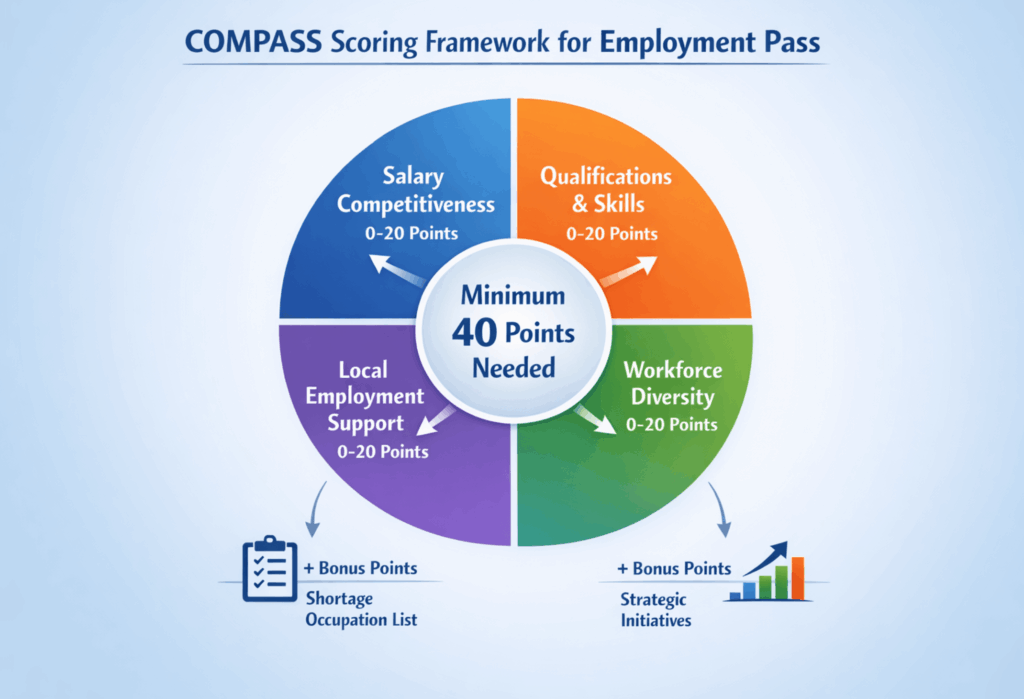
Applications must generally score at least 40 points across the relevant criteria in order to qualify.
Using the MOM Self Assessment Tool Before Applying
Before submitting an Employment Pass application, employers and employment agents may use the Self Assessment Tool (SAT) provided by the Ministry of Manpower.
The SAT allows companies to perform a preliminary check on whether a candidate is likely to meet the Employment Pass requirements.
The tool considers factors such as:
• the proposed salary
• the candidate’s qualifications
• the job role
• the company profile
Although the SAT result does not guarantee approval, it can help employers identify potential issues before submitting the application.
Employers must also continue to comply with the Fair Consideration Framework (FCF) job advertising requirement before submitting new Employment Pass applications.
In practice, the SAT is often used as an initial screening step before preparing the full Employment Pass submission.
For a full explanation of the submission process and required documents, you may also refer to our guide on how to apply for an Employment Pass in Singapore .
Example COMPASS Scenarios
The COMPASS framework evaluates multiple criteria together. In practice, applications may still meet the required score even where one criterion is weaker.
For example:
Scenario 1 – Balanced profile
A candidate with competitive salary, recognised qualifications, and a company with a balanced workforce profile may achieve the required COMPASS score across the core criteria.
Scenario 2 – Strong salary but weaker workforce profile
In some cases, a candidate may earn higher points under the salary criterion, which offsets weaker scores under other criteria such as workforce diversity.
Scenario 3 – Shortage occupation bonus
Certain specialised roles listed under Singapore’s Shortage Occupation List may earn additional points, allowing the application to meet the required COMPASS score even where some foundational criteria are weaker.
These examples illustrate how COMPASS evaluates the overall complementarity between the candidate and the employer’s workforce rather than relying on a single factor.
The Four COMPASS Criteria Explained
The COMPASS framework evaluates Employment Pass applications across four main criteria, taking into account both the candidate’s profile and the employer’s workforce composition.
Applications must generally obtain at least 40 points across the criteria in order to qualify.
In addition to the four core criteria, COMPASS may also award bonus points in certain situations, such as where the role falls under Singapore’s Shortage Occupation List or supports strategic economic priorities.
Each criterion assesses a different aspect of how the candidate and the employer complement Singapore’s workforce.
| COMPASS Criterion | Type |
|---|---|
| Salary | Candidate attribute |
| Qualifications | Candidate attribute |
| Workforce Diversity | Employer attribute |
| Support for Local Employment | Employer attribute |
Salary Competitiveness
The salary criterion evaluates how the candidate’s proposed salary compares with local professionals in similar roles and sectors.
This is different from the minimum Employment Pass qualifying salary, which is the basic eligibility threshold for the pass. Under COMPASS, the proposed salary is benchmarked against the salaries of local Professionals, Managers, Executives and Technicians (PMETs) within the same industry.
In general, higher salaries relative to sector benchmarks may earn more points under this criterion.
However, salary alone does not determine the outcome of an application. The salary must also align with the job scope, seniority of the role, and the company’s commercial activities.
Qualifications and Skills
This criterion evaluates the candidate’s academic qualifications or recognised professional credentials.
Certain qualifications may earn higher points under COMPASS. These may include:
• degrees from highly ranked universities
• degrees from Singapore’s autonomous universities
• qualifications from institutions recognised within specific industries
Other qualifications that are comparable to a bachelor’s degree may still contribute points depending on their recognition.
Candidates without degree-equivalent qualifications can still pass COMPASS if they earn sufficient points from other criteria.
Where qualification points are claimed, employers may be required to provide verification proof from an approved background screening company when submitting the Employment Pass application.
Workforce Diversity
Workforce diversity evaluates whether the company maintains a balanced mix of nationalities among its professional employees.
COMPASS awards more points where the candidate’s nationality represents a smaller share of the company’s existing PMET workforce. Conversely, where a company’s workforce is heavily concentrated in one nationality group, fewer points may be awarded under this criterion.
The intention of this criterion is to encourage companies to build teams that combine local and international talent from diverse backgrounds.
Employers can review their workforce diversity indicators through the Workforce Insights tool available on the myMOM portal, which provides benchmarking data based on MOM workforce statistics.
Support for Local Employment
This criterion evaluates the extent to which a company supports opportunities for local professionals at the PMET level.
Companies with a relatively higher proportion of local PMET employees compared with industry peers may receive more points under this criterion.
This does not mean that companies must hire locals solely to satisfy the COMPASS framework. Rather, the framework assesses whether the company’s workforce structure demonstrates a balanced approach to hiring both local and foreign professionals.
For newer companies or smaller businesses, the final outcome will usually depend on the overall profile of the application, including the candidate’s salary, qualifications, and the commercial credibility of the role.
Common Misunderstandings and Rejection Triggers
Many Employment Pass rejections occur not because of a single issue, but due to several factors combined.
Some common scenarios include:
• Salary meets the minimum requirement but appears misaligned with the job scope.
• The candidate has strong qualifications but the employer workforce profile weakens the overall score.
• A newly incorporated company submits an application before establishing sufficient operational evidence.
• The application documentation does not clearly explain the commercial rationale for the role.
Where an application is rejected, the underlying factors should be reviewed before deciding whether to appeal or reapply.In some situations, addressing the structural issues within the application can lead to a successful outcome, as illustrated in this Employment Pass eligibility check case study.
For a deeper explanation of common refusal reasons, you may refer to our guide on Employment Pass rejection in Singapore.
What to Do if Your COMPASS Outcome is Borderline
If an application is close to the COMPASS threshold, strengthening the overall profile may improve the chances of approval.
Common improvements include:
Clarifying the role scope
Ensuring the job responsibilities clearly reflect the seniority and expertise required.
Reviewing salary positioning
Aligning the compensation package with market expectations for the role.
Strengthening employer readiness
Providing clearer evidence of the company’s operations, staffing structure, and commercial activity.
Timing the application appropriately
Submitting the application once the company profile and documentation are strongest.
These adjustments often make a meaningful difference when applications are close to the assessment threshold.
In practice, restructuring the application and clarifying the role justification can sometimes improve the outcome, as shown in this Employment Pass appeal case study.
COMPASS Considerations for New Companies
Newly incorporated companies are not prohibited from applying for an Employment Pass. However, such applications are often assessed with closer attention to commercial credibility and salary sustainability.
Because new companies may have limited operating history, the Ministry of Manpower may review additional factors such as:
• the company’s business model
• financial sustainability of the salary offered
• the necessity of the role at that stage of the business
• the professional background of the applicant
For founders and new companies planning their first Employment Pass application, it is useful to structure the submission carefully to demonstrate that the business is operationally ready.
You may also find our guide on Employment Pass for new companies in Singapore and what MOM typically looks at helpful when planning an application under a newly incorporated entity.
Frequently Asked Questions
No. Meeting the minimum salary is only the starting point. The COMPASS framework evaluates the overall profile of the applicant and the employer before approval is granted.
Not necessarily. While salary competitiveness is an important factor, other criteria such as workforce diversity and local employment support are also assessed.
This depends on the circumstances of the rejection. Appeals may be appropriate where additional information can clarify the application, while reapplication may be more suitable if structural changes are needed.
Not necessarily.
The COMPASS framework assesses several criteria together. While support for local PMET employment is one factor, the final score is calculated based on the overall profile of the candidate and the employer.
In some situations, companies may still meet the required COMPASS score through other criteria such as:
• salary competitiveness
• qualifications and professional experience
• workforce diversity
• bonus criteria such as shortage occupations
For smaller companies or newly incorporated entities, the application may still be assessed based on the overall credibility of the role and the commercial operations of the business.
Yes. An Employment Pass application can still be approved even if the candidate does not hold a degree.
Under the COMPASS framework, academic qualifications are only one of several assessment criteria. Candidates who do not receive points under the qualifications criterion may still meet the COMPASS threshold by scoring sufficiently in other areas such as:
• salary competitiveness
• workforce diversity within the company
• support for local PMET employment
In practice, candidates without degree-equivalent qualifications are often expected to demonstrate strong professional experience or higher salary levels relative to industry benchmarks.
If the candidate’s salary meets the high-salary exemption threshold (currently SGD 22,500 per month), the application may also be exempt from the COMPASS framework.
For a full overview of the process, you may also refer to our guide on how to apply for an Employment Pass in Singapore.
Employment Pass applications assessed under COMPASS must generally obtain at least 40 points across the core criteria.
These points are calculated based on the candidate’s salary competitiveness, qualifications, the employer’s workforce diversity, and support for local PMET employment.
Additional bonus points may also be awarded where the role appears on Singapore’s Shortage Occupation List or where the company contributes to strategic economic priorities.
Because the scoring considers both the candidate and the employer profile, the final outcome depends on the overall alignment between the role, salary, and company workforce structure.
COMPASS itself applies only to Employment Pass applications. However, stable employment, credible salary levels, and a consistent professional history are relevant factors when applying for permanent residency.
If long term residency is your goal, you may refer to our guide on applying for Singapore PR.
Consultation and Next Steps
COMPASS assessments can sometimes be improved through clearer role positioning, stronger documentation, and careful alignment between the applicant’s profile and the company’s workforce structure.
This is particularly relevant for founders, newly incorporated companies, and employers hiring foreign professionals into specialised roles.
If you would like structured guidance, you may explore our Singapore work pass services.
Alternatively, you may book a 20 minute consultation to review eligibility and discuss the appropriate application strategy.
For the full step by step process of submitting an Employment Pass application, you may also refer to our guide on how to apply for an Employment Pass in Singapore.

About the Author: Sulochana Uthirapathi is the Founder of Transform Borders, a Singapore immigration consultancy established in 2017. She specialises in Employment Pass (EP), Permanent Residency (PR) and Citizenship applications, supporting professionals, families and corporate clients with legally guided and structured immigration processes.