Category: guidebooks

  • Singapore Entrepreneur Pass (EntrePass): Eligibility, Criteria & Application Guide

    Singapore Entrepreneur Pass (EntrePass): Eligibility, Criteria & Application Guide

    Written by: Sulochana Uthirapathi

    Last updated: January 2026

    Summary: The Singapore Entrepreneur Pass (EntrePass) is a selective work pass for foreign founders building venture-backed, innovation-led or research-driven businesses in Singapore. Approval depends on meeting recognised innovation criteria and alignment with Singapore’s economic priorities.

    This guide explains who the Singapore Entrepreneur Pass (EntrePass) is intended for, who it is not suitable for, and how applications are assessed based on Singapore’s innovation and business contribution requirements.

    Table of Contents

    Introduction to the EntrePass Scheme

    Singapore’s Entrepreneur Pass (EntrePass) is a highly selective work pass designed for foreign founders who are building venture-backed, research-driven, or innovation-led businesses in Singapore.

    Unlike the Employment Pass or Letter of Consent routes, the EntrePass is not intended for small trading businesses, professional services firms, or lifestyle ventures. Approval depends on whether both the applicant and the business align with Singapore’s national innovation and economic priorities.

    The EntrePass is typically suited to experienced founders, technology entrepreneurs, and investors who can demonstrate venture funding, proprietary intellectual property, or recognised research collaboration. Applications are assessed holistically, with close scrutiny of the business model, innovation profile, and growth potential.

    For a broader view of how Singapore’s 2025–2026 immigration and startup policies are evolving, including trends affecting foreign founders and business owners, see our Singapore Immigration Trends 2025–2026 Report.

    Back to top

    Who is Eligible for the EntrePass?

    The EntrePass is open to foreign entrepreneurs of all nationalities who intend to start and operate an innovation-led business in Singapore.

    There is no minimum salary requirement for EntrePass applicants. Instead, eligibility is assessed based on the applicant’s entrepreneurial background and the business’s innovation, funding, or research profile.

    At a baseline level, applicants must meet the following structural requirements:

    • You must have started, or intend to start, a Private Limited company registered with the Accounting and Corporate Regulatory Authority (ACRA)
    • The company must be less than 12 months old at the time of application
    • You must hold at least 30 per cent shareholding in the company

    Meeting these requirements alone does not guarantee approval. Applicants must also satisfy at least one recognised innovation criterion, which is assessed separately.

    Back to top

    Who the EntrePass Is Not Suitable For

    The EntrePass is commonly misunderstood as a general business visa. In practice, many applications are rejected because the business does not meet Singapore’s innovation threshold.

    The EntrePass is generally not suitable for:

    • Professional services firms such as consultancies, agencies, law, accounting, or recruitment businesses
    • Traditional trading, wholesale, or retail businesses
    • Food and beverage outlets
    • Freelancers or sole practitioners
    • Businesses without venture funding, proprietary technology, or recognised research backing

    Applicants whose businesses fall into these categories may need to consider alternative routes, such as an Employment Pass with shareholder involvement or other business structuring options, depending on their circumstances.

    Back to top

    Key Benefits and Features of the Singapore EntrePass

    The Singapore EntrePass offers several advantages for eligible foreign founders:

    • Flexibility to start and operate an innovation-led business in Singapore.
    • Eligibility to sponsor family members under the Dependant’s Pass or Long-Term Visit Pass, subject to criteria.
    • No foreign worker levy or quota requirements for the EntrePass holder.
    • Validity of one year for the initial pass, with subsequent renewals of up to two years if renewal criteria are met.

    Back to top

    Eligibility Criteria for EntrePass

    Applicants must meet at least one recognised innovation criterion. Meeting multiple criteria strengthens the application, but meeting none will almost certainly result in rejection.

    1. Fundraising for a Business

    You must have raised at least SGD 100,000 from a recognised investor for a past or current business. Eligible investors include:

    2. Support from Incubators or Accelerators

    Your business must be supported by a government-recognised or internationally renowned incubator or accelerator. Examples include:

    3. Founded and Sold a Tech Business

    If you have founded and sold a venture-backed or innovative technology business, you will need to provide supporting documents such as:

    • Incorporation documents
    • Sale and Purchase Agreements
    • Business plans outlining venture-backed status

    4. Intellectual Property Ownership

    Your registered or proposed business must own Intellectual Property (IP) that is registered with an approved national IP institution. The IP must provide a significant competitive advantage to your business.

    5. Research Collaboration in Singapore

    Your business must have an ongoing research collaboration with an Institute of Higher Learning (IHL) or Research Institution (RI) in Singapore. Examples of eligible institutions include:

    Applicants who do not meet any of the recognised innovation criteria should not proceed with an EntrePass application. In such cases, an Employment Pass with shareholder involvement may be a more appropriate route, depending on the role, salary, and company structure.

    These innovation criteria align with Singapore’s broader policy focus on high-impact entrepreneurship and economic contribution. For policy context and approval trends affecting foreign founders, see our Singapore Immigration Trends 2025–2026 Report.

    Unsure whether the EntrePass is the right route?

    Before proceeding, it can be helpful to clarify whether your profile and business meet MOM’s innovation criteria, or whether an alternative structure may be more appropriate.

    Book a complimentary 20-minute consultation →

    Back to top

    EntrePass Application Process

    Applying for the Singapore EntrePass is a structured process overseen by the Ministry of Manpower (MOM). While the steps appear straightforward, approvals depend heavily on how well the application demonstrates innovation, credibility, and alignment with Singapore’s economic priorities.

    Step 1: Prepare Required Documents

    Applicants must compile a complete and well-supported application package, including:

    • Personal particulars page of your passport
    • A detailed business plan (maximum 10 pages)
    • Documentary evidence supporting at least one recognised innovation criterion, such as:
      • Venture funding agreements or term sheets
      • Research collaboration agreements
      • Intellectual Property registrations or ownership documents

    Incomplete or weak documentation at this stage is a common reason for delays or rejection.

    Step 2: Submit the Application Online

    EntrePass applications are submitted online via the Ministry of Manpower (MOM) portal.

    The application fee is SGD 105 (non-refundable).

    Applicants whose profiles do not meet the EntrePass innovation threshold should not proceed at this stage. In some cases, an Employment Pass with shareholder involvement may be a more appropriate alternative, depending on the role, salary, and company structure.

    Learn more about eligibility and requirements in our step-by-step guide on how to apply for an Employment Pass in Singapore.

    Step 3: Application Review by MOM

    The standard processing time is up to 8 weeks. During this period, MOM may:

    • Request additional supporting documents
    • Seek clarification on funding, IP ownership, or business activities
    • Conduct background and credibility checks

    Any follow-up requests will extend the processing timeline, so prompt and accurate responses are important.

    Businesses and founders who need support coordinating documentation, submissions, and follow-ups often work with a immigration agency in Singapore to manage the application process alongside legal and strategic oversight.

    Step 4: Receive Your In-Principle Approval (IPA)

    If the application is approved, MOM will issue an In-Principle Approval (IPA) letter.

    The IPA allows a single entry into Singapore for the purpose of completing pass issuance formalities.

    Step 5: Issue the EntrePass in Singapore

    Applicants must be physically present in Singapore to complete pass issuance within six months of the IPA date. Once the EntrePass is issued, the holder may begin operating the approved business in Singapore, subject to ongoing compliance with MOM conditions

    Back to top

    Required Documents for EntrePass Application

    When applying for the Singapore EntrePass, applicants must submit documents that clearly support the innovation or venture-backed criteria under which they are applying. Incomplete or poorly aligned documentation is a common reason for rejection.

    The standard document checklist includes:

    • Passport particulars page
    • Business plan (up to 10 pages) outlining the product or service, market opportunity, competitive advantage, operational roadmap, and management profile
    • Supporting evidence relevant to the eligibility track, such as:
      • Venture funding agreements or investor letters
      • Intellectual Property registrations or filings
      • Research collaboration agreements with recognised institutions
    • Curriculum vitae (CV) highlighting entrepreneurial, technical, or leadership experience
    • Past employment testimonials, professional awards, or recognitions, where applicable

    Additional documents may be requested by MOM depending on the eligibility criteria relied upon and the complexity of the business model.

    Practical note: MOM assesses consistency across documents. The business plan, funding evidence, and applicant profile should clearly reinforce the same innovation narrative. Submitting generic or mismatched documents can weaken an otherwise viable application.

    For reference, the Ministry of Manpower publishes its official EntrePass document requirements on its website. Applicants should note that MOM’s list outlines baseline requirements, while approval depends on how well the documents support the innovation criteria of the application.

    Back to top

    Insider Tips for EntrePass Success

    Here are some key insider tips to ensure your EntrePass application stands out:

    • Avoid Common Mistakes: Many EntrePass applications fail not because the idea is weak, but because the business plan does not clearly demonstrate innovation, market differentiation, or commercial viability. MOM assesses whether the proposal aligns with Singapore’s innovation objectives, not just whether a company can be registered.

    In more complex cases involving innovation positioning, funding structures, or prior rejections, working with an immigration lawyer in Singapore can help ensure the application is framed in line with MOM’s assessment criteria.

    • Strengthen Your Business Plan: Emphasize any proof of concept, pilot projects, or strategic partnerships that demonstrate your business’s growth potential. Including testimonials from investors or clients can boost credibility.
    • Leverage Local Networks: Reach out to Singapore-based incubators and accelerators early in the process. Being able to name a recognised local partner in your application could strengthen your chances.

    In practice, successful EntrePass applications require more than a strong idea. They require clear positioning against MOM’s innovation criteria, supported by evidence and consistency across documents.

    Back to top

    Additional Resources for Entrepreneurs in Singapore

    Building an innovation-led business in Singapore often involves engaging with the country’s broader startup and funding ecosystem. The following initiatives are commonly referenced in EntrePass applications and business plans:

    • Startup SG Equity: A government-backed co-investment scheme that provides matched funding for venture-backed startups working with approved investors.
    • Enterprise Development Grant (EDG):
      Supports eligible companies in innovation, productivity, and international expansion. While not an EntrePass requirement, EDG funding can strengthen longer-term business sustainability.
    • Action Community for Entrepreneurship (ACE):
      A national platform connecting founders with mentors, investors, and industry partners across Singapore’s startup ecosystem.

    Many early-stage founders also use co-working spaces like WeWork, The Working Capitol, and JustCo to access founder communities, accelerator programmes, and investor networking opportunities during the initial build phase.

    Back to top

    EntrePass vs Other Singapore Work Passes

    Choosing the correct work pass is critical. A common reason for rejection is applying under the wrong framework. The EntrePass is assessed primarily on innovation, venture backing, or research alignment, not on salary, job title, or employer sponsorship.

    If you are deciding between founder routes and employment routes, it helps to compare what each pass is designed for.

    EntrePass vs Other Singapore Work Passes: Key Differences

    Choosing the correct work pass is critical. A common reason for rejection is applying under the wrong framework. The table below compares the EntrePass with other common Singapore work passes based on eligibility, purpose, and flexibility.

    Criteria EntrePass Employment Pass (EP) PEP ONE Pass LOC
    Best suited for Founders building venture-backed or innovation-led businesses Salaried professionals hired by Singapore companies High-earning professionals seeking job flexibility Exceptional global professionals with strong income or achievements Eligible DP/LTVP holders working or running small businesses
    Main assessment focus Innovation, funding, IP, research collaboration Salary, job scope, employer profile, COMPASS Salary history and eligibility conditions Individual stature, achievements, income threshold Underlying DP/LTVP status and approved activity
    Tied to an employer No Yes No No Indirectly (via DP/LTVP)
    Business ownership allowed Yes (core purpose) Possible (with structure and approvals) No Yes Yes (commonly used for small businesses)
    Minimum salary requirement No fixed minimum Yes (MOM benchmarks) Yes (high threshold) Yes (high income threshold) No EP-style benchmark
    Validity & renewal 1 year initially; renewals subject to criteria Up to 2 years; renewable 3 years; non-renewable Typically 5 years; renewable Aligned with DP/LTVP validity
    Common rejection reason Business does not meet innovation threshold Salary-to-role mismatch, weak employer profile Eligibility or income criteria not met Profile not sufficiently exceptional DP/LTVP or activity misalignment

    How to interpret this table (quick guidance)

    • If you are building an innovation-led or venture-backed business and your eligibility is based on funding, IP, or research collaboration, the EntrePass is usually the relevant framework.
    • If you will be working in a salaried role with a Singapore employer (including as a shareholder-employee), the Employment Pass may be more appropriate, subject to salary benchmarks and COMPASS assessment.
    • If you are a senior professional who qualifies for the Personalised Employment Pass (PEP), it can offer job flexibility, but it does not allow you to operate your own business directly.
    • If you qualify for the Overseas Networks and Expertise Pass (ONE Pass), it allows multi-employer work and business activities, but it is assessed primarily on the applicant’s individual profile and income level, rather than the viability or innovation profile of a specific venture.

    Recommended reading

    If you are still comparing pathways, the following guides may help clarify which framework fits your situation:

    Back to top

    Renewal and Validity of EntrePass

    The EntrePass is issued on a progressive framework designed to assess whether a founder’s business continues to contribute meaningfully to Singapore’s innovation ecosystem.

    Validity period

    • The initial EntrePass and first renewal are typically granted for 1 year
    • Subsequent renewals are granted for 2 years, subject to meeting renewal criteria set by the Ministry of Manpower (MOM)

    Renewal is not automatic. Applications are assessed based on ongoing business activity, innovation profile, and local economic contribution, rather than the original approval factors alone.

    For founders considering long-term residence, the EntrePass does not guarantee Permanent Residency. However, those who build sustainable businesses, create local employment, and demonstrate ongoing economic contribution may later be eligible to apply for Singapore Permanent Residency (PR), subject to ICA’s assessment criteria.

    Back to top

    FAQs on the Singapore EntrePass

    1. Can I bring my family members with me on an EntrePass?

    Yes. Eligible EntrePass holders may apply for a Dependant’s Pass (DP) for their spouse and children, or a Long-Term Visit Pass (LTVP) for other eligible family members, subject to prevailing MOM criteria.

    2. How long does it take to process an EntrePass application?

    Processing typically takes up to 8 weeks from the date of submission. Applications requiring additional clarification or supporting documents may take longer.

    3. What happens if my EntrePass application is rejected?

    If your application is rejected, you may submit an appeal within 3 months, addressing the specific reasons cited by MOM and providing additional supporting documents where relevant. Appeals are assessed on their merits and are not guaranteed approval.

    4. What types of businesses are not eligible for the EntrePass?

    The EntrePass is not intended for businesses that do not meet Singapore’s innovation threshold. Commonly ineligible businesses include:
    – Coffee shops, restaurants, and food and beverage outlets
    – Massage parlours, nightclubs, and entertainment venues
    – Employment agencies
    – Traditional trading, retail, or wholesale businesses

    5. Can I switch to another work pass if I do not qualify for the EntrePass?

    Yes. Applicants who do not meet the EntrePass criteria may consider alternative frameworks such as the Employment Pass (EP) or in limited cases, the Tech.Pass, depending on the role, salary structure, and nature of the business or employment arrangement.

    6. How much does it cost to apply for the EntrePass?

    The application fee is SGD 105 (non-refundable). Upon approval, additional fees apply for pass issuance (SGD 225) and a Multiple Journey Visa (SGD 30), if required.

    7. How can I improve my chances of EntrePass approval?

    Successful applications typically demonstrate:
    – A clearly articulated innovation-led or venture-backed business model
    – Strong alignment with Singapore’s economic and technology priorities
    – Credible funding, intellectual property, or recognised research collaboration

    Support from established incubators, accelerators, or venture capital firms can strengthen an application. Where applications involve complex structuring or prior rejections, professional guidance may help ensure the application is positioned appropriately.

    Can I apply for Singapore PR while holding an EntrePass?

    Yes, but PR applications are assessed independently by ICA. Holding an EntrePass does not guarantee Permanent Residency. ICA considers long-term business contribution, local employment creation, and economic integration.

    Back to top

    Book a Consultation

    Applying for the Singapore EntrePass requires careful positioning of both the applicant and the business. Many rejections arise not from weak ideas, but from applications that do not align clearly with MOM’s innovation and renewal criteria.

    If you would like structured guidance on Singapore work pass options for founders, including the EntrePass, Employment Pass alternatives, and long-term compliance considerations, you may refer to our Singapore work pass services.

    If you would like to clarify whether the EntrePass is an appropriate option for your circumstances, you may book a 20-minute consultation with Transform Borders. This initial discussion is intended to help you understand the relevant framework and possible next steps, rather than to provide a full assessment or application advice..

    If long-term settlement is part of your future planning,
    our resources on Singapore Permanent Residency and Singapore citizenship may also be useful reference points.

    Back to top

    Sulochana Uthirapathi, Singapore Immigration Lawyer and Founder of Transform Borders

    About the Author: Sulochana Uthirapathi is the Founder of Transform Borders, a Singapore immigration consultancy established in 2017. She specialises in Employment Pass (EP), Permanent Residency (PR) and Citizenship applications, supporting professionals, families and corporate clients with legally guided and structured immigration processes.

  • How to Apply for Personalised Employment Pass (PEP) in Singapore

    How to Apply for Personalised Employment Pass (PEP) in Singapore

    Written by: Sulochana Uthirapathi
    Last updated: January 2026


    Summary: The Personalised Employment Pass (PEP) is a non-renewable, three-year Singapore work pass issued by the Ministry of Manpower for senior foreign professionals earning at least S$22,500 per month. Unlike the Employment Pass, it is not tied to an employer and allows holders to change jobs freely, subject to strict income and compliance conditions.

    Moving to Singapore or planning your next career step here? The Singapore Personalised Employment Pass (PEP) is a flexible work pass designed for high-calibre foreign professionals who value career freedom and long-term opportunities. Issued by the Ministry of Manpower (MOM), it allows you to switch employers without reapplying for a new pass, making it one of Singapore’s most versatile work options.

    For the latest policy direction, workforce calibration, and PR/citizenship trends that may affect senior professionals, see our Singapore Immigration Trends 2025–2026 Report.

    1. Introduction to the Personalised Employment Pass (PEP)

    The Singapore Personalised Employment Pass (PEP) is a flexible work pass issued by the Ministry of Manpower (MOM) to attract and retain senior professionals with exceptional credentials. Unlike the standard Employment Pass, the PEP is not tied to any specific employer — offering greater career mobility and long-term stability in Singapore.

    Having assisted professionals through various MOM frameworks since 2015, I have seen how the PEP benefits high-earning individuals who value flexibility and independence. PEP holders can switch employers without reapplying for a new pass and remain in Singapore between jobs for up to six months.

    Back to top

    2. Who Should Apply for a Personalised Employment Pass (PEP)?

    Illustration of a professional reviewing Singapore Personalised Employment Pass (PEP) application requirements and eligibility.
    Professionals who meet the salary and eligibility criteria can apply for the Singapore Personalised Employment Pass (PEP).


    Eligibility Criteria for PEP Application

    To qualify for a Personalised Employment Pass (PEP), applicants must earn a fixed monthly salary of at least S$22,500. The PEP is open to:

    • Existing Employment Pass (EP) holders who are earning the qualifying salary.
    • Foreign professionals who are currently employed overseas and meet the same income threshold. For overseas applicants, your last drawn salary must have been received within the past six months before submitting your PEP application.

    PEP holders can bring certain family members, such as spouses and children, to Singapore under Dependant’s Pass or Long Term Visit Pass schemes.

    Who the PEP Is Not Suitable For

    You are not eligible for the Personalised Employment Pass (PEP) if you are:

    • An Employment Pass holder under the sponsorship scheme.
    • A freelancer or foreigner who intends to work on a freelance basis.
    • A sole proprietor, partner, or director who is also a shareholder in an ACRA-registered company.

    The PEP is also not available to individuals who have previously held a PEP, as this pass can only be issued once per applicant.

    If your long-term goal is to continue living and working in Singapore after your PEP expires, you can:

    How Long Is the PEP Valid For

    The Personalised Employment Pass (PEP) is valid for three years and cannot be renewed. During this time, holders may change employers without reapplying for a new pass.

    After expiry, professionals can consider switching to an Employment Pass if they secure a new job offer, or exploring business options such as the EntrePass if they plan to start a venture in Singapore.

    Comparison Table: Personalised Employment Pass (PEP) vs Employment Pass (EP)

    Understanding the key differences between the Personalised Employment Pass (PEP) and the standard Employment Pass (EP) helps you determine which option best fits your professional goals in Singapore.

    If you do not meet the income requirement for a PEP, you can still qualify for an Employment Pass in Singapore and build a strong career foundation before upgrading later.

    Criteria Personalised Employment Pass (PEP) Employment Pass (EP)
    Issued By Ministry of Manpower (MOM) Ministry of Manpower (MOM)
    Who It’s For High-earning professionals with a strong work history who want flexibility without employer sponsorship. Foreign professionals sponsored by a Singapore-based employer for a specific role.
    Sponsorship Requirement No employer sponsorship required. Requires employer sponsorship.
    Minimum Salary At least S$22,500 fixed monthly salary (Singapore or overseas) in the last 12 months before application. At least S$5,000 (or higher depending on age, experience, and sector).
    Validity 3 years, non-renewable. Up to 2 years initially; renewable thereafter.
    Job Flexibility Can change employers freely without reapplying. New employer must file a fresh application.
    Job Search Buffer Up to 6 months allowed between jobs. No job search buffer; a new pass must be approved before changing employers.
    Entrepreneurship Not permitted to run or own a business directly. Possible if company qualifies and proper pass is secured.
    Dependant Privileges Eligible to bring family under Dependant Pass or Long-Term Visit Pass. Same privileges if salary is ≥ S$6,000.
    Renewal Not renewable; must switch to another pass or PR after 3 years. Renewable as long as employment and salary criteria are met.
    Relevance to PR May strengthen PR application due to seniority and salary level. Eligible to apply for PR after establishing stable employment history.

    While both passes are issued by MOM, the Personalised Employment Pass and Employment Pass are assessed under entirely different frameworks. Choosing the wrong route can lead to unnecessary delays or rejection.

    For a deeper breakdown of EP eligibility, salary benchmarking, and employer obligations, see our step-by-step Employment Pass guide.

    Back to top

    3. Documents Required for a PEP Application

    The Personalised Employment Pass (PEP) application requires gathering all the necessary documents and supporting documentation to verify your income, professional background, and employment history. Submitting clear and consistent records is essential for a successful personalised employment pass application and helps ensure a smooth process with the Ministry of Manpower (MOM).

    While the exact requirements may differ slightly depending on whether you are working in Singapore, overseas, or between jobs, the following documents are typically required:

    • Applicant’s passport (copy of the personal particulars page)
    • Monthly payslips for the past 3–6 months
    • Personal bank statements (3–6 months) showing your name, bank account number, and electronic salary crediting
    • Employment contracts with your current, previous, or future employer (if applicable)
    • Latest Notice of Assessment from the Inland Revenue Authority of Singapore (IRAS) or equivalent overseas tax statements
    • Employment history and job details
    • Educational certificates and transcripts, where applicable. For certain countries, such as India, transcripts are required in addition to degree certificates. Non-English documents must be accompanied by certified English translations.

    Be sure to provide accurate contact details in your application, as MOM may need to reach you for clarifications or updates.

    Note: Many applicants encounter issues when their salary payments are split between fixed income, bonuses, or stock options. To avoid delays, ensure your payslips and bank statements clearly reflect consistent salary crediting. If there are discrepancies, include a written explanation and supporting documents to clarify the source of income.Missing additional documents requested by MOM can also slow down the process.

    Many applications are delayed because supporting documents are incomplete or inconsistent. A careful review of salary proof, tax statements, and employment history before submission can prevent MOM verification issues and speed up processing.

    For the most up-to-date and detailed checklist, visit MOM’s official page on PEP document requirements.

    Back to top

    4. How to Apply for a Personalised Employment Pass (PEP)

    Laptop showing PEP application form and Singapore passport, representing the step-by-step process to apply for a Personalised Employment Pass online.
    Apply for your Singapore Personalised Employment Pass (PEP) through the Ministry of Manpower’s online portal.

    Understanding the PEP Application Process

    The personalised employment pass application process in Singapore is done directly through the MOM’s portal. It is important to follow each step carefully and ensure all supporting documents meet MOM’s requirements for a smooth approval process.

    Step 1: Prepare Your Documents

    Gather all required supporting documents, including income proof, employment records, and educational qualifications. Ensure that all details are consistent across your documents and your application form.

    You can access the official Personalised Employment Pass (PEP) application form on MOM’s eService to review the required information.

    Note: While the form may look straightforward, MOM’s system cross-checks every field with IRAS and ACRA records. A single inconsistency in declared salary or company details can delay approval or lead to rejection.

    Step 2: Submit the Application

    Applications must be submitted online via the official MOM eService.

    You can complete the form yourself or authorise a licensed employment agent to do so on your behalf.

    Many senior professionals prefer to work with a licensed immigration agency in Singapore to ensure salary documentation, tax records, and employment history are structured correctly before submission.

    Once submitted, MOM will issue an electronic acknowledgement confirming receipt.

    Note: Avoid resubmitting or making changes while your application is still under review. MOM evaluates all records carefully, and duplicate submissions can reset the processing timeline.

    If you’d like to confirm your eligibility or have your profile reviewed before submission, book a free 20-minute consultation for a professional assessment.

    Step 3: Await Processing

    Most applications are processed within eight weeks, although this may vary depending on the complexity of your case or document verification requirements. You can monitor the progress of your application through the MOM Check Status portal using your application reference number.

    Step 4: Receive In-Principle Approval (IPA)

    Successful applicants will receive an In-Principle Approval (IPA) letter by email. This letter allows you to enter Singapore (if applicable) and collect your PEP within the validity period stated.

    Step 5: Issuance and Collection of the PEP

    Once your PEP is approved, you will receive an In-Principle Approval (IPA) letter from the MOM by email. Follow the instructions in the letter to issue your pass.

    If you have a Singpass account or an authorised employment agent, you can complete the issuance online through MOM’s EP eService.

    If you do not have a Singpass account, you will need to make an appointment and visit the Employment Pass Services Centre (EPSC) to collect your pass in person. You may also be required to register your fingerprints and photo within two weeks of the pass being issued.

    The official MOM fees are S$225 for the application and S$30 for issuance.

    The average PEP processing time is around eight weeks, although this may vary depending on MOM’s assessment of your documents and employment background. You may check your application status after 2 weeks.

    Once issued, the PEP card will typically be ready for collection within one to two weeks after final approval.

    Back to top

    5. Singapore PEP Validity, Renewal Rules, and Key Conditions Explained

    Illustration of Singapore Personalised Employment Pass (PEP) validity period and renewal conditions, showing calend
    The Singapore Personalised Employment Pass (PEP) is valid for 3 years and must meet MOM’s renewal and income conditions.

    The Personalised Employment Pass (PEP) is valid for three years from the date of issuance and cannot be renewed.

    When it nears expiry, the holder may transition to an Employment Pass (EP) if they secure new employment, or apply for an EntrePass if they plan to start a business in Singapore.

    Some PEP holders may also choose to explore Singapore Permanent Residence (PR) through the Immigration & Checkpoints Authority (ICA) while their pass is still valid.


    What are the Key Conditions to Maintain Your PEP?

    To retain your PEP status throughout its three-year validity, you must:

    • Avoid operating your own business or registering a company as a director or shareholder under your name while holding the PEP.
    • Earn a fixed monthly salary of at least S$12 000, regardless of the number of months you are employed each year.
    • Notify MOM within seven days of any change in your employment status, such as starting or leaving a job.
    • Remain in Singapore for at least six months in any calendar year.

    Note: The monthly qualifying salary (S$22,500) is assessed at application, while the annual income threshold applies to ongoing compliance after approval.

    Many PEP holders unintentionally breach MOM conditions by taking up freelance projects or registering companies in their own name. Always confirm your arrangements with MOM or a licensed immigration advisor before proceeding.

    Always confirm your arrangements with MOM or a licensed immigration advisor before proceeding.

    What Happens as Your PEP Nears Expiry (Plan 6+ months ahead)

    Because the PEP is non-renewable, plan your next step before it expires. If you intend to remain in Singapore after expiry, you must hold another valid pass.

    Common paths:

    • Transition to an Employment Pass (EP): If you secure a new role, your prospective employer files the EP application.
    • Entrepreneur route: If you plan to start/run a business and qualify, explore EntrePass.
    • Permanent Residence (PR): PR applications are made to ICA and are typically submitted while you still hold a valid pass (e.g., PEP/EP). If PR is part of your long-term plan, apply before your current pass expires.

    Note: PR is assessed independently by ICA and is not a renewal/extension of your work pass. Ensure your immigration status remains valid throughout processing.

    Back to top

    6. Common Mistakes in Singapore PEP Applications and How to Avoid Them

    Illustration showing common mistakes in Singapore Personalised Employment Pass (PEP) applications, highlighting errors to avoid during submission.
    Avoid these common mistakes when applying for your Singapore Personalised Employment Pass (PEP) to prevent unnecessary rejections or delays.

    Mistakes during the PEP application process can lead to delays or even rejection.

    • Missing proof for income variations: Provide bonus letters or breakdowns if your pay includes variable components such as stock options.
    • Salary mismatches: Ensure that your payslips and bank statements reflect identical salary amounts. Include a short employer letter if discrepancies exist.
    • Incomplete employment history: List all previous positions, even short-term roles, to avoid unexplained gaps.

    Note: MOM officers often cross-check salary information against tax records. Consistency between your IRAS submissions and payslips helps prevent verification delays.

    If your application is denied due to errors or missing documents, this is known as a PEP rejection. In such cases, carefully review the rejection letter to understand the reasons. You may be able to appeal the decision or reapply after addressing the issues.

    We frequently see senior professionals impacted by documentation and timing issues in cases like the Employment Pass renewal lapse case study, where compliance gaps created unnecessary delay and uncertainty during pass transitions.

    If you would like professional help reviewing your rejection or planning your next application, see our Immigration Lawyer Singapore Guide for how expert legal advice can improve your chances of success.

    Back to top

    7. Case Study — How a Finance Professional Secured His PEP

    Illustration showing a successful Singapore Personalised Employment Pass (PEP) approval, representing a case study of how applicants can qualify and secure approval.
    A Singapore Personalised Employment Pass (PEP) approval achieved through strategic preparation and compliance with MOM requirements.


    A senior finance executive approached us when his Employment Pass (EP) was due to expire because of company restructuring.

    Without a new employer ready to sponsor him, he risked losing his legal stay.

    Our Approach

    • Confirmed eligibility — his income exceeded S$22 500 per month.
    • Recommended the Personalised Employment Pass (PEP) for flexibility during his job search.
    • Reviewed his employment record and income proof to ensure compliance with MOM requirements.
    • Structured the application to highlight his consistent track record and seniority.
    • Filed the application promptly and tracked its progress through MOM’s portal.

    The Outcome

    • PEP approved within weeks.
    • Client received a new job offer shortly after approval.
    • As the pass was not issued, he retained eligibility to reapply later if needed.

    Key Takeaway

    A well-prepared PEP application can give senior professionals flexibility and peace of mind during career transitions, allowing them to remain in Singapore legally while exploring new opportunities.

    Back to top

    8. Special Conditions and Restrictions for PEP Holders

    While the Singapore PEP offers broad flexibility, it also comes with specific limitations to protect its intent as a professional work pass.

    Business and Directorship Rules

    PEP holders cannot:

    • Register or operate as a sole proprietor or partner.
    • Act as a director in a company where they also hold shares.

    If you wish to start or manage a business in Singapore, consider applying for the EntrePass or Employment Pass — schemes specifically designed for entrepreneurs and business owners who wish to operate locally under proper work authorisation.

    Salary Requirements

    To keep your PEP active, your annual income must exceed S$270 000, or S$144 000 if your pass was approved before 1 September 2023.

    If your income falls below the threshold, MOM may cancel your pass based on your tax submissions or declared income.

    Note: Plan ahead if you expect a temporary drop in income — for example, due to a career break or change in employment. You can consider switching to an Employment Pass (EP) through your employer to remain in Singapore legally.

    Remote Work and Freelancing Rules

    While remote work has become more common, MOM restricts PEP holders to contracts with Singapore-based employers only.

    You cannot:

    • Freelance or take up short-term overseas contracts.
    • Work for an overseas company without a registered Singapore entity.

    To stay compliant, ensure that your employment contract clearly identifies a Singapore-registered company as your hiring entity.

    ✅ In summary

    The PEP is designed for senior professionals, not entrepreneurs or freelancers.

    To maintain your pass:

    • Follow MOM’s restrictions on business ownership and remote work.
    • Monitor your income to meet the annual threshold.
    • Switch to another valid work pass (e.g., EP or EntrePass) if your situation changes.

    By complying with these conditions, you will protect your residency status and maintain good standing with Singapore’s Ministry of Manpower.

    Back to top

    9. Singapore Personalised Employment Pass (PEP) – Frequently Asked Questions

    Illustration with a question mark symbol representing frequently asked questions about the Singapore Personalised Employment Pass (PEP).
    Common questions answered about the Singapore Personalised Employment Pass (PEP) — from eligibility to renewal and restrictions.
    Can I apply for a PEP while holding an
    Employment Pass
    (EP)?

    Yes. You can apply for the Singapore Personalised Employment Pass (PEP) before your current Employment Pass expires. Once approved, you may decide when to issue the PEP and make the transition.

    Can I apply for a PEP while on a Visit Pass?

    Yes. You can apply for a Personalised Employment Pass while holding a valid Visit Pass. However, you must provide the details of a local contact person who is either a Singapore Citizen or Permanent Resident.

    Can my family join me if I hold a PEP?

    Yes. PEP holders can bring their immediate family members to Singapore. Your spouse and children can apply for a Dependant’s Pass, while parents may apply for a Long-Term Visit Pass. These passes remain valid as long as your PEP is valid.

    Do I need to reapply for my family’s passes when switching to a PEP?

    Yes. Once your PEP is approved, new Dependant’s Pass (DP) or Long-Term Visit Pass (LTVP) applications must be submitted. These are tied to your updated PEP status.

    Can my dependants work in Singapore?

    Dependant’s Pass (DP) holders can work in Singapore, but not automatically. Their ability to work depends on the type of activity involved and the form of work authorisation obtained.

    In general, DP holders must either obtain their own valid work pass, such as an Employment Pass, S Pass, or Work Permit, if they are being hired by a company, or apply for a Letter of Consent (LOC) if they wish to operate or run their own business, subject to MOM’s eligibility criteria.

    Because the LOC is assessed differently from standard employment passes and is tied to the underlying Dependant’s Pass, it is important to understand how the LOC application process works in practice before proceeding.

    For a detailed breakdown of eligibility, documentation, and renewal requirements, refer to our guide on how to apply for a Letter of Consent (LOC) in Singapore.

    If you are specifically exploring how Dependant’s Pass holders transition into work or business activities, our walkthrough on how DP holders can start working legally in Singapore under an LOC provides practical examples and common pitfalls to avoid

    What are the main benefits of the Singapore PEP?

    The PEP offers flexibility and stability. Holders can switch employers without reapplying for a new pass, enjoy a 6-month job search period between roles, and bring their immediate family members on dependant passes. It’s designed for high-earning professionals seeking a long-term career in Singapore.

    Can I apply for Singapore PR while holding a Personalised Employment Pass (PEP)?

    Yes. You may apply for Singapore Permanent Residence (PR) while holding a Personalised Employment Pass.

    Does holding a PEP help with my Singapore PR application?

    While holding a PEP does not guarantee Permanent Residency (PR), it can strengthen your profile. The PEP is granted to senior professionals with high salaries and consistent employment records — factors that align with ICA’s long-term residency criteria.

    If PR is your long-term goal, refer to our Step-by-Step Guide to Applying for Singapore Permanent Residency.

    For broader insights into Singapore’s 2025–2026 immigration policies, workforce direction, and PR approval trends, see our Singapore Immigration Trends 2025–2026.

    Can I renew my PEP after three years?

    No. The Personalised Employment Pass is valid for three years and is non-renewable. Before it expires, you must switch to another valid work pass, such as the Employment Pass or EntrePass.

    What happens if my income falls below the required threshold?

    If your annual fixed salary falls below S$270,000 (or S$144,000 for passes issued before 1 September 2023), the Ministry of Manpower (MOM) may cancel your PEP. Monitor your income closely and plan ahead if you expect changes to your salary or employment.

    Can I cancel my PEP before the three-year validity ends?

    Yes, but cancellation is permanent. Once you cancel your PEP, it cannot be reinstated. If you plan to remain in Singapore, make sure you apply for another valid work pass before cancelling.

    How do I prepare my PEP application?

    Gather clear proof of income and employment before applying — recent payslips, bank statements, tax records, and employment contracts. Include your degree certificates and transcripts if required. Ensure all details match across documents to avoid MOM delays. If your salary includes bonuses or stock options, add an employer letter explaining the breakdown. A well-prepared PEP application shows consistency and strengthens your chances of approval.

    How long does a PEP application take?

    Most PEP applications take about 6 to 8 weeks to process, depending on document verification and MOM’s workload. You can check your application status online using your reference number. Submitting complete, consistent documents helps avoid delays and speeds up approval.

    Back to top

    10. Book a Consultation

    Many professionals who consider the PEP also explore how the Employment Pass fits into their career journey. If you are comparing both routes, read our detailed Employment Pass guide to understand eligibility, salary criteria, and application steps.

    For those thinking further ahead, long-term residence outcomes are often part of the picture. Our guide on applying for Singapore Citizenship after Permanent Residency explains how work history, pass type, and economic contribution may be assessed over time.

    If you would like structured guidance on Singapore work pass options, including Personalised Employment Pass eligibility, Employment Pass alternatives, and longer-term planning considerations, you may refer to our Singapore work pass services.

    If you would like personalised guidance on your PEP eligibility, documentation, or long-term immigration strategy, you can book a 20-minute consultation with Transform Borders.

    For complex situations involving senior compensation structures, multi-employer transitions, or long-term residency planning, working with an immigration lawyer in Singapore can help reduce risk and ensure compliance.

    Back to top


    Sulochana Uthirapathi, Singapore Immigration Lawyer and Founder of Transform Borders

    About the Author: Sulochana Uthirapathi is the Founder of Transform Borders, a Singapore immigration consultancy established in 2017. She specialises in Employment Pass (EP), Permanent Residency (PR) and Citizenship applications, supporting professionals, families and corporate clients with legally guided and structured immigration processes.

  • Singapore Employment Pass Guide: Eligibility, COMPASS, Salary & How to Apply

    Singapore Employment Pass Guide: Eligibility, COMPASS, Salary & How to Apply

    Written by: Sulochana Uthirapathi  |  Last updated: January 2026

    This guide explains who qualifies for a Singapore Employment Pass (EP), how the COMPASS framework is assessed, and the key considerations around salary alignment, employer readiness, renewals, and appeals. It is intended for foreign professionals considering work in Singapore, employers hiring overseas talent, business owners sponsoring themselves for an EP, and existing EP holders planning renewals or appeals.

    This guide does not cover Work Permit applications for semi-skilled roles or short-term visit passes.

    An Employment Pass (EP) is Singapore’s primary work pass for foreign professionals in managerial, executive, or specialised roles who meet minimum salary requirements and assessment criteria set by the Ministry of Manpower.

    In practice, an Employment Pass application is assessed on salary, job scope, employer credibility, and alignment with MOM’s workforce objectives under the COMPASS framework.

    Table of Contents

    1. Who Needs an Employment Pass in Singapore?
    2. Employment Pass Updates for 2025–2026
    3. Employment Pass Eligibility and the COMPASS Framework
      1. Stage 1: Minimum Salary Requirements
      2. Stage 2: How COMPASS Is Assessed in Practice
      3. COMPASS Exemptions and Practical Considerations
    4. How to Prepare a Strong Employment Pass Application
    5. Applying for an Employment Pass as a Business Owner or Director
    6. Step-by-Step Employment Pass Application Process
    7. Renewals and Salary Adjustments for EP Holders
    8. Common Reasons EP Applications Are Rejected
    9. Legal and Compliance Considerations for Employers and EP Holders
    10. EP vs Other Singapore Work Passes
    11. Practical Tips from a Singapore Immigration Lawyer
    12. Final EP Checklist Before Submission
    13. Employment Pass FAQs
    14. Speak with an Immigration Professional

    Applying for an Employment Pass (EP) is one of the most common ways for professionals and entrepreneurs to work legally in Singapore. The EP is intended for executives, managers, and specialists whose experience and skills contribute to the local economy.

    Over the past few years, the Ministry of Manpower (MOM) has refined how EP applications are assessed. The COMPASS framework, introduced in 2023, is now fully in effect. Together with rising qualifying salaries, it represents Singapore’s move toward a workforce that is both diverse and highly skilled.

    This guide brings together the most recent 2026 updates and the practical experience of an immigration lawyer who has assisted numerous individuals and companies in obtaining, renewing, and appealing Employment Passes. It is written to help you understand exactly what matters, how to prepare correctly, and how to approach the process with confidence.

    For a broader look at how national immigration policies, workforce trends, and approval rates are evolving, see our Singapore Immigration Trends 2025–2026 Report.

    Who Needs an Employment Pass

    The Employment Pass is required for most foreign professionals who plan to work in managerial, executive, or specialised roles in Singapore. It is available to nationals of any country, provided both the applicant and the employer meet MOM’s criteria.

    You will need an Employment Pass if you are:

    • A foreign professional who has received a formal job offer from a Singapore-registered company.
    • A company director or business owner who intends to manage your Singapore entity directly.
    • A foreign entrepreneur who has transitioned from an EntrePass to an operational business.

    You will not need an EP if you fall under other categories such as:

    • S Pass – for mid-level skilled staff.
    • ONE Pass – for global top-tier talent earning above S $30 000 per month.
    • Personalised Employment Pass (PEP) – for existing EP holders or high earners who wish to work freely for any employer.
    • Letter of Consent (LOC) – for certain Dependant Pass holders who operate a registered business.
    • Work Permit – for semi-skilled workers in designated industries.

    Each pass carries distinct requirements, but the Employment Pass remains the preferred option for foreign professionals seeking a long-term career path in Singapore.

    If you are unsure whether an Employment Pass or another work pass is more suitable, you may wish to review our overview of immigration lawyer services in Singapore to understand when legal guidance becomes important.

    Back to top ↑

    Employment Pass Updates for 2025 – 2026

    1. Higher Minimum Qualifying Salaries

    From 1 January 2025 onwards, the minimum fixed monthly salary required for new Employment Pass applications is S$5600 in non-financial sectors and S$6200 in the financial sector.

    The salary requirement increases gradually with age and seniority, reaching around S $10 000 for senior professionals in their mid-40s.

    These new thresholds will apply to renewals from 1 January 2026.

    2. COMPASS Fully Implemented

    The Complementarity Assessment Framework (COMPASS) is now an integral part of the EP evaluation. It allocates points to balance the candidate’s professional value with the employer’s local workforce contribution. More importantly, it provides a transparent way to understand how MOM views an application beyond salary figures.

    3. Verification of Qualifications

    All declared educational qualifications must now be verified by MOM-recognised third-party agencies. Verification is not mandatory if you choose not to declare education, but verified credentials often strengthen applications.

    4. Renewal and Ongoing Compliance

    MOM now assesses renewals with the same level of detail as new applications. Salary progression, company track record, and ongoing compliance with local employment policies are all reviewed at the renewal stage.

    To see how this works in practice, read our case study on how we navigated an Employment Pass renewal lapse and successfully addressed the renewal rejection.

    For deeper insights into the policies shaping Employment Pass approvals and Singapore’s talent strategy in 2025–2026, read our Singapore Immigration Trends 2025–2026 Report.

    Back to top ↑

    Employment Pass Eligibility and the COMPASS Framework

    Eligibility for an Employment Pass involves two stages: first meeting the minimum salary requirement, and then achieving a satisfactory score under COMPASS.

    Stage 1 – Employment Pass Salary Requirements

    The fixed monthly salary must meet or exceed MOM’s published thresholds:

    • S$5600 minimum for most sectors.
    • S$6200 for the financial sector. Applicants with greater experience or seniority must earn proportionately higher salaries to reflect their level.

    Only the fixed monthly salary is considered. Variable bonuses, commissions, or allowances are excluded.

    Employers must ensure the declared salary is reasonable for the job scope and supported by the company’s financial capacity.

    If you are uncertain whether your salary and position align correctly, refer to our case study “They Got the Employment Pass Requirements Wrong – and How Solved the Confusion”.

    Common mistake: Declaring a high salary without a corresponding job scope or sufficient company revenue often triggers additional scrutiny or rejection.

    Stage 2 – How COMPASS Is Assessed in Practice (What MOM Actually Looks At)

    Many applicants find COMPASS confusing, but it can be understood easily once broken down. If you would like a more detailed explanation of how the framework works in practice, you may also refer to our guide on the COMPASS framework for Employment Pass approval in Singapore.

    Think of COMPASS as Singapore’s way of ensuring that every Employment Pass holder adds genuine value to the workforce. It is not meant to make applications harder; it simply measures balance and fairness through several clear pillars.

    What COMPASS Is (and What It Is Not)

    COMPASS is not a ranking of applicants against each other.

    It is a framework MOM uses to assess balance between foreign professionals and the local workforce.

    The Four Main Pillars of COMPASS

    1. Your Pay Level – Higher salaries score more points because they reflect senior experience and skill.
    2. Your Qualifications – Recognised degrees or professional credentials add credibility to your profile.
    3. Workforce Diversity – Companies employing people from a mix of nationalities are rewarded for inclusiveness.
    4. Support for Local Employment – Firms that hire and train Singapore citizens or Permanent Residents score higher.

    Additional bonuses may be given for roles that are on Singapore’s Shortage Occupation List or for employers contributing to Strategic Economic Sectors.

    MOM converts these factors into a points system. A total of 40 points or more is generally required for approval, subject to overall application consistency and employer credibility.

    Real case example: Many Employment Pass rejections arise not from salary alone, but from weak alignment under the COMPASS framework. To see how role positioning and employer readiness can affect the outcome in practice, you may find it helpful to review our Employment Pass eligibility check case study for a business owner → .

    For readers who prefer a visual reference, the table below summarises how MOM allocates points under the COMPASS framework.

    COMPASS Scoring Criteria

    Criterion Points Description
    Salary 10–20 20 points if salary ≥ 90th percentile for the sector; 10 points if ≥ 65th percentile.
    Qualifications 10–20 20 points for top-tier institutions or equivalent; 10 for degree-level qualifications.
    Diversity 0–20 Points depend on how many employees of the same nationality are in the company.
    Support for Local Employment 0–20 Based on the company’s local-to-foreign PMET ratio.
    Skills Bonus +10 For roles on MOM’s Shortage Occupation List.
    Strategic Economic Priorities Bonus +10 For companies supporting Singapore’s strategic sectors.


    COMPASS Exemptions and Practical Tips

    You are exempt from COMPASS if you:

    • Earn a fixed monthly salary of S $22 500 or more.
    • Are an intra-corporate transferee under World Trade Organization rules.
    • Hold an Employment Pass for less than one month.

    Practical Advice

    Provide consistent and clear information across all documents. Before applying, use MOM’s Self-Assessment Tool (SAT) to estimate your eligibility. For a fuller explanation of COMPASS scoring, exemptions, qualification verification, and the Workforce Insights tool, you may also find our COMPASS Employment Pass guide helpful.

    If your COMPASS score seems low, increase salary or local employment ratios before submission.

    In summary: COMPASS evaluates not just salary, but how well a candidate and employer align with Singapore’s broader workforce goals. Strong applications balance pay, qualifications, workforce diversity, and support for local employment.

    Back to top

    Preparing a Strong Employment Pass Application (Practical Checklist)

    Submitting an EP application is not only an administrative task; it is a demonstration of your and your employer’s credibility.

    1. Align Salary and Job Scope

    Ensure that your salary corresponds to the responsibilities listed in the job description. If the remuneration appears high for the position, attach a justification explaining the specialised expertise or regional duties involved.

    2. Verify Educational Credentials Early

    Use a MOM-approved verification agency such as RMI and obtain the verification report before submission. It can save weeks of delay when MOM requests evidence later.

    3. Check Employer Readiness

    Employers should review that their ACRA records, financial statements, CPF contributions and levy payments are current. Any non-compliance may slow down approval.

    4. Prepare Supporting Documents

    The standard set includes:

    • Passport bio-data page.
    • Educational certificates and transcripts.
    • Verification report (if applicable).
    • Current curriculum vitae.
    • Signed offer letter and job description.

    For Employment Pass applications that do not involve prior refusals, appeals, or regulatory complexity, some employers choose to work with a professional immigration agency in Singapore for eligibility screening and submission support

    Important: MOM does not allow extra documents to be uploaded unless specifically requested. Once the initial application is submitted, wait for MOM to request additional information and then respond promptly and completely. The speed and clarity of your reply often determine whether the process moves smoothly or faces delay.

    Back to top ↑

    Employment Pass for Business Owners and Company Directors

    Many foreigners incorporate a Singapore company and then wish to relocate to manage it directly.

    This is entirely possible under the Employment Pass framework, provided the business demonstrates substance and sustainability. If you are applying under a newly incorporated entity, you may also find our guide on Employment Pass for new companies in Singapore helpful.

    1 – Company Incorporation and Shareholding

    The company is usually a Private Limited (Pte. Ltd.) entity registered with the Accounting and Corporate Regulatory Authority (ACRA), as this is the most common structure used for Employment Pass applications.

    Foreigners may hold shares and act as directors, but at least one local resident director is required under Singapore law for all locally incorporated entities.

    If you are the main shareholder or director, you may apply for an Employment Pass under your own company, provided the business can show genuine operations and financial capacity to support the declared salary.

    2 – Demonstrating Credibility for Your Company

    Whether your business is newly incorporated or already operating, MOM will assess whether it can genuinely support your declared salary and role.

    Strengthen your application by providing:

    • Agreements, latest invoices, and corporate bank statements showing active or upcoming operations.
    • Letters of intent or contracts from clients, suppliers, or investors.
    • A clear business plan outlining your company’s activities and local employment plans.
    • Proof of paid-up capital or investor funding that supports financial stability.

    These documents help MOM verify that your company is credible, active, and able to sustain employment.

    3 – Salary and Role Alignment

    Your declared salary must match the responsibilities of a founder or director-level position. MOM evaluates whether the remuneration is realistic based on the company’s size, turnover, and role description.

    Overstating salaries or submitting vague job scopes can lead to rejection. It is better to provide context, such as the business’s regional nature or the founder’s specialised expertise.

    4 – Post-Approval Obligations

    Once your Employment Pass is approved, you must:

    • Maintain CPF contributions for any local employees.
    • File annual tax returns and keep proper accounting records.
    • Update ACRA promptly on any changes in directorship, shareholding, or registered address.

    For an example of how a business owner successfully secured an Employment Pass, see our case study “Employment Pass Eligibility Check for Business Owner Approved in Under 2 Weeks.”

    Some founders and senior professionals may also qualify for alternative passes such as the EntrePass or the Personalised Employment Pass (PEP), depending on business structure, salary level, and employment history.

    You may wish to review our guide on the EntrePass eligibility and application process, or learn more about the Personalised Employment Pass (PEP) if you are seeking greater flexibility beyond a single employer.

    Back to top ↑

    Employment Pass Application Process Step by Step

    The Employment Pass application follows a defined process. Understanding each stage helps you plan the timeline, manage expectations, and avoid unnecessary delays.

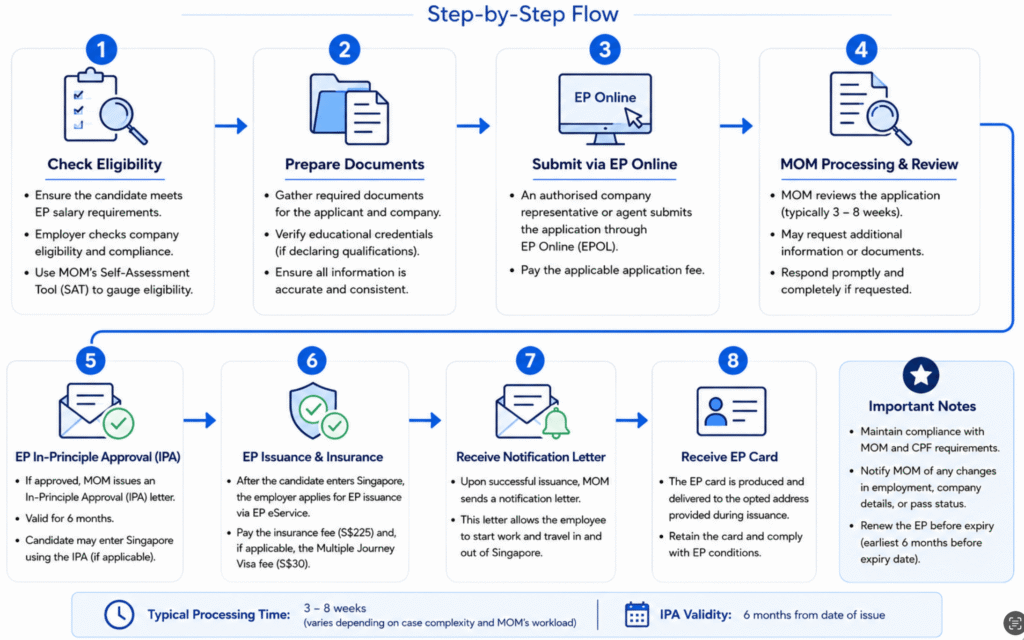
    Step 1 – Check Eligibility

    Before starting the application, confirm that both the employer and the candidate meet MOM’s criteria.

    • Use the Self-Assessment Tool (SAT) to estimate eligibility.
    • Ensure that salary, qualifications, and company profile align with the declared job.

    If the SAT indicates a borderline result, it is still possible to proceed, but additional justification may be required later.

    Step 2 – Prepare Documents

    Gather all required documents, including:

    • ACRA Business Profile of the employer.
    • Passport biodata page.
    • Educational certificates and verification reports.
    • Employment history and curriculum vitae.
    • Signed employment contract and detailed job description.

    All documents should be clear, consistent, and in English. Translations must be certified.

    Step 3 – Submit via EP Online (EPOL)

    Only authorised company representatives or appointed employment agencies may submit the EP application through the EP Online portal. Independent submissions by applicants are not allowed.

    When completing the form, ensure that:

    • The company’s information matches the latest ACRA records.
    • The salary stated in the form corresponds to the employment contract.
    • The job title accurately reflects the applicant’s duties.

    Step 4 – Wait for Processing

    Processing normally takes between three and eight weeks, depending on MOM’s workload and the complexity of the case. Some applications are referred for further checks, particularly those involving newly incorporated companies or foreign-owned entities.

    Step 5 – Respond to MOM Requests

    If MOM requires clarification or additional documents, respond promptly.

    Applicants cannot submit extra documents voluntarily at the start of the process. Only provide materials once MOM requests them. A timely and complete response often determines whether the application proceeds smoothly or faces further delay.

    Step 6 – Receive the In-Principle Approval (IPA)

    When the application is approved, MOM issues an In-Principle Approval (IPA) letter.

    The applicant may enter Singapore on this basis and complete formalities such as fingerprint registration.

    The IPA is valid for six months from the date of issue.

    Step 7 – Card Issuance and Follow-Up

    After the Employment Pass is approved and the applicant has entered Singapore, the employer arranges the pass issuance through MOM’s EP eService.

    The issuance fee is S$225 per pass, with an additional S$30 for a Multiple Journey Visa if applicable.

    Once issued, a notification letter is sent by email. It allows the holder to begin work and travel in and out of Singapore while waiting for the card.

    If biometrics registration is required, the applicant will receive instructions for an appointment at the MOM Services Centre.

    After the appointment, the card is typically delivered to the company’s registered address shortly thereafter.

    It is advisable to keep copies of the In-Principle Approval (IPA) letter, issuance notification, and card details for company records and future renewals.

    While the EP application follows a structured process, most delays arise from misaligned salary declarations, weak job scopes, or incomplete responses to MOM.

    Back to top ↑

    Renewals and Salary Adjustments for EP Holders

    Employment Pass renewals are assessed with the same level of scrutiny as new applications. The earliest you can submit a renewal is six months before the pass expiry, and it should be filed before the existing pass lapses to avoid cancellation.

    Renewal refusals are increasingly common where salary progression or company substance is unclear. You may find it useful to review how we resolved an Employment Pass renewal lapse and secured approval.

    1 – Salary Progression

    If your salary has remained unchanged for several years, MOM may question whether your role has evolved. Demonstrate growth through reasonable salary increases, expanded duties, or additional responsibilities.

    2 – Company Track Record

    Employers should ensure that their financial statements, local employment ratios, and CPF contributions remain consistent and compliant.

    If the company’s turnover has declined or remained low, provide supporting context such as:

    • Temporary market conditions.
    • Investments or restructuring that affected cash flow.
    • New contracts or expansion plans that show improving revenue.

    Providing a clear explanation helps MOM understand the long-term sustainability of the business.

    3 – Education Verification

    From 2023 onwards, all Employment Pass renewals that declare educational qualifications must include verification reports from a MOM-approved third-party agency.

    If you do not wish to declare qualifications, verification is not required — but declaring verified education can strengthen your renewal, particularly for applicants under the COMPASS framework.

    4 – Supporting Documents

    While most renewals do not require re-uploading all original documents, MOM may request updated materials such as financials, job descriptions, or payslips. Respond promptly to such requests to prevent processing delays.

    5 – Change of Employer

    Employment Passes are not transferable.

    If you intend to move to a new employer, a fresh EP application must be submitted and approved before you can commence employment with the new company.

    Back to top ↑

    Common Reasons EP Applications Are Rejected(Even When Salary Is High)

    Even strong applicants sometimes face rejections due to small inconsistencies. Understanding common pitfalls can help prevent this.

    For a fuller breakdown of refusal scenarios, appeal timing, and what employers should do after a rejection, see our guide on Employment Pass rejection in Singapore.

    Salary-to-Role Mismatch

    When the declared salary appears disproportionate to the job scope, MOM may view it as an attempt to meet the threshold artificially. Explain the salary level with context, such as regional responsibility or niche expertise.

    Insufficient Company Substance

    For newly incorporated businesses, lack of operational activity is a frequent cause of rejection. Include evidence of funds, revenue, and a credible plan for local hiring.

    Unverified Qualifications

    If educational documents are not verified through a MOM-approved agency, the application may be delayed or refused.

    Incomplete Forms or Errors

    Minor mistakes in names, passport numbers, or dates can lead to rejection. Cross-check every field carefully before submission.

    Weak COMPASS Score

    A total score below 40 points typically results in rejection unless other exceptional factors exist. Use the Self-Assessment Tool and review diversity or local employment ratios before re-applying.

    Low or Zero Turnover

    If a company reports very low or no turnover, MOM may question its ability to support the applicant’s salary. Provide evidence such as investor funding, recent capital injection, or signed contracts that demonstrate financial capacity and genuine business activity. Without such proof, applications are often rejected for lack of operational substance.

    If your EP is rejected, you may file up to two appeals within three months of the decision. The appeal should directly address MOM’s stated reasons and include clarifying documents.

    Where an application has been rejected due to COMPASS or employer profile issues, an appeal requires a different strategy from the original submission.

    Back to top ↑

    Singapore maintains strict standards for employment practices. Employers must comply with MOM’s requirements at all times.

    • Record-Keeping: Keep employment contracts, salary payment records, and CPF filings for at least five years.
    • Notification of Changes: Inform MOM promptly of any change in company name, address, or ownership.
    • Pass Cancellation: If employment ends, cancel the EP within one week of the final working day.
    • Dependants: Ensure that Dependant Pass holders linked to the main EP holder are updated accordingly.
    • False Declarations: Submitting inaccurate information can result in debarment for both employer and applicant.

    Compliance is not merely about avoiding penalties; it also builds a solid reputation with MOM, which strengthens future applications.

    Back to top ↑

    EP vs Other Singapore Work Passes

    Type of Pass Key Eligibility Duration Renewability Typical Use
    Employment Pass (EP) Degree-qualified professionals earning ≥ S$5,600 / S$6,200 (financial sector) Up to 2 years (first issue) Renewable for 3 years Professionals, managers, executives
    S Pass Mid-level skilled staff earning ≥ S$3,150 Up to 2 years Renewable Technicians, supervisors
    Personalised Employment Pass (PEP) High-earning EP holders or overseas professionals earning ≥ S$270,000 per year 3 years Non-renewable Flexibility to change employers
    ONE Pass Top-tier global talent earning ≥ S$30,000 per month 5 years Renewable Senior leaders, entrepreneurs
    Letter of Consent (LOC) Eligible Dependant Pass or LTVP holders operating a registered business Up to 2 years Renewable Small business owners
    EntrePass Innovative start-up founders supported by accredited partners 1 year initially Renewable Venture-backed or tech entrepreneurs

    Back to top ↑

    Practical Tips from an Immigration Lawyer

    Accuracy Is Everything

    Inconsistencies across ACRA filings, job titles, and salary declarations are among the most common triggers for rejection. Double check every document.

    Avoid Over Explaining

    Provide concise evidence rather than lengthy narratives. MOM officers prefer clear, factual presentation.

    Do Not Rush New Companies

    For newly incorporated businesses, it is advisable to wait until basic operations are in place before applying. This includes opening a corporate bank account, defining your products or services, and establishing your target market. MOM assesses whether the business is genuinely operational, so even minimal activity such as signed service agreements, invoices, or supplier contracts strengthens credibility.

    Think Strategically Before Appeals

    Appeals should only be filed after identifying the specific reason for rejection. Submitting the same documents again rarely changes the outcome.

    Invest in Proper Verification

    Unverified qualifications or unsubstantiated salary figures undermine credibility. Always ensure documentation supports each claim.

    Communicate Transparently

    Explain rather than conceal gaps, whether in employment history or business performance. MOM values honesty, context, and a clear narrative that aligns with supporting documents.

    Back to top ↑

    Final EP Checklist Before You Apply

    Before submitting an Employment Pass application, confirm the following:

    • The applicant’s fixed monthly salary meets or exceeds MOM’s prevailing threshold.
    • The company’s financials, paid-up capital, or funding are sufficient to support the declared salary.
    • All educational qualifications have been verified through a MOM-approved agency.
    • The job description accurately reflects the declared position and responsibilities.
    • All supporting documents are clear, consistent, and in English.
    • No additional documents are uploaded unless MOM specifically requests them.
    • The company is compliant with CPF contributions, levy payments (where applicable), and ACRA registration details are up to date.
    • The COMPASS score is at least 40 points, or the applicant meets exemption criteria.
    • The application has been thoroughly cross checked for spelling, figures, and data accuracy.

    Completing this checklist before submission greatly reduces the risk of delay or rejection.

    Back to top ↑

    Employment Pass Frequently Asked Questions

    1. How long does it take to process an Employment Pass?

    Processing usually takes three to eight weeks, depending on the case complexity and MOM’s workload.

    2. Can I apply for my own Employment Pass as a business owner?

    Yes. A foreign-owned Private Limited company can sponsor its director or shareholder for an Employment Pass if it shows active business operations and the ability to pay the declared salary.

    3. Can I work while waiting for approval?

    No. You may only commence work after receiving the In-Principle Approval and collecting the EP card.

    4. What happens if my application is rejected?

    You may appeal within three months, but the correct next step depends on the reason for refusal. In some cases, a stronger reapplication may be more appropriate than an appeal. You may also wish to read our guide on Employment Pass rejection in Singapore for a fuller explanation of what to do next.

    5. How do renewals work?

    Renewals are reviewed as thoroughly as new applications. Submit them up to six months before expiry and ensure salary progression is justified.

    6. Can I change employers?

    Yes, but the new employer must file a fresh Employment Pass application before you begin work with them.

    7. Can Dependant Pass holders work instead of applying for an Employment Pass?

    In some cases, yes.

    Dependant Pass (DP) holders are not allowed to work in Singapore by default, but certain DP holders may be eligible to work legally by applying for a Letter of Consent (LOC) instead of an Employment Pass.

    This route is commonly used where a DP holder operates a registered business or works under specific arrangements permitted by MOM. For some individuals, particularly those whose role or income does not meet Employment Pass thresholds, the LOC can be a more appropriate option.

    You can learn more about this pathway in our guide on how Dependant Pass holders can start working legally in Singapore under a Letter of Consent (LOC).

    8. Does holding an Employment Pass help with Singapore PR or Citizenship later?

    Holding an Employment Pass does not guarantee Permanent Residency or Citizenship, but it is often the starting point ICA uses to assess long-term contribution and integration.

    Through an Employment Pass, ICA is able to assess factors such as employment stability, income level, economic contribution, length of stay, and overall integration into Singapore. Many PR and citizenship applicants first establish their profile in Singapore through an EP before applying for permanent status.

    If your longer-term goal is to settle in Singapore, you may wish to review our step-by-step guide on how to apply for Singapore Permanent Residency, which explains how ICA evaluates applications beyond work pass status alone.

    How does COMPASS affect Employment Pass approval?

    Most Employment Pass applications are now assessed under the COMPASS framework, which considers salary competitiveness, qualifications, workforce diversity, and support for local PMET employment. You may also refer to our guide on the COMPASS framework for Employment Pass approval in Singapore for a clearer breakdown.

    Back to top ↑

    Book a Consultation

    If you would like structured guidance on Singapore work pass applications, including Employment Pass eligibility, COMPASS positioning, renewals, and appeals, you may refer to our Singapore work pass services.

    If you are planning to apply for an Employment Pass, whether as an employer hiring foreign talent or as a business owner managing your company in Singapore, a brief discussion at the outset can help avoid delays and missteps.

    You may book a 20-minute consultation to clarify eligibility, application readiness, or renewal considerations.

    If you are already holding an Employment Pass and exploring longer-term stability in Singapore, you may also wish to review our step-by-step guide on how to apply for Singapore Permanent Residency.

    Back to top ↑

    Sulochana Uthirapathi, Singapore Immigration Lawyer and Founder of Transform Borders

    About the Author: Sulochana Uthirapathi is the Founder of Transform Borders, a Singapore immigration consultancy established in 2017. She specialises in Employment Pass (EP), Permanent Residency (PR) and Citizenship applications, supporting professionals, families and corporate clients with legally guided and structured immigration processes.


  • How to Apply for a Letter of Consent (LOC) in Singapore

    How to Apply for a Letter of Consent (LOC) in Singapore

    Written by: Sulochana Uthirapathi  |  Last updated: January 2026

    Summary

    A Letter of Consent (LOC) is a work authorisation issued by Singapore’s Ministry of Manpower that allows eligible Dependant Pass and Long-Term Visit Pass holders to work or operate a business in Singapore without applying for a separate work pass.

    It is commonly used by Dependant Pass holders and spouses of Singapore citizens or Permanent Residents, and approval depends on pass type, business or employment structure, and ongoing compliance with MOM conditions.

    In practice, the Letter of Consent is most relevant to Dependant Pass holders and certain Long-Term Visit Pass holders who wish to work or operate a business in Singapore but do not qualify for an Employment Pass.

    Unlike an Employment Pass, the LOC does not confer independent work rights. It is tied to an existing Dependant Pass or LTVP and remains valid only as long as the underlying pass is in force.

    While the LOC does not impose a minimum salary requirement, approval is not automatic. Applications are assessed based on the underlying pass type, the proposed business or employment structure, and ongoing compliance with Ministry of Manpower conditions.

    This guide does not cover Work Permit applications for semi-skilled roles or short-term visit passes, which are assessed under different frameworks.

    Use the table of contents below to jump to the scenario that applies to you.

    Table of Contents

    1. What Is a Letter of Consent (LOC) in Singapore?
    2. Who the LOC Is For (and Who It Is Not)
    3. Types of LOC in Singapore
    4. LOC vs Employment Pass: Which Is More Suitable?
    5. Applying for an LOC as an LTVP / LTVP+ Holder
    6. Applying for an LOC as a Dependant Pass Holder (Business Owners)
    7. Applying for an LOC for Secondary Directorships
    8. Renewal Rules, Local Hiring Requirements, and Common Pitfalls
    9. Frequently Asked Questions
    10. Professional Tips for a Successful LOC Application
    11. Book a Consultation
    At a glance

    A Letter of Consent is not a visa and not an Employment Pass alternative. It is a dependent-based work authorisation tied to an existing pass, with strict limits on who can apply, what work is permitted, and how renewals are assessed.

    1. What is a Letter of Consent (LOC)?

    A Letter of Consent (LOC) is a work authorisation issued by Singapore’s Ministry of Manpower that allows eligible Dependant Pass and Long-Term Visit Pass holders to work or operate a business in Singapore, subject to strict conditions.

    The LOC is most commonly used by Dependant Pass holders who wish to start or operate a business in Singapore, as well as spouses of Singapore citizens or Permanent Residents holding an LTVP or LTVP+.

    For broader context on how Singapore’s workforce policies and dependent work arrangements are evolving, you may also find our Singapore Immigration Trends 2025–2026 report useful.

    Key Benefits of an LOC:

    • Work Legally in Singapore: The LOC grants you the legal right to work under Singaporean law without needing a separate work pass.
    • Run a Business: Dependant’s Pass holders can operate businesses in Singapore.
    • No Minimum Salary Requirement: Unlike other work passes, the LOC does not have any qualifying salary criteria.

    Back to top

    2. Who the LOC Is For (and Who It Is Not)

    A Letter of Consent (LOC) is not a general work authorisation. If you do not already hold a Dependant Pass, LTVP/LTVP+, or an Employment Pass in a secondary directorship scenario, you cannot apply for a Letter of Consent.

    You may be eligible to apply for a Letter of Consent (LOC) in Singapore if you fall into one of the following categories:

    • LTVP or LTVP+ holders who are spouses or unmarried children of a Singapore Citizen or Permanent Resident, and who have been granted (or are eligible for) work authorisation under MOM or ICA frameworks.
    • Dependant’s Pass holders whose sponsor holds a valid Employment Pass, S Pass, Personalised Employment Pass (PEP), or Overseas Networks and Expertise (ONE) Pass, and who meet MOM’s conditions for permitted work or business activity.
      If you are a Dependant Pass holder looking to work or run a business in Singapore, you may find our guide on how Dependant Pass holders can start working legally with a Letter of Consent useful.
    • Employment Pass holders who are taking up a secondary directorship in a related Singapore-registered company, subject to MOM approval.

    In all cases, work may only commence after the Letter of Consent has been approved and the employer or company has been notified by MOM. Starting work before approval is considered a breach of pass conditions.

    Back to top

    3. Types of Letter of Consent

    There are three main types of LOC, depending on your status in Singapore:

    1. LOC for ICA-Issued LTVP or LTVP+ Holders

    Certain Long-Term Visit Pass (LTVP or LTVP+) holders may be issued a Pre-approved Letter of Consent (PLOC) when applying for or renewing their pass with the Immigration & Checkpoints Authority (ICA).

    According to MOM, the PLOC is intended for spouses and unmarried children (under 21 years old) of Singapore Citizens or Permanent Residents who hold an LTVP or LTVP+ and wish to work in Singapore.

    Key points to note:

    • The PLOC is employment-only and does not permit self-employment or business ownership
    • The PLOC is issued together with the LTVP or LTVP+, not as a standalone application
    • Before employment starts, the employer must notify MOM
    • The PLOC is tied to the validity of the underlying LTVP or LTVP+

    Eligibility for a PLOC is assessed by ICA at the point of LTVP or LTVP+ application or renewal and is subject to prevailing immigration policies.

    If a Pre-approved Letter of Consent (PLOC) is not granted at the point of LTVP or LTVP+ application or renewal, the LTVP holder is not permitted to work by default. In such cases, work authorisation may still be possible, but the LOC must be applied for separately by a Singapore employer through MOM’s EP eService, subject to eligibility and approval.

    For families navigating work eligibility under LTVP or LTVP+ arrangements, our Singapore family and LTVP services outline how eligibility, sponsorship, and work permissions are typically assessed.

    2. LOC for Dependant’s Pass Holders

    Dependant’s Pass holders sponsored by work pass holders may also apply for an LOC, but the scope of permitted activity depends on the sponsor’s pass type.

    Business-Related LOCs (All DP Holders)

    For Dependant’s Pass holders who wish to operate a business, the same LOC business rules apply regardless of the sponsor’s pass type.

    This includes Dependant’s Pass holders sponsored by:

    • Employment Pass (EP) holders
    • S Pass holders
    • Personalised Employment Pass (PEP) holders
    • Overseas Networks and Expertise (ONE) Pass holders

    In these cases, the LOC is typically structured through:

    • Sole proprietorships
    • Partnerships
    • Company directorships with at least 30 percent shareholding

    Business-based LOCs are assessed based on business structure, operational substance, and compliance with MOM’s renewal conditions.

    Employment-Based LOCs (Limited Category)

    A key distinction applies when the LOC is intended for employment rather than business ownership.

    Only Dependant’s Pass holders sponsored by ONE Pass holders may apply for an LOC to work for an employer.

    Dependant’s Pass holders sponsored by EP, S Pass, or PEP holders are generally not permitted to take up employment under an LOC and are restricted to business-related LOC arrangements.

    This distinction is important, as applying under the wrong structure may lead to rejection or compliance issues.

    3. LOC for Secondary Directorships

    Employment Pass holders who wish to take on a secondary directorship in a related Singapore company must apply for a Letter of Consent before assuming any director duties.

    In this context, directorship responsibilities are treated as work under Singapore law, even if no salary is drawn. The LOC is therefore required to ensure compliance with Employment Pass conditions.

    To be eligible:

    • The secondary company must be related to the EP holder’s primary employer through shareholding or corporate structure, as reflected in ACRA records.
    • The primary employer must have no objection to the EP holder taking on the additional role.
    • The directorship duties must be aligned with the EP holder’s existing role and expertise.

    MOM assesses whether the secondary appointment creates conflicts of interest, dilutes the primary employment role, or circumvents work pass controls. Applications that lack clear corporate linkage or commercial rationale are commonly rejected.

    If the directorship is unrelated or involves active business operations beyond board-level oversight, alternative pass options may need to be considered.

    In secondary directorship cases, the LOC functions as a compliance approval rather than a standalone work authorisation.

    In some cases, an Employment Pass or EntrePass may be more appropriate depending on the nature of the role, business structure, or level of operational involvement. You may wish to review our guides on applying for an Employment Pass in Singapore or the EntrePass eligibility and application process for founders.

    Important: Each LOC scenario is assessed under a different legal framework. Rejections and renewal issues commonly arise where the proposed work or business structure does not align with what is permitted for the applicant’s underlying pass type.

    Back to top

    4. LOC vs Employment Pass: Which Is More Suitable?

    Not sure which route applies to you?

    LOC and Employment Pass applications are assessed under different legal frameworks. Choosing the wrong route can result in rejection or restructuring delays.

    The comparison below highlights the key differences.

    Feature Letter of Consent (LOC) Employment Pass (EP)
    Who it is for Dependant Pass or LTVP / LTVP+ holders Foreign professionals without dependent status
    Tied to an existing pass Yes No
    Minimum salary requirement No Yes, subject to MOM criteria
    Typical structure Business ownership or limited employment Employer-sponsored employment
    Assessed by MOM, linked to the underlying pass MOM under the COMPASS framework
    Most suitable for Dependant Pass holders starting businesses or spouses seeking work authorisation Professionals in salaried employment roles

    In short, an LOC is a dependent-based work authorisation, while an Employment Pass is an independent work pass assessed on salary, job scope, and the COMPASS framework.

    In some cases, applicants are unsure whether a Letter of Consent or an Employment Pass is the more appropriate route.

    The two passes are assessed under different frameworks and are not interchangeable.

    In general, a Letter of Consent is suitable for Dependant Pass or LTVP holders who already have residency status in Singapore and wish to work or operate a business without meeting Employment Pass salary thresholds.

    An Employment Pass, on the other hand, is assessed independently based on salary, job scope, COMPASS scoring, and employer sponsorship, and is not tied to an existing Dependant Pass or LTVP.

    Applying under the wrong route can result in rejection, delays, or unnecessary restructuring. Where there is uncertainty, eligibility should be assessed carefully before proceeding.

    You may find it helpful to review our step-by-step guide on how to apply for an Employment Pass in Singapore for a clearer comparison.

    Back to top

    5. Applying for a Letter of Consent (LOC) for LTVP/LTVP+ Holders

    If you are a Long-Term Visit Pass holder issued by the Immigration & Checkpoints Authority (ICA), you can apply for an LOC to work in Singapore, provided you meet the eligibility requirements.

    The LOC application must be submitted by a Singapore-registered company or an authorised employment agent on behalf of the LTVP or LTVP+ holder.

    If a Pre-Approved Letter of Consent (PLOC) is issued together with the LTVP or LTVP+ by ICA, the holder may take up employment without applying separately for an LOC.

    Where a PLOC is not granted, the employer must apply for an LOC through MOM before the LTVP or LTVP+ holder can start work.

    Step-by-Step Application Process:

    1. Written consent from the candidate: Ensure that the candidate (LTVP/LTVP+ holder) provides written consent to apply for the LOC.
    2. Login to EP eService: The employer should log in EP eService to submit the application.
    3. Update turnover information: Ensure that the company’s turnover information for the past three years is updated before submitting the LOC application.
    4. Submit required documents: Upload the necessary documents and fill out the online application.
    5. Processing time: Expect a processing time of one week. If additional documents are required, processing may take longer.
    6. Receive approval: Once approved, the employer will receive an email confirming the LOC approval, and the candidate can start working.

    Documents Required for Specific Professions:

    If the candidate is in certain professions, such as healthcare or law, additional documents are required. For non-English documents, a certified translation must be submitted along with the original document.

    Back to top

    6. Applying for a Letter of Consent (LOC) for Dependant’s Pass Holders

    For many Dependant Pass holders, the Letter of Consent is the most practical and lawful way to work in Singapore, especially where traditional employment options are limited or employers are reluctant to sponsor an Employment Pass.

    In most cases, the LOC for Dependant Pass holders is structured through business ownership rather than employment.

    Eligibility for LOC for DP Holders Who Are Business Owners:

    To be eligible to apply for an LOC, you must be one of the following types of business owners:

    1. The sole proprietor of an ACRA-registered business.

    2. A partner of an ACRA-registered business.

    3. A company director with at least 30% shareholding in an ACRA-registered business.

    Renewal eligibility requirements:

    For LOC renewals, business-owning Dependant Pass holders must continue to meet MOM’s local employment and CPF contribution requirements, including:

    • Hire at least one Singaporean or Permanent Resident who earns at least the prevailing Local Qualifying Salary.
    • Ensure that the local employee has received CPF contributions for at least three months before applying for the LOC renewal.

    Failure to meet these renewal conditions can result in the LOC not being renewed, even if the business remains operational.

    Dependant Pass holders sponsored by Overseas Networks & Expertise (ONE) Pass holders may also be eligible to work under an LOC in an employment capacity, subject to MOM approval.

    Application Process for Business Owners:

    If you’re a Dependant’s Pass holder looking to operate a business:

    1. Check Dependant’s Pass validity: Ensure that the Dependant’s Pass is valid for at least three months.
    2. Submit an online request: Request to apply for the LOC through EP eService or engage an employment agent to submit on your behalf.
    3. Update business turnover: Ensure that your business’ turnover information is up-to-date.
    4. Processing time: It takes approximately four weeks to process most applications.
    5. Receive approval: If the LOC is approved, you will receive an email outcome with instructions to proceed.

    Because LOC applications for Dependant Pass holders are closely scrutinised, especially for business ownership structures and renewals, many applicants choose to work with an experienced Singapore immigration lawyer or a professional immigration agency to ensure compliance and reduce delays.

    If you are considering a Letter of Consent as a Dependant Pass holder — particularly for business ownership or renewal — it can be helpful to confirm eligibility, structure, and timing before submitting an application.

    You may book a complimentary 20-minute consultation with Transform Borders to review your circumstances and clarify the most appropriate next steps for your LOC application or renewal.

    Back to top

    7. Applying for a Letter of Consent (LOC) for Secondary Directorship

    Another important category of LOC applies to Employment Pass holders who are appointed as directors in a related Singapore company. If you are considering appointing an Employment Pass holder to your Board of Directors, they must have an LOC, as directorship duties are considered work under Singapore’s Companies Act.

    For Employment Pass holders, a Letter of Consent for a secondary directorship is a compliance approval, not a general work authorisation.

    Eligibility for Secondary Directorship LOC:

    1. Related Company: The company appointing the director must be related to the Employment Pass holder’s primary employer by shareholding, and this relationship must be reflected in ACRA’s records.

    2. No Objections: The Employment Pass holder’s primary employer must have no objections to them taking up the secondary directorship.

    3. Primary Employment Related: The directorship role must be related to the Employment Pass holder’s primary job.

    Application Process:

    1. Check Eligibility: Ensure your company and the Employment Pass holder’s employer are related through shareholding.
    2. Obtain Employer Consent: Ensure that the primary employer provides written consent for the Employment Pass holder to take on this directorship.
    3. Submit Application: You must submit the LOC application through EP e-service to gain approval.
    4. Register Directorship: Once approved, you can proceed to register the directorship with ACRA.

    Because secondary directorship LOC applications often involve coordination between companies, directors, and MOM requirements, you may also find our overview of immigration agency services in Singapore useful when assessing compliance and application scope.

    Back to top

    8. Renewal Rules, Local Hiring Requirements, and Common Pitfalls

    While the initial Letter of Consent application is often straightforward, renewal requirements are where many applicants encounter difficulties. MOM assesses renewals more closely, particularly where the LOC is tied to business ownership.

    Timing matters. Most LOC renewal issues arise not from business failure, but from timing. Local hiring and CPF contributions must be in place before the renewal application is submitted, not after.

    Renewal rules for business-related LOCs

    For Dependant Pass holders operating a business under an LOC, renewal is not automatic. MOM will typically assess whether the business has demonstrated genuine economic activity and local contribution.

    Key renewal considerations include:

    • The business must be active and properly registered with ACRA.
    • Turnover information should be updated and consistent with the nature of the business.
    • At least one Singapore citizen or Permanent Resident must be employed and paid at or above the prevailing Local Qualifying Salary.
    • CPF contributions for the local employee must have been made for the required period prior to renewal.

    Failure to meet local hiring conditions is one of the most common reasons LOC renewals are delayed or not approved.

    Local hiring requirements: timing matters

    Local employment requirements are assessed before renewal submission. Hiring a local employee shortly before applying, or making CPF contributions only after renewal is submitted, may not satisfy MOM’s expectations.

    Planning ahead is critical. Business owners should ensure that local hiring and CPF compliance are in place well before the LOC renewal window opens.

    Common pitfalls to avoid

    Applicants frequently encounter issues due to:

    • Treating the LOC as a one-time approval rather than an ongoing compliance arrangement.
    • Inconsistent information between ACRA records, MOM declarations, and business activity.
    • Assuming that business incorporation alone is sufficient for renewal.
    • Delaying renewal preparations until the Dependant Pass or LOC is close to expiry.

    In some cases, lapses in compliance can result in LOC cancellation or difficulties renewing the underlying Dependant Pass. Understanding renewal conditions early helps avoid unnecessary disruptions to your work or business activities in Singapore.

    Back to top

    8. Frequently Asked Questions (FAQs)

    How long does it take to process a Letter of Consent (LOC) application?

    Processing times vary depending on the applicant’s pass type and circumstances. In most cases, LOC applications for LTVP or LTVP+ holders are processed within about one week. Applications for Dependant Pass holders, particularly those involving business ownership, typically take up to four weeks. Additional checks or document requests may extend processing time.

    Can Dependant Pass holders operate a business in Singapore with an LOC?

    Yes. Dependant Pass holders may apply for an LOC to operate a business in Singapore, provided they meet MOM’s ownership and control requirements. In practice, this usually means operating as a sole proprietor, partner, or company director with at least 30 percent shareholding.

    For a practical walkthrough of how DP holders legally start work through this route, see our guide on how Dependant Pass holders can start working in Singapore under an LOC.

    Can Dependant Pass holders work as employees under an LOC instead of running a business?

    In most cases, Dependant Pass holders sponsored by Employment Pass or S Pass holders are only permitted to work through a business-related LOC structure, not as employees.

    An exception may apply to Dependant Pass holders sponsored by Overseas Networks & Expertise (ONE) Pass holders, where employment under an LOC may be allowed subject to MOM approval.

    What documents are required for an LOC application?

    Required documents depend on the applicant’s status and proposed activity. Common documents include business registration records, proof of shareholding or directorship, and details of the proposed work or business activities. Certain regulated professions may require additional supporting documents or registrations.

    Can an LOC be renewed, and what are the renewal requirements?

    Yes. LOCs can generally be renewed, particularly for business owners. Renewal eligibility usually requires the business to demonstrate local hiring support, including employing at least one Singapore citizen or Permanent Resident earning the prevailing Local Qualifying Salary, with CPF contributions made for at least three months prior to renewal.

    You may find it helpful to review our case study on Employment Pass renewal and compliance issues, which illustrates how renewal considerations are assessed in practice.

    Does holding a Letter of Consent (LOC) lead to PR or Citizenship later?

    No. A Letter of Consent is a work authorisation, not a residency pathway.

    Holding an LOC does not make a Dependant Pass or LTVP holder independently eligible for Permanent Residency or Citizenship.

    PR eligibility is assessed by ICA based on the applicant’s own qualifying status (such as holding an Employment Pass or being included under a main applicant’s PR application). Citizenship is assessed separately and only after PR is granted.

    Does holding an LOC help with Singapore PR or Citizenship applications later?

    An LOC does not automatically lead to Permanent Residency or Citizenship. However, long-term compliance, business sustainability, local employment contribution, and tax records can form part of the broader profile ICA reviews in future applications.

    If you are thinking ahead, our step-by-step guide on applying for Singapore Permanent Residency explains how work history and economic contribution are evaluated over time.

    For those planning a long-term future in Singapore beyond PR, our guide on applying for Singapore Citizenship outlines the additional residency, integration, and contribution factors ICA considers at the final stage.

    What happens if I start work before my LOC is approved?

    Working before LOC approval is a breach of pass conditions.
    Starting work before the LOC is formally approved is not permitted and may result in compliance issues affecting future applications. Work should only commence after MOM approval has been issued and, where applicable, the employer has completed the required notification.

    What are the risks of an LOC being cancelled or not renewed?

    An LOC may be cancelled or not renewed if MOM determines that the underlying conditions are no longer met. Common risk factors include changes to the Dependant Pass or LTVP status, failure to meet local hiring requirements for business-related LOCs, non-compliance with declared business activities, or inconsistencies between the approved scope and actual work performed.

    LOC holders should ensure ongoing compliance and review renewal requirements well in advance of expiry to avoid disruption.

    What are common mistakes when choosing between an LOC and an Employment Pass?

    A common mistake is assuming that an LOC and an Employment Pass are interchangeable. The two passes are assessed under different frameworks.

    An LOC is tied to an existing residency pass and is often structured through business ownership, while an Employment Pass is assessed independently based on salary, job scope, COMPASS scoring, and employer sponsorship. Applying under the wrong route can result in rejection, delays, or unnecessary restructuring. Understanding which option aligns with your status and long-term plans is critical before applying.

    Back to top

    9. Tips for a Successful LOC Application

    Keep your records current

    Ensure that business turnover information, ACRA records, and supporting documents are accurate and up to date before submission. Inconsistencies or outdated information are a common cause of processing delays.

    Plan ahead

    Apply for the Letter of Consent well in advance of your intended work or business start date. While processing timelines are generally predictable, additional document requests can extend the overall timeframe.

    Understand renewal conditions early

    For business-related LOC renewals, local hiring requirements must be met in advance. Ensure that at least one Singapore citizen or Permanent Resident has received CPF contributions for the required period before submitting a renewal application.

    Seek guidance for complex situations

    Where applications involve business ownership, renewals, or secondary directorships, professional guidance can help ensure that applications are structured correctly and remain compliant with MOM requirements.

    If you are exploring alternative work authorisation options beyond the LOC, such as greater employment flexibility or future mobility, you may also wish to review our guide on the Personalised Employment Pass (PEP) in Singapore.

    Back to top

    Book a Consultation

    If you would like structured guidance on work authorisation options in Singapore, including Letters of Consent, Employment Pass alternatives, and compliance considerations, you may refer to our Singapore work pass services.

    If you are considering a Letter of Consent, whether as a Dependant Pass holder, LTVP or LTVP+ holder, or a company appointing a secondary director, it can be helpful to clarify eligibility, structure, and timing before proceeding.

    You may book a consultation for a complimentary 20-minute discussion to review your circumstances and outline the most appropriate next steps for your LOC application or renewal.

    Back to top

    Sulochana Uthirapathi, Singapore Immigration Lawyer and Founder of Transform Borders

    About the Author: Sulochana Uthirapathi is the Founder of Transform Borders, a Singapore immigration consultancy established in 2017. She specialises in Employment Pass (EP), Permanent Residency (PR) and Citizenship applications, supporting professionals, families and corporate clients with legally guided and structured immigration processes.

  • A Step-by-Step Guide to Applying for Singapore Citizenship

    A Step-by-Step Guide to Applying for Singapore Citizenship

    Written by: Sulochana Uthirapathi  |  Last updated: January 2026

    This guide explains how Singapore citizenship applications are assessed, who may qualify, and the key considerations around timing, National Service obligations, and long-term commitment. It is intended for Singapore Permanent Residents, families applying through sponsorship schemes, and individuals seeking clarity before taking this significant step.

    What is Singapore Citizenship?

    Unlike Permanent Residency, Singapore citizenship carries long-term legal, civic, and National Service obligations. Applicants are assessed not only on economic contribution, but also on integration, family ties, and long-term commitment to Singapore.

    Singapore citizenship grants you the full legal status of a Singaporean, including the right to reside permanently in the country, participate in civic life such as voting, and access government benefits, subsidies, and unrestricted employment opportunities across both the public and private sectors.

    Back to top ↑

    Why Apply for Singapore Citizenship?

    Here are some of the key benefits of becoming a Singaporean citizen:

    • Healthcare: Enjoy access to world-class healthcare services at subsidised rates.
    • Education: Citizens are given priority in school placements and can access government financial aid and scholarships.
    • Travel Freedom: The Singapore passport is one of the strongest globally, offering visa-free or visa-on-arrival access to numerous countries.
    • Housing: Citizens are eligible for various housing grants and public housing options, making it easier to own a home in Singapore.
    • Government Support: Access government subsidies for medical care, housing, and education.

    By following the steps outlined below, you can confidently apply for Singapore citizenship and enjoy these benefits.

    Back to top ↑

    Eligibility for Singapore Citizenship

    To apply for Singapore citizenship, you must meet one of the following eligibility requirements:

    a) Singapore Permanent Residents (PRs) Aged 21 and Above

    • You must have been a PR for at least two years.
    • You can include your spouse and unmarried children under 21 (born within a legal marriage or legally adopted) in your application.

    If you’re holding a work pass like an Employment Pass and considering taking the next step toward citizenship, you might also find our step-by-step guide on how to apply for Permanent Residency helpful before planning your citizenship application.

    b) Spouse of a Singapore Citizen

    • You must have been a PR for at least two years and married to a Singapore citizen for at least two years.
    • Your Singaporean spouse must sponsor your application by logging into the ICA e-Service portal using SingPass.

    c) Unmarried Child Below 21

    • You must be born to a Singapore citizen within a legal marriage or legally adopted by a Singapore citizen.
    • The application must be submitted by your Singapore citizen parent.

    d) PR Student Studying in Singapore

    • You must have resided in Singapore for over three years, including one year as a PR.
    • You must have passed at least one national exam (PSLE, GCE ‘N’/‘O’/‘A’ levels) or be in the Integrated Programme (IP).
    • If you are aged 15 and above, you can apply using SingPass. Applicants below 15 can apply through the non-SingPass option.

    e) Aged Parent of a Singapore Citizen

    • You are a PR and an aged parent of a Singapore citizen. Your citizen child will need to sponsor your application.

    Important Factors Considered by ICA:

    Citizenship applications are assessed holistically. Applicants with complex family profiles, National Service considerations, or cross-border circumstances may benefit from early professional guidance. You can learn more about when to engage an immigration lawyer in Singapore for citizenship and PR matters.

    ICA evaluates your application based on your family ties to Singaporeans, economic contributions, qualifications, age, family profile, length of residency, and your commitment to integrating into Singaporean society.

    In short: Meeting the minimum criteria is not enough. Citizenship outcomes are strongly influenced by timing, profile stability, and how consistently your personal, family, and work circumstances reflect long-term commitment to Singapore.

    For a clearer understanding of how immigration policies and approval trends are evolving, see our Singapore Immigration Trends 2025–2026 Report.

    For full eligibility criteria, visit the official ICA website on Singapore Citizenship.For a detailed breakdown of eligibility factors and documents, see our Singapore citizenship requirements guide.

    Back to top ↑

    Step-by-Step Application Process

    a) Decide Who You Want to Apply For

    You can apply for yourself, your spouse, and any unmarried children under 21. For students and aged parents, a Singapore citizen family member must act as the sponsor.

    If you are applying for yourself, your spouse, or your children and want to ensure a smooth process, you may wish to review when legal guidance may be relevant for citizenship or PR matters.

    b) Gather Required Documents

    Before starting your application, gather the following documents:

    • Identification Documents: Passport, birth certificate, NRIC, marriage certificate.
    • Employment and Financial Information: Payslips, employment letter, income tax returns.
    • Education Documents: Certificates, transcripts, and professional qualifications.
    • Additional Documents: Medical records, financial statements, testimonials, or other supporting documents.

    For the full checklist of required documents, refer to the ICA Citizenship Document Checklist.

    c) Log into ICA e-Service

    Using SingPass, log into the ICA e-Service portal to begin your application. Follow these steps:

    1. Select Applicants: Add your spouse and children if applicable.
    2. Fill in Details: Complete all required fields (marked with an asterisk *) for each applicant.
    3. Upload Documents: Ensure that your documents are in the correct format. All non-English documents must be translated and notarised. The Immigration Checkpoint Authority (ICA) only accepts:
      • Translations by the embassy of the country/place that issued the document.
      • Translations produced by a notary public in Singapore or the country/place that issued the document.

    d) Review and Declare

    After completing the application:

    1. Review Information: Double-check all entries for accuracy.
    2. Send Declarations: All applicants must review and declare their information.
    3. Payment: Pay the application fee of S$100 per applicant (e.g., S$300 for a family of three).
    4. Final Submission: Download a copy of your submitted application and receipt for your records.

    In summary: While the citizenship application process is fully online via ICA’s e-Service, many delays arise not from eligibility issues but from incomplete uploads, inconsistencies, or missed system deadlines. Careful preparation before starting the application is often more important than speed.

    Back to top ↑

    Common Mistakes to Avoid When Applying for Singapore Citizenship

    To ensure a smooth application process and avoid delays, make sure to avoid these common mistakes:

    1. Incomplete or Incorrect Documentation

    Failing to provide complete documentation is a common issue. Make sure all necessary documents, such as employment letters, income tax returns, and education certificates, are submitted and up-to-date.

    For cases where legal expertise may be required, you might find it useful to review our list of top immigration lawyers in Singapore who specialise in citizenship and PR applications.

    For first-time applicants who mainly need help with document collation and submission, some choose to work with a professional immigration agency in Singapore.

    2. Not Meeting Eligibility Requirements

    Many applicants overlook certain eligibility criteria, especially the required length of residency. Confirm your eligibility before applying.

    3. Missing Deadlines

    You have 7 days to complete your application and upload all required documents. Missing this deadline means you’ll have to restart the process.

    4. Incorrect or Outdated Information

    Submitting inaccurate or outdated information can lead to delays or rejection. Double-check all details, especially any changes in employment or address.

    5. Skipping National Service Requirements

    Male applicants who are liable for National Service (NS) must fulfil these obligations. Failure to do so can result in the rejection of the application.

    6. Failing to Renounce Foreign Citizenship

    For applicants aged 21 and above, renunciation of foreign citizenship is mandatory. Start this process early to avoid delays.

    7. Overlooking the Singapore Citizenship Journey (SCJ)

    If you’re aged 16 to 60, completing the Singapore Citizenship Journey (SCJ) is essential after receiving your In-Principle Approval.

    8. Underestimating Processing Times

    The processing time is 12 months for adults and 2 months for children born overseas. Plan your timeline accordingly to avoid unnecessary frustration.

    Before you apply: Singapore citizenship is a permanent legal commitment. For families with sons approaching National Service age, applicants planning overseas relocation, or PRs with recent employment changes, timing and profile readiness can significantly affect outcomes. A well-timed application is often more effective than an early one.

    If you are unsure whether now is the right time, you may speak with an immigration professional before proceeding.

    Back to top ↑

    What Happens After Submission?

    Once your application is submitted, you can track its status through MyICA using SingPass. The processing time for adults is 12 months, and for children born overseas to Singapore citizens, it’s 2 months.

    Applicants who are unsure how ICA evaluates citizenship readiness may also wish to review the official citizenship requirements and assessment criteria before proceeding.

    Singapore’s citizenship policies are updated periodically. For key trends affecting PR and citizenship approvals, see our Singapore Immigration Trends 2025–2026 Report.

    What If My Citizenship Application Is Rejected?

    Not all citizenship applications are approved on the first attempt. Where an application is rejected, ICA does not provide detailed reasons, and reapplication or appeal requires careful assessment of timing, documentation, and changes in circumstances. Before proceeding further, a professional review can help identify gaps and determine whether an appeal or reapplication is appropriate. You may wish to review the process involved in a citizenship or PR application appeal in Singapore.

    Back to top ↑

    Steps After Approval

    1. The Singapore Citizenship Journey (SCJ)

    Applicants aged 16 to 60 years old must complete the Singapore Citizenship Journey (SCJ) after receiving In-Principle Approval (IPA). The SCJ program consists of:

    • e-Journey: An online course to learn about Singapore’s history, culture, and values.
    • Experiential Visit: A visit to key cultural and historical sites in Singapore.
    • Community Sharing Session: Engage with community leaders and other new citizens.

    For more details, visit the official SC Journey Guide.

    2. Renunciation of Foreign Citizenship

    If you hold foreign citizenship, you must renounce it after receiving In-Principle Approval. This applies only to applicants aged 21 and above. Ensure all legal obligations (e.g., property ownership issues) in your home country are settled before renouncing.

    For more information on renouncing foreign citizenship, you may approach the Embassy of your foreign Nationality/Citizenship to enquire on the procedures for renunciation.

    3. National Service Obligations

    All male applicants are required to complete National Service (NS) unless exempted. Male applicants who obtained Singapore citizenship as foreign students or through their parents must fulfil NS obligations upon reaching 18 years old. This includes:

    • Full-Time NS: A commitment of two years.
    • NS Liabilities: Those who fail to fulfil their NS duties cannot renounce their Singapore citizenship.

    For further details, refer to the CMPB NS Requirements.

    4. Citizenship Ceremony

    Once you’ve completed all steps, you will be invited to attend a Citizenship Ceremony, where:

    • You’ll take the Oath of Allegiance.
    • Receive your Singapore Citizenship Certificate.
    • Collect your NRIC (National Registration Identity Card).

    Back to top ↑

    Who Should Carefully Consider Timing Before Applying for Citizenship?

    While eligibility is important, citizenship outcomes are often influenced by timing, profile stability, and long-term plans. Applying at the right stage can materially affect how an application is assessed.

    While Singapore citizenship offers long-term stability and benefits, it also comes with permanent legal, civic, and family obligations. In some situations, timing your application carefully is just as important as eligibility itself.

    Before proceeding, the following profiles should consider their circumstances closely and, where appropriate, seek professional guidance.

    Families with Sons Approaching National Service Age

    National Service (NS) obligations are a critical consideration for families with male children.

    For families applying under family sponsorship routes (such as spouse or child of a Singapore citizen), citizenship approval for a minor male child will typically result in full National Service obligations upon reaching enlistment age.

    For families where the child is already a Singapore Permanent Resident, NS liability may already apply regardless of future citizenship status. In such cases, applying for citizenship does not create the obligation, but it does formalise long-term ties to Singapore.

    Parents should therefore understand:

    • Whether NS obligations already apply due to PR status
    • How citizenship timing may affect future education, relocation, or overseas plans
    • That failure to fulfil NS obligations can have serious consequences for future immigration matters

    Careful planning is especially important for families who are uncertain about long-term residence in Singapore.

    PRs with Recent Job Changes or Employment Instability

    Citizenship applications are assessed holistically, and employment stability remains a key factor.

    Applicants who have:

    • Recently changed employers
    • Experienced gaps in employment
    • Moved into contract, freelance, or self-employment roles

    may wish to allow time for their profile to stabilise before applying. A stronger employment track record can materially improve how an application is assessed.

    Applicants Planning Overseas Relocation or Extended Absences

    Citizenship signals a long-term commitment to Singapore. Applicants uncertain about long-term residence may wish to review how ICA evaluates commitment under Singapore’s broader immigration framework.

    Applicants who are:

    • Considering relocation abroad
    • Planning extended overseas assignments
    • Maintaining primary residences outside Singapore

    Applying for citizenship while actively planning to relocate overseas, or while living outside Singapore for extended periods where Singapore is no longer the primary base, may undermine the credibility of long-term commitment, even if eligibility requirements are technically met.

    Applicants Holding Assets in Countries with Renunciation Restrictions

    Singapore does not allow dual citizenship for applicants aged 21 and above. Renunciation of foreign citizenship is mandatory after In-Principle Approval.

    Applicants should consider:

    • Whether their home country restricts or complicates renunciation
    • Potential impacts on property ownership, inheritance rights, or business interests
    • Processing timelines for renunciation, which may delay citizenship completion

    These issues are often overlooked early but can create significant stress later in the process.

    Applicants with Admissibility Issues or Complex Family Profiles

    Some applicants may wish to review timing and documentation strategy more carefully before applying for citizenship, particularly where there are underlying admissibility or family-structure considerations.

    This may include applicants with:

    • Recent immigration refusals, deportations, or entry bans in other countries
    • Past criminal convictions or ongoing legal matters, even if resolved
    • Outstanding tax issues, regulatory breaches, or compliance concerns in Singapore or overseas
    • Complex family profiles, such as blended families, dependants from previous marriages, or cross-border custody arrangements
    • Prior sponsorship histories involving a former spouse or dependants, followed by remarriage or changes in family structure

    In such cases, careful preparation and clear disclosure are essential. A premature application may be less effective than a well-timed, carefully structured submission that fully addresses these considerations.

    Key takeaway: Even when eligibility requirements are met, applying at the right time with stable employment, clear family plans, and a clear long-term commitment to Singapore can significantly influence how a citizenship application is assessed.

    Back to top ↑

    Frequently Asked Questions (FAQs)

    The following questions address common concerns we receive from Singapore Permanent Residents and families considering citizenship, including timing, eligibility, and long-term implications.

    1. How much does it cost to apply for Singapore citizenship?

    The application fee is S$100 per applicant, plus an additional S$70 for the Singapore Citizenship Certificate and S$10 for the Singapore Identity Card (for new citizens aged 15 and above).
    These are government fees payable to ICA. They do not include any professional advisory or document preparation support, which is optional and varies depending on complexity.

    2. How long does the application process take?

    For most adult applicants, ICA processing takes around 12 months. In some cases, it may be shorter or longer depending on profile complexity, family composition, and whether ICA requests additional documents during review.

    3. Can I apply for citizenship for my entire family at once?

    Yes, you can include your spouse and unmarried children under 21 in the same application.
    Each family member is assessed individually, even when submitted as a single application.

    4. Do male applicants need to fulfil National Service (NS) obligations?

    Yes, all male applicants must fulfil National Service (NS) obligations. This requirement applies to those who received citizenship as foreign students or through their parents, and they are required to serve full-time NS at the age of 18.
    NS obligations are a key factor ICA considers, especially for families with long-term relocation plans.

    5. Can I hold dual citizenship after obtaining Singapore citizenship?

    No, Singapore does not allow dual citizenship for applicants aged 21 and above. You must renounce your foreign citizenship to obtain Singapore citizenship.
    Renunciation is required only after In-Principle Approval, not at the point of application.

    6. Can a rejected citizenship application be re-submitted later?

    Yes. A rejection does not permanently bar future applications. Applicants may reapply after allowing sufficient time for changes in circumstances, such as longer residency, stronger employment history, or clearer family integration. ICA assesses each application on its current merits.

    7. Should I seek professional advice before applying for citizenship?


    While some applicants apply independently, others choose to seek guidance where timing, National Service implications, or family structures are complex. Professional review can help ensure documentation is consistent, disclosures are complete, and the application is submitted at an appropriate stage.

    Back to top ↑

    Book a Consultation

    If you would like structured guidance on Singapore citizenship applications, including eligibility assessment, timing considerations, and submission strategy, you may refer to our Singapore citizenship services.

    If you are unsure whether now is the right time to apply, you may book a 20-minute consultation to clarify suitability, risks, and next steps.

    Back to top ↑

    Sulochana Uthirapathi, Singapore Immigration Lawyer and Founder of Transform Borders

    About the Author: Sulochana Uthirapathi is the Founder of Transform Borders, a Singapore immigration consultancy established in 2017. She specialises in Employment Pass (EP), Permanent Residency (PR) and Citizenship applications, supporting professionals, families and corporate clients with legally guided and structured immigration processes.

  • Overseas Networks & Expertise Pass (ONE Pass) Singapore

    Overseas Networks & Expertise Pass (ONE Pass) Singapore

    Last updated: March 2026

    ONE Pass at a glance

    The Overseas Networks & Expertise Pass (ONE Pass) is a five-year personalised work pass for top global talent in business, academia, research, arts, and sports. It allows holders to work for multiple companies simultaneously, is not tied to a single employer, and is exempt from COMPASS and job advertising requirements.

    However, it is not suitable for most professionals. While the salary threshold is a key eligibility requirement, approval is still assessed holistically based on the applicant’s profile, credibility, and demonstrated standing in their field.

    Contents

    What is the Overseas Networks & Expertise Pass (ONE Pass)?

    The Overseas Networks & Expertise Pass (ONE Pass) is a Singapore work pass introduced to attract exceptional individuals whose skills and experience are unlikely to compete with the local workforce.

    Unlike traditional work passes, the ONE Pass focuses on the individual rather than a single employer. Holders may concurrently work for multiple employers, start and operate businesses, and change roles without submitting a new work pass application.

    For context on how the ONE Pass fits within Singapore’s broader work pass framework, it is helpful to compare it against other Singapore work pass options such as the Employment Pass and Personalised Employment Pass.

    Who is the ONE Pass for?

    The ONE Pass is intended for a narrow group of high-calibre individuals, including:

    • Senior business leaders and executives
    • Experienced founders building or scaling ventures
    • Renowned professionals in arts and culture
    • Elite athletes and sports professionals
    • Academics and researchers with international recognition

    For Employment Pass holders earning S$30,000 or more, the ONE Pass can be an attractive alternative that offers significantly greater flexibility and longer-term stability.

    Once approved, the ONE Pass replaces the existing Employment Pass.

    Back to top ↑

    ONE Pass eligibility criteria

    The ONE Pass has two distinct eligibility pathways, depending on whether the applicant is already working in Singapore or applying from overseas.

    Salary-based eligibility (most common for existing EP holders)

    Applicants may qualify if they meet either of the following:

    • Earned a fixed monthly salary of at least S$30,000 for the 12 consecutive months immediately before applying; or
    • Will earn a fixed monthly salary of at least S$30,000 under a future Singapore-based employer

    If salary was drawn from multiple employers, the qualifying S$30,000 must come from one employer only.

    For professionals already in Singapore holding an Employment Pass, this salary threshold is typically the primary determinant of eligibility. Where the salary requirement is clearly met and sustained, applications are generally straightforward, subject to standard credibility checks.

    If you fall short of the S$30,000 salary threshold, the Personalised Employment Pass (PEP) may be a more appropriate option.

    The PEP is a self-sponsored work pass for high-earning professionals with a minimum qualifying salary of S$22,500. It is granted for a one-time, non-renewable period of up to 3 years and allows holders to remain in Singapore for up to 6 months without employment between roles.

    Unlike a standard Employment Pass, the PEP is not tied to a single employer, making it suitable for senior professionals who want flexibility while transitioning roles or negotiating new opportunities.

    Overseas applicants and established company requirement

    Applicants applying from overseas are subject to an additional assessment of their employer’s standing.

    In addition to meeting the S$30,000 salary requirement, the applicant must have worked for an established overseas company for at least 12 consecutive months prior to applying.

    An overseas company is generally considered established if it meets at least one of the following criteria:

    • Market capitalisation of at least US$500 million; or
    • Annual revenue of at least US$200 million

    Where applicable, combined figures across global operations may be considered on a case-by-case basis.

    This requirement reflects a higher threshold for overseas applicants, compared to professionals already working in Singapore, and ensures that applicants are coming from organisations with sufficient scale and credibility.

    Outstanding achievements track

    Applicants who do not meet the salary threshold may still qualify if they have outstanding achievements in one or more of the following areas:

    • Arts and culture
    • Sports
    • Academia and research

    Applications under this track are assessed holistically by MOM together with relevant government agencies such as MCCY, MOE, NRF, or A*STAR.

    In practice, this track is highly selective. Approval is not based on titles or claims alone, but on:

    • Verifiable achievements and recognition within the field
    • Demonstrable impact at a national or international level
    • Credibility, consistency, and strength of supporting documentation

    How achievements are positioned and substantiated plays a critical role in outcomes.

    While this pathway is distinct from salary-based eligibility, similar assessment principles are applied across senior work pass evaluations where profiles fall outside standard academic or employment routes. A practical illustration of how experience, seniority, and credibility are assessed can be seen in our Employment Pass eligibility assessment case study, which shows how MOM evaluates non-traditional profiles in practice.

    Back to top ↑

    Duration and renewal

    The Overseas Networks & Expertise Pass is granted for an initial period of up to five years.

    It may be renewed for further five-year periods, subject to meeting MOM’s renewal requirements.

    Renewal eligibility is assessed based on the pass holder’s sustained senior-level contribution in Singapore, either through continued high-income employment or business activity.

    Back to top ↑

    Key features of the ONE Pass

    The ONE Pass offers flexibility not available under other work passes, including:

    • No requirement to meet COMPASS or job advertising rules
    • Ability to work for multiple companies at the same time
    • Freedom to change roles or employers without reapplying
    • Ability to start and operate businesses concurrently
    • No foreign worker quota or levy

    These features make the ONE Pass particularly attractive for senior executives, founders, and professionals with portfolio careers.

    Back to top ↑

    Family members and dependant passes

    Eligible family members may apply for passes after the ONE Pass is approved.

    Spouse

    • Legally married spouse: Dependant’s Pass
    • Common-law spouse (where legally recognised in home country): Long-Term Visit Pass

    Spouses holding a Dependant’s Pass or LTVP may apply for a Letter of Consent (LOC) to work in Singapore.

    Children and parents

    • Unmarried children under 21 (including legally adopted children): Dependant’s Pass
    • Handicapped unmarried children aged 21 and above: Dependant’s Pass
    • Parents of the ONE Pass holder: Long-Term Visit Pass

    Family passes are not available for married children or children over 21 who are not handicapped.

    Back to top ↑

    When should family passes be applied for?

    Family passes are generally recommended after the ONE Pass is approved. While concurrent applications are allowed, family application fees may be forfeited if the main ONE Pass application is rejected.

    Back to top ↑

    Application process and timeline

    Applications are submitted online by:

    • The candidate directly; or
    • An appointed employment agency or employer

    Typical processing time:

    • About 4 weeks for most cases
    • Longer for applications under the outstanding achievements track

    Applicants may submit only one work pass application at a time. For example, you cannot apply for an Employment Pass and ONE Pass simultaneously.

    Back to top ↑

    ONE Pass renewal criteria

    The Overseas Networks & Expertise Pass is renewable for five years at a time.

    To qualify for renewal, the pass holder must meet one of the following:

    • Have earned a fixed monthly salary of at least S$30,000 on average over the previous five years in Singapore; or
    • Have started and operated a Singapore-based company that employs at least 5 local employees, each earning at least the prevailing EP minimum qualifying salary

    This renewal framework reflects Singapore’s intention for the ONE Pass to support long-term contribution, either through sustained senior-level employment or through business creation and local job generation.

    Back to top ↑

    Is the ONE Pass better than an Employment Pass or PEP?

    From a flexibility and stability standpoint, the ONE Pass is clearly the more powerful pass.

    Compared to a standard Employment Pass or PEP, the ONE Pass offers:

    • A five-year validity period (instead of the typical 2–3 years)
    • The ability to work for multiple employers concurrently
    • Freedom to start and operate businesses without applying for a new work pass
    • No requirement to meet COMPASS or job advertising criteria

    For eligible individuals, this provides a much higher level of long-term certainty and career flexibility in Singapore.

    However, the key determining factor is salary.

    In practice:

    • Professionals earning below S$30,000 per month will continue to be assessed under the Employment Pass or Personalised Employment Pass framework.
    • Professionals earning S$30,000 or more, and who can credibly maintain this level of income, may consider the ONE Pass as an upgrade from an Employment Pass.

    Because the ONE Pass is assessed on both income level and sustainability, it is not simply a “better version” of the Employment Pass – it is a higher-threshold option designed for a much smaller group of senior earners.

    This is why many candidates remain on an Employment Pass even after reaching senior roles, and only explore the ONE Pass once income stability, role seniority, and longer-term plans are clear.

    Back to top ↑

    Common misconceptions about the ONE Pass

    • There are several common misunderstandings about how the ONE Pass is assessed in practice:
    • It is not a general work pass for all professionals, but it is accessible to existing Employment Pass holders who meet the S$30,000 salary threshold
    • For applicants already in Singapore, sustained salary at or above S$30,000 is usually the key eligibility factor
    • For overseas applicants, salary alone is not sufficient — the employing company’s scale and financial standing are also assessed
    • Applications are reviewed for credibility and consistency, but this does not mean subjective “super seniority” requirements where salary and employment history are clear
    • In short, the ONE Pass is highly selective, but selectivity operates differently depending on where the applicant is based.

    Back to top ↑

    Common questions about the ONE Pass

    Can ONE Pass holders apply for Singapore Permanent Residency?

    Yes. ONE Pass holders may apply for Singapore Permanent Residency, but approval is assessed separately by ICA and is not automatic. PR applications are evaluated holistically, taking into account factors such as income stability, length of stay, family ties, and overall contribution to Singapore.
    You may wish to review the Singapore Permanent Residency application process to understand how eligibility is assessed in practice.

    Can dependants of ONE Pass holders work or run a business in Singapore?

    Yes. Spouses of ONE Pass holders who are issued a Dependant’s Pass or Long-Term Visit Pass may apply for a Letter of Consent (LOC), which allows them to work in Singapore without a separate Employment Pass
    Depending on their circumstances, an LOC may also allow a spouse to operate a business or work under their own company structure, subject to prevailing requirements and compliance conditions.
    To understand how this works in practice, see our guide on working in Singapore under a Letter of Consent.

    How does the ONE Pass compare to other Singapore work passes?

    The ONE Pass offers longer validity and greater flexibility than most work passes, but it is available only to professionals who meet higher eligibility thresholds. Many applicants assess it alongside other Singapore work pass options such as the Employment Pass or Personalised Employment Pass before deciding which route is appropriate.

    Back to top ↑

    When professional assessment helps

    Because the ONE Pass is discretionary and profile-driven, professional assessment can be useful where:

    • The applicant is transitioning from an Employment Pass or PEP
    • Income is complex or drawn internationally
    • The applicant is a founder, investor, or portfolio professional
    • Family pass planning is required

    In such cases, understanding how MOM assesses credibility, achievements, and long-term contribution can materially affect outcomes.

    Back to top ↑

    Next steps

    If you are considering applying for the Overseas Networks & Expertise Pass and would like assistance with eligibility assessment or application strategy, you may book a consultation to discuss your situation or review our Singapore immigration services.

    Sulochana Uthirapathi, Singapore Immigration Lawyer and Founder of Transform Borders

    About the Author: Sulochana Uthirapathi is the Founder of Transform Borders, a Singapore immigration consultancy established in 2017. She specialises in Employment Pass (EP), Permanent Residency (PR) and Citizenship applications, supporting professionals, families and corporate clients with legally guided and structured immigration processes.