
At a glance
Singapore’s immigration framework in 2026 continues to prioritise quality over quantity, with stronger emphasis on long-term contribution, workforce sustainability, and social integration. Recent parliamentary replies and population data also suggest that while immigration intake remains stable, Singapore is preparing for long-term demographic pressures linked to low fertility and an ageing population.
Written by: Sulochana Uthirapathi, Singapore Immigration Lawyer & Managing Director at
Transform Borders
Last updated: January 2026
This report provides a consolidated overview of Singapore’s latest immigration, workforce, PR, and citizenship trends based on government releases, parliamentary statements, and current policy developments.
Key takeaway: Singapore’s 2025–2026 immigration framework remains stable but more selective. Policy emphasis has shifted toward sustained economic contribution, stronger integration signals, and clearer differentiation between short-term mobility and long-term settlement.
Singapore is a vibrant city-state known for its economic strength and cultural diversity. Immigration has long been a cornerstone of its success, shaping not only the workforce but also the rhythm of daily life.
According to Population in Brief 2025, Singapore’s total population has reached 6.12 million, reflecting stable citizen growth and a measured rise in foreign professionals and essential workers. This demonstrates the government’s ongoing effort to balance economic vitality with social harmony.
In 2025, policies continue to prioritise workforce quality and long-term sustainability. The focus is on attracting globally competitive talent through work opportunities and encouraging entrepreneurship through business pathways, while maintaining routes for long-term contributors seeking Permanent Residency or citizenship.
Singapore remains open to global talent and enterprise, but with increasing emphasis on community integration, economic participation, and accountability.These principles ensure that immigration continues to support both national growth and community cohesion.
- 1. Overview of Singapore’s Immigration Landscape
- 1.1 Historical Context of Singapore’s Immigration Policies
- 2. Population and Workforce: 2025 Snapshot
- 3. Employment Pass, S Pass and Foreign Workforce Dynamics
- 4. Permanent Residency and Citizenship: Current Trends
- 5. Economic and Policy Drivers
- 6. Integration and Community Participation
- 7. Regional Comparisons and Global Context
- 8. Outlook for 2026 and Beyond
- 9. In Summary
- 10. FAQ
- 11. Book a Consultation
1. Overview of Singapore’s Immigration Landscape
Singapore has long been a hub for innovation and opportunity. Its immigration framework supports both economic competitiveness and demographic sustainability, ensuring every new resident contributes meaningfully to national priorities.
The Ministry of Manpower (MOM) and the Immigration & Checkpoints Authority (ICA) oversee policies that balance workforce needs with community cohesion. These agencies adjust regulations regularly in response to market conditions, labour demand, and social feedback — a reflection of Singapore’s data-driven governance model.
According to SingStat, nearly 30 per cent of Singapore’s population comprises non-residents, underscoring the significant role immigrants play in sustaining the nation’s economic dynamism.
Singapore’s immigration framework includes:
- Employment Pass (EP): for professionals and executives.
- S Pass: for mid-level technical staff.
- Work Permit: for essential manpower in construction, domestic work, and healthcare.
- Permanent Residency (PR): for individuals who contribute to Singapore’s long-term growth.
- Citizenship: for PRs who have demonstrated strong social and economic ties.
The city also attracts international students and families who value its education system and safety. This younger demographic contributes to future workforce renewal, while integration programmes encourage community participation and cross-cultural understanding.
Singapore’s approach reflects a long-standing principle: openness anchored in accountability. By maintaining this balance, the country continues to thrive as one of the world’s most connected and forward-looking societies.
(For detailed guidance on navigating Singapore’s immigration policies and applications, visit our Immigration Lawyer Singapore page.)
1.1: Historical Context of Singapore’s Immigration Policies
Singapore’s immigration journey is closely linked to its national development. In the early twentieth century, migrants from China, India, and the Malay Archipelago arrived in search of trade and work opportunities. These communities formed the foundation of the multicultural society that defines Singapore today.
After independence in 1965, Singapore began a period of rapid industrialisation. The government welcomed foreign labour to meet the manpower needs of growing industries such as manufacturing and construction.
By the 1980s and 1990s, the focus shifted from industrial labour to skilled professionals. As Singapore developed into a financial and innovation hub, policies started to prioritise global talent and education-driven migration.
In the 2000s and 2010s, new frameworks such as the S Pass and tighter Permanent Residency criteria were introduced to refine the balance between economic openness and population sustainability. These adjustments were guided by data, public feedback, and a continued emphasis on social cohesion.
Singapore’s ability to adapt immigration policy in response to demographic and global changes remains one of its strengths. Each phase, from post-independence growth to today’s innovation economy, reflects a consistent principle of openness grounded in accountability.
Understanding this evolution provides context for current trends and shows how historical pragmatism continues to shape Singapore’s approach to population, talent, and national identity.
2. Population and Workforce: 2025 Snapshot
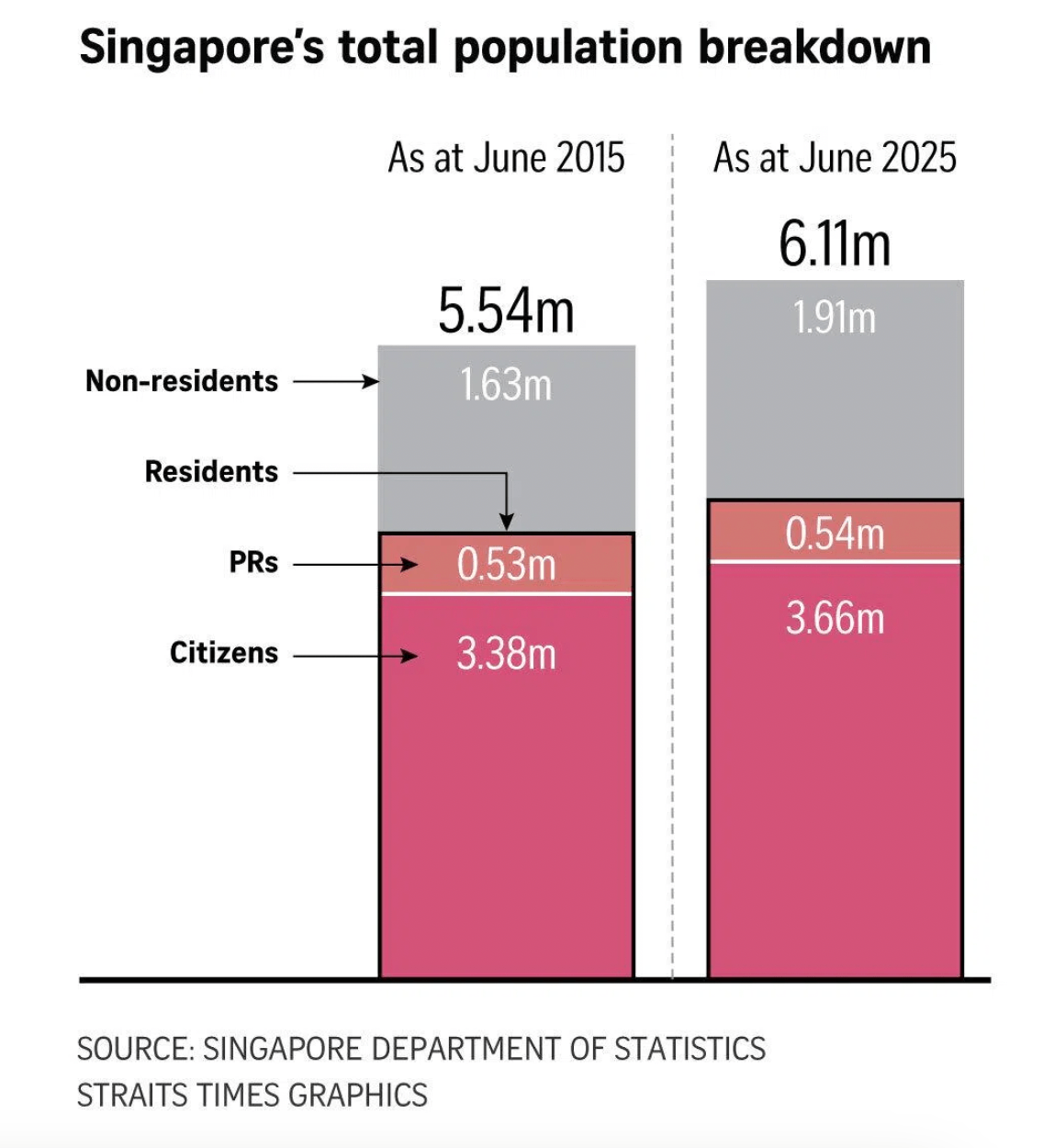
According to Population in Brief 2025 and SingStat data,
Singapore’s population grew by 1.3 per cent year-on-year, reaching 6.12 million — a record high that reflects steady citizen growth and a carefully managed rise in non-residents.
- Residents (Citizens + PRs): 4.14 million
- Non-residents: 1.98 million
Most new non-residents are in construction, caregiving, and domestic roles, sectors still recovering from post-pandemic shortages. Meanwhile, the professional segment saw continued expansion, particularly in technology, finance, and healthcare. (Learn more about Employment Pass eligibility and sector-based hiring trends.)
Foreign professionals, students, and entrepreneurs now form an essential pillar of Singapore’s economy. As industries evolve, the government’s approach increasingly emphasises workforce sustainability and long-term economic value, ensuring every entrant contributes to long-term growth and local employment balance.
For step-by-step eligibility checks and document lists, learn more in our Singapore PR Application Guide.
Singapore’s careful border reopening and data-led manpower planning have stabilised labour supply without overheating the job market. The MOM Labour Market Report Q2 2025 notes that overall unemployment remains below 3 per cent, with continued demand in growth sectors such as green energy, biomedical research, and digital services.
It also highlights Singapore’s unique position as one of Asia’s most open yet tightly managed labour markets, balancing economic necessity with social stability.
3. Employment Pass, S Pass and Foreign Workforce Dynamics
Singapore’s manpower strategy in 2025 continues to emphasise quality over quantity.
According to the Ministry of Manpower (MOM), approvals for new work passes have become more selective as part of a long-term plan to strengthen local-foreign complementarity rather than substitution.
Key Developments
1. Higher qualifying salaries
Employment Pass (EP) thresholds now scale with seniority and experience, ensuring parity with local professionals. This aligns with the COMPASS framework, introduced to measure applications across salary, qualifications, diversity, and local hiring ratios.
At the upper tier, the Personalised Employment Pass (PEP) remains available to established professionals earning at least S$22,500 per month, offering flexibility to switch employers without reapplying. Above that, the Overseas Networks & Expertise Pass (ONE Pass) targets exceptional global talent earning S$30,000 or more per month, or recognised for outstanding achievements in areas such as research, innovation, or the arts.
Together, these frameworks reinforce Singapore’s long-term strategy to attract world-class professionals while maintaining fairness, transparency, and opportunities for local progression.
2. Greater scrutiny of renewals
Renewals undergo a more detailed evaluation of tax compliance, CPF contributions for local staff, and business performance. Companies must show continued contribution to Singapore’s economy and workforce stability.

3. Sector-based adjustments
Growth sectors such as digital services, biomedical research, and green energy receive priority processing, reflecting Singapore’s shift toward high-skill industries. Conversely, reliance on low-wage or short-term labour remains tightly regulated through Work Permit quotas.
4. Balanced pathways for entrepreneurs and start-ups
For innovators, the EntrePass programme continues to offer a gateway for founders who contribute to Singapore’s innovation ecosystem through venture-backed or high-potential start-ups.
For employers, these policies mean preparation is essential.
Strong documentation, accurate salary benchmarking, and well-defined job scopes are now critical to approval. MOM expects applications to clearly demonstrate why a foreign professional’s expertise is necessary and how the hire supports local capability building.
Businesses navigating Employment Pass renewals, compliance reviews, or multi-hire planning often work with a licensed immigration agency in Singapore to manage documentation, timelines, and ongoing submissions alongside legal oversight.
For step-by-step guidance on eligibility, salary benchmarks, and application requirements, see our detailed guide on how to apply for an Employment Pass in Singapore.
Singapore’s approach reflects a mature labour ecosystem—open to talent yet firm on accountability. Together, these refinements ensure that immigration continues to serve national goals of competitiveness, inclusivity, and shared progress.
For family members of Employment Pass holders, the Ministry of Manpower continues to support flexible work options through the Letter of Consent (LOC) scheme. Eligible Dependant Pass and Long-Term Visit Pass (LTVP) holders may apply to work or operate a business in Singapore under clear renewal and compliance guidelines.
Learn more in our Guide to Applying for a Letter of Consent (LOC) in Singapore.
4. Permanent Residency and Citizenship: Current Trends
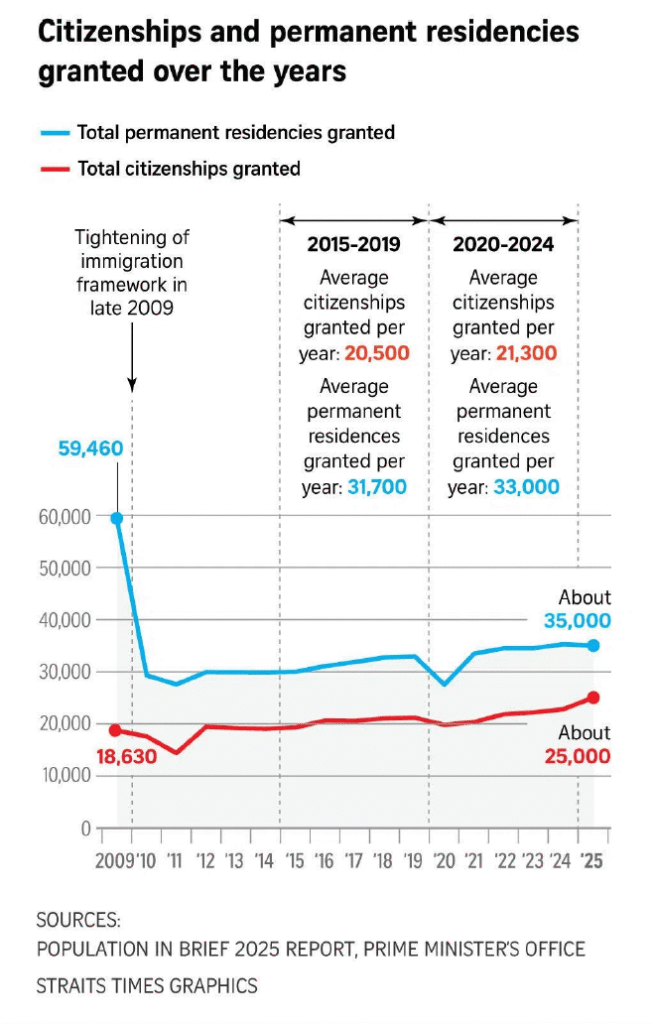
According to the Parliamentary Replies and government population data around 34,800 individuals were granted Permanent Residency and about 23,000 became Singapore citizens in 2024. In 2025, the figures remained broadly stable, with around 35,000 new PRs and 25,000 new citizenships granted. These numbers remain broadly consistent with Singapore’s long-term and carefully managed population planning approach.
More recent parliamentary discussions in early 2026 also signalled that immigration intake may gradually increase over time in response to demographic pressures such as Singapore’s declining fertility rate and ageing population. Public discourse has increasingly focused not only on immigration numbers, but also on integration, long-term contribution, and social cohesion.
Minister Indranee Rajah further clarified in Parliament that Singapore’s methodology for determining PR and citizenship intake has not fundamentally changed, and continues to take into account factors such as life expectancy, age profile, and the quality of applications received.
With an ageing population and tight labour market, Singapore continues to prioritise Permanent Residency and citizenship applicants who strengthen workforce renewal, contribute economically, and participate meaningfully in community life.
PR and citizenship applicants are encouraged to present a coherent personal narrative demonstrating steady employment, CPF contributions, and social participation. This approach balances fairness and merit, ensuring new residents add depth to Singapore’s long-term social fabric.
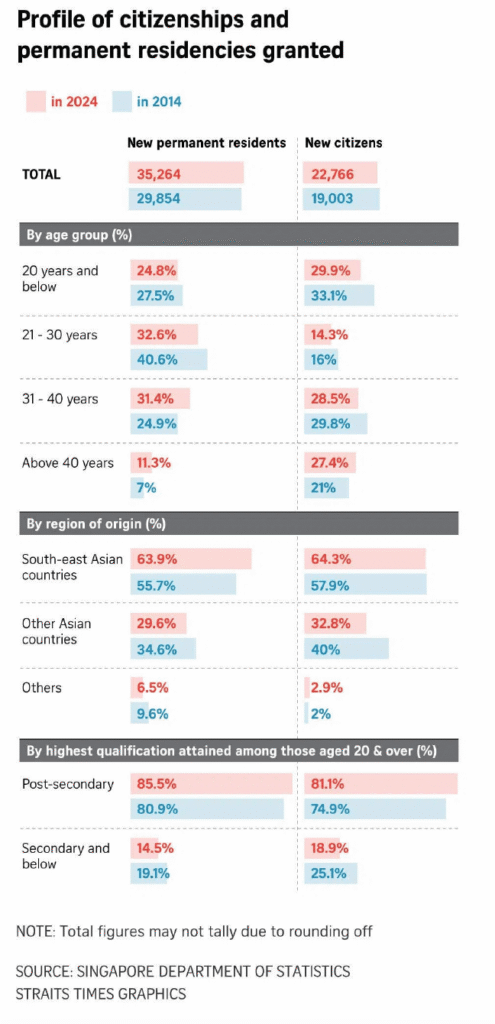
Recent population data also provides insight into the demographic and educational profile of newly approved PRs and citizens. Overall, the approval profile continues to reflect Singapore’s emphasis on economically active age groups, workforce participation, educational attainment, and long-term integration potential.
Those assessing their long-term residency and settlement prospects may also find it useful to review our Singapore PR eligibility calculator and assessment tool , together with our guide to Singapore PR requirements, which outlines some of the practical profile factors commonly associated with stronger PR applications over time.
Importantly, stable approval numbers do not indicate relaxed criteria. ICA continues to assess applications holistically, with increasing emphasis on consistency, long-term settlement signals, and integration rather than application volume.
For eligibility strategies, timelines, and required documents, start with our Singapore PR Application Guide and Singapore Citizenship Application Guide.
5. Economic and Policy Drivers
The Ministry of Trade and Industry (MTI) projects GDP growth between 1.5 and 2.5 per cent in 2025, supported by expansion in digital services, biomedical sciences, and green manufacturing.
These trends reflect Singapore’s strategy to balance innovation with inclusive growth which encourages global expertise while investing in local capability through initiatives such as SkillsFuture and talent renewal grants.
Immigration remains a vital pillar of this ecosystem. Skilled foreigners complement an ageing local workforce, while permanent residents and entrepreneurs help anchor long-term economic resilience.
To maintain transparency, agencies such as MOM, ICA, and IRAS increasingly share data to verify company compliance before approving passes or renewals. This integrated approach safeguards fairness and public trust.
For investors and entrepreneurs, Singapore’s pro-business environment, predictable regulation, and transparent immigration pathways make it a preferred base for regional expansion.
(Learn more through our Immigration Lawyer Singapore page for tailored corporate and compliance guidance.)
6. Integration and Community Participation
Integration in Singapore happens through everyday community life, not just government programmes. Programmes under the National Integration Council (NIC) such as Who’s Your Neighbour? and Unity in Diversity provide opportunities for locals and newcomers to connect and collaborate.
Integration can take many forms:
- Joining grassroots or community club activities.
- Volunteering in local schools or resident committees.
- Learning local phrases or celebrating multicultural festivals.
- Building authentic workplace relationships beyond professional circles.
Employers also play a key role. They can encourage inclusivity through mentorship programmes, cross-cultural onboarding, and celebrating cultural events within teams. These small but meaningful actions align with Singapore’s vision of unity through diversity, a principle that keeps social cohesion strong as demographics evolve.
For many newcomers, Singapore’s first impression is efficiency. But what makes people stay is the sense of belonging that slowly grows through shared experiences, from hawker centres to community volunteering and everyday neighbourly gestures.
Public sentiment toward immigration in Singapore remains broadly balanced, with continued support for economic openness alongside strong emphasis on social cohesion, fairness, and long-term integration.
Singaporeans generally recognise that foreign professionals and workers play an important role in supporting innovation, investment, healthcare, technology, and broader economic resilience. At the same time, public discussions increasingly focus on how newcomers integrate into local communities and contribute beyond purely economic participation.
Reflecting this shift, Singapore has begun introducing more structured integration initiatives for newly approved Permanent Residents. In late 2025, the Government piloted a new Permanent Resident Journey programme designed to help new PRs better understand Singapore’s culture, social norms, and community expectations through a combination of e-learning modules and experiential activities such as museum visits and local community events.
Authorities have also announced plans to pilot a voluntary orientation programme for Employment Pass holders in 2026, signalling a broader emphasis on helping newcomers integrate more smoothly into Singapore’s social and cultural environment alongside workplace participation.
Singapore’s immigration approach is increasingly focused not only on attracting talent, but also on encouraging long-term integration, community participation, and social stability as demographic pressures evolve.
7. Regional Comparisons and Global Context
Across Asia, governments are recalibrating immigration policy to attract global talent and remote professionals. While countries like Malaysia and the UAE focus on flexibility, Singapore’s strategy remains selective, emphasising quality, compliance, and long-term economic participation over volume.
A quick comparison of popular talent pathways in the region. Use this to position Singapore’s strengths for long-term planning.
Singapore’s edge is predictability and long-term clarity. If your goal is regional headquarters, stable family settlement, or structured career growth, Singapore offers a clear, rules-based pathway with strong legal certainty.
Singapore’s consistency continues to rank it at the top of regional indices such as the Global Talent Competitiveness Index. This reputation reinforces its position as Asia’s most predictable and trusted destination for skilled professionals and investors seeking long-term stability
🎓 International Students and Pathways
International students continue to play a vital role in Singapore’s talent ecosystem. Many choose to remain after graduation, contributing to innovation-driven sectors such as technology, finance, and healthcare.
Graduates may transition from a Student’s Pass to an Employment Pass or S Pass if they meet eligibility criteria. These pathways strengthen Singapore’s future-ready workforce and reflect the city’s commitment to attracting global talent while nurturing local opportunities.
8. Outlook for 2026 and Beyond
What this means going forward: Applicants and employers should expect fewer abrupt policy shifts, but greater scrutiny around compliance, economic contribution, workforce quality, integration, and long-term alignment with Singapore’s broader population and labour objectives. Employers and applicants should also expect stronger emphasis on documentation consistency across immigration, tax, and corporate records during both initial applications and renewals.
Singapore’s next phase of immigration policy will likely emphasise three key directions:
1. Smarter use of data across agencies.
The Ministry of Manpower (MOM) now collaborates more closely with the Immigration and Checkpoints Authority (ICA) and the Inland Revenue Authority (IRAS) to verify companies’ financial standing, workforce composition and local hiring ratios.(See our Employment Pass Guide or an overview of company eligibility and documentation.) This cross-agency verification occurs before approving or renewing work passes.
The latest MOM Labour Market Report Q2 2025 highlights these cross-checks as part of a broader data-driven approach to maintain fair employment practices.
2. Greater transparency and fairness in applications.
Authorities are giving more attention to corporate tax compliance, salary justification and equal-opportunity hiring. Companies that demonstrate strong governance and timely tax filings tend to see smoother renewals, according to the Baker McKenzie Global Immigration Handbook 2025.
3. Visible signs of social contribution.
While integration is not formally scored, the National Integration Council (NIC) continues to encourage participation in neighbourhood, school and workplace initiatives such as Who’s Your Neighbour? and Unity in Diversity. These programmes highlight how everyday community involvement can help newcomers build belonging and complement professional success.
As Singapore moves into 2026, it faces both opportunities and trade-offs. Global talent mobility and sustainability goals will test how far the system can innovate without diluting fairness. At the same time, advances in digital verification and cross-border data systems will enable faster and more transparent immigration decisions, positioning Singapore to stay agile amid regional competition.
4. Demographic pressure and long-term population planning
Singapore’s long-term immigration planning is increasingly linked to demographic sustainability. In 2025, Singapore’s preliminary total fertility rate fell to 0.87, among the lowest globally. Public discussions in 2026 have therefore focused more closely on how immigration, integration, workforce renewal, and population sustainability interact over the long term.
At the same time, the Government has consistently emphasised that immigration policy is not driven purely by population growth targets. Social cohesion, population stability, and maintaining a stable citizen core remain central policy considerations alongside economic needs.
As demographic pressures continue to evolve, Singapore’s approach is likely to remain measured rather than expansionary, prioritising long-term contribution, workforce quality, and social stability over rapid population growth.
Together, these developments reflect Singapore’s evolving balance between openness and accountability. The government continues to refine immigration processes so that both individuals and businesses contribute meaningfully, economically, socially, and ethically to Singapore’s long-term stability and growth.
9. In Summary
Singapore’s immigration system in 2025 reflects refinement, resilience and readiness for the future.
The balance between attracting global talent and maintaining social harmony continues to define Singapore’s position as a trusted global hub.
- For foreign professionals: Strong career opportunities remain available across technology, finance and healthcare.
- For PR and citizenship applicants: Success depends on planning ahead, showing stability and contributing meaningfully to the community.
- For businesses: Aligning hiring practices with Singapore’s transparent standards supports smoother approvals and long-term compliance.
Ultimately, immigration in Singapore is not just an administrative process. It is a long-term partnership between people and policy, designed to sustain both economic growth and social cohesion.
10. FAQ
1.What is the single biggest immigration trend in Singapore for 2026?
The most significant trend is increased selectivity without numerical reduction. Singapore continues to welcome foreign professionals and long-term residents, but approvals increasingly depend on quality of contribution, compliance history, and integration indicators rather than eligibility alone.
Singapore’s immigration policies in 2025 focus on attracting quality talent, maintaining stable PR and citizenship numbers, and deepening social integration through community engagement.
According to Population in Brief 2025, Singapore’s population reached 6.12 million, comprising 4.14 million residents and 1.98 million non-residents. The increase reflects steady citizen growth and a carefully managed rise in foreign manpower.
Permanent Residency and Citizenship applications are assessed holistically, considering career consistency, economic contribution, family stability, and social participation rather than nationality or income alone.
Newcomers can integrate successfully by participating in community clubs, volunteering, learning local languages, and joining workplace inclusion initiatives. These everyday efforts reflect Singapore’s spirit of unity through diversity and support long-term settlement goals.
Consulting an immigration lawyer in Singapore can provide clarity on eligibility, strengthen your documentation, and ensure your application aligns with current policies. Professional guidance helps you approach the process with confidence and precision.
10. Book a Consultation
This immigration trends report is intended to provide context and clarity on how Singapore’s work pass, PR, and citizenship policies are evolving.
If you would like structured guidance on how these policy developments may affect your work pass, Permanent Residency, or citizenship plans, you may refer to our Singapore work pass services, which outline the scope of assistance available for professionals, employers, and families.
You may also book a 20-minute consultation to clarify eligibility frameworks, timing considerations, and the appropriate immigration pathway based on your circumstances. This discussion is intended to help clarify eligibility frameworks and appropriate next steps.

About the Author: Sulochana Uthirapathi is the Founder of Transform Borders, a Singapore immigration consultancy established in 2017. She specialises in Employment Pass (EP), Permanent Residency (PR) and Citizenship applications, supporting professionals, families and corporate clients with legally guided and structured immigration processes.