

For many foreigners, Singapore quickly becomes more than just a place to work, it can feel like home.
Applying for Permanent Residency (PR), however, can feel overwhelming. Each year, applicants from different nationalities and professional backgrounds are assessed under a highly selective and discretionary framework.
This guide, prepared by Transform Borders, walks you through the full process of applying for Singapore PR. For PR eligibility criteria and document requirements, see our Singapore PR Requirements Guide here.
What is Permanent Residency (PR)?

The permanent resident card serves as the official identification document for Singapore PRs.
Permanent Residency grants you the right to live, work, and study in Singapore without time restrictions. It is an immigration status granted by the Singapore Government that reflects your long term commitment to the country’s economy and community.
Key benefits include:
- Eligibility to apply for Singapore citizenship after several years.
- Access to subsidised education and healthcare.
- CPF (Central Provident Fund) contributions and retirement savings, which provide family protection through combined social security benefits like healthcare, retirement, and housing support.
- Ability to buy selected HDB flats and enjoy lower property taxes.
To summarise, Singapore Permanent Residency gives foreigners the stability to live, work, and contribute long-term without relying on work pass renewals.
Why Should You Apply for Singapore PR?

Holding PR status brings long-term stability and peace of mind.
Top reasons to apply:
- No more work pass renewals or dependency on employers.
- Key residency privileges: With PR status, you have the right to live, work, and study in Singapore without any time limits.
- Eligibility for public housing and home loans.
- Access to CPF for healthcare, housing, and retirement.
- Freedom to switch jobs easily.
- Ability to include your spouse (who must be in a legal marriage with you) and children under 21 in your PR application.
- Option to apply for long-term visit passes for parents.
- Opportunities to start a business and benefit from Singapore’s low-tax environment.
PR status is often the first step toward eventually becoming a Singapore citizen, with access to subsidised healthcare, CPF savings, and long-term housing stability along the way.
What Are the Different Types of PR Applications in Singapore?

The Immigration & Checkpoints Authority (ICA) accepts PR applications under several categories:
ICA accepts PR applications under five main categories:
- Spouse and unmarried children (under 21) of a Singapore Citizen or PR
- Aged parents of a Singapore Citizen
- Employment Pass, S Pass, PEP, or ONE Pass holders (minimum 6 months in Singapore)
- Students and foreign artists
- Foreign investors via the Global Investor Programme (GIP)
For full eligibility details under each category, see our Singapore PR Requirements Guide.
How to Apply for Singapore PR: Step-by-Step Process
Step 1: Gather Required Documents

Before you begin your PR submission, collect key documents confirming your identity, employment history, and financial stability. Preparing these clearly helps avoid delays or rejection.
In practice, ICA’s PR application process now goes significantly beyond basic identity and salary documents alone. Depending on the applicant’s profile, additional sections may involve detailed employment history, overseas residential history, family background information, business ownership records, achievements, memberships, or broader supporting profile details.
For the full ICA document checklist, see our Singapore PR Requirements Guide.
Note: All documents must be consistent with ICA’s records and your previous work pass filings. Missing or mismatched details may delay processing or prompt ICA to request further clarification.
Step 2: Online Submission via ICA e-Service

The official ICA e-Service portal is where you can submit your application as an online application.
Eligible applicants can now submit their PR applications online through the ICA e-PR system. Log in with Singpass on ICA e-Service and upload all supporting documents. Depending on the applicant’s profile and application type, additional profile information and supporting documents may also be required during the online submission process.
Applications for permanent residency are submitted online via ICA’s e-Service portal. In normal cases no in-person interview or visit to the ICA building is required. However, in exceptional cases ICA may contact the applicant or sponsor to provide further documents or clarifications.
For a full breakdown of supporting documents required, please refer to ICA’s official PR application form and submission guide.
Step 3: Fill in Particulars and Upload Documents Within 7 Days

Review ICA’s pre-submission checklist carefully. Make sure every detail, especially your personal particulars, is filled in accurately.
ICA’s system gives you seven days to complete this step — if you miss the window, you will need to restart your application.
In practice, the PR application form can become significantly more detailed than many applicants initially expect.
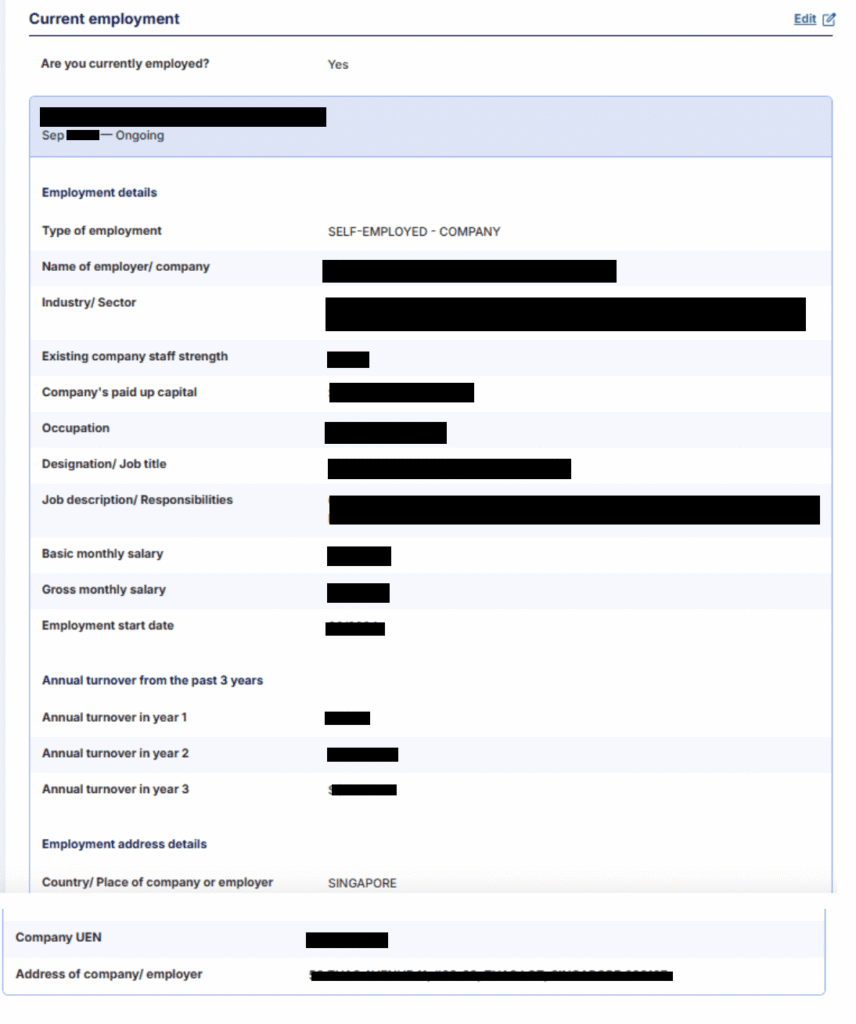
Depending on the applicant’s profile, ICA’s forms may contain extensive sections relating to family background, overseas addresses, previous employment history, education records, business activities, achievements, memberships, and other supporting profile information.
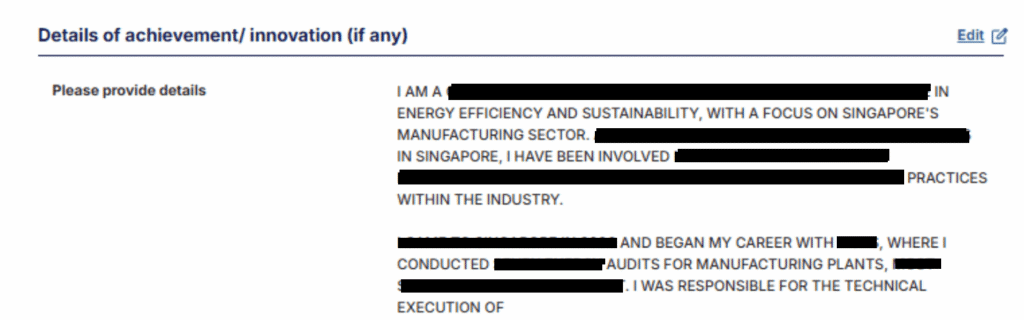
Certain sections within the application may also require applicants to prepare longer written explanations or profile summaries relating to their professional background, achievements, or broader circumstances. Where spouses or family members are included within the same PR application, similar achievements and profile-related sections may also need to be completed for accompanying applicants as part of the overall submission.
Step 4: Review and Declare the Application Within 7 Days

Log in to ICA’s PR e-Service using Singpass. Each applicant, including your spouse and children, must log in to review and confirm their own details. Before submitting, complete the declaration confirming that the details provided are accurate and true.
If Singpass is not applicable (e.g., for applicants overseas or under 15 years old), ICA will provide unique login credentials for this purpose. If you are eligible and do not have an account, you can register online or visit a counter.
Need help preparing your PR application?
Speak with our team to better understand your profile, documentation strategy, and next steps before submission.
Step 5: Pay the Application Fee

Once the application is submitted, you will need to pay a non-refundable processing fee of SGD 100 per applicant. This payment can be made online via credit card.
After successful submission and payment, applicants will generally receive an acknowledgement email from ICA confirming that the application has been lodged. Applicants may also log in to MyICA or ICA’s e-Service portal to monitor the application status during the processing period, where the application will typically reflect as processing while under review. A downloadable copy of the submitted application is also usually available through the portal for future reference.
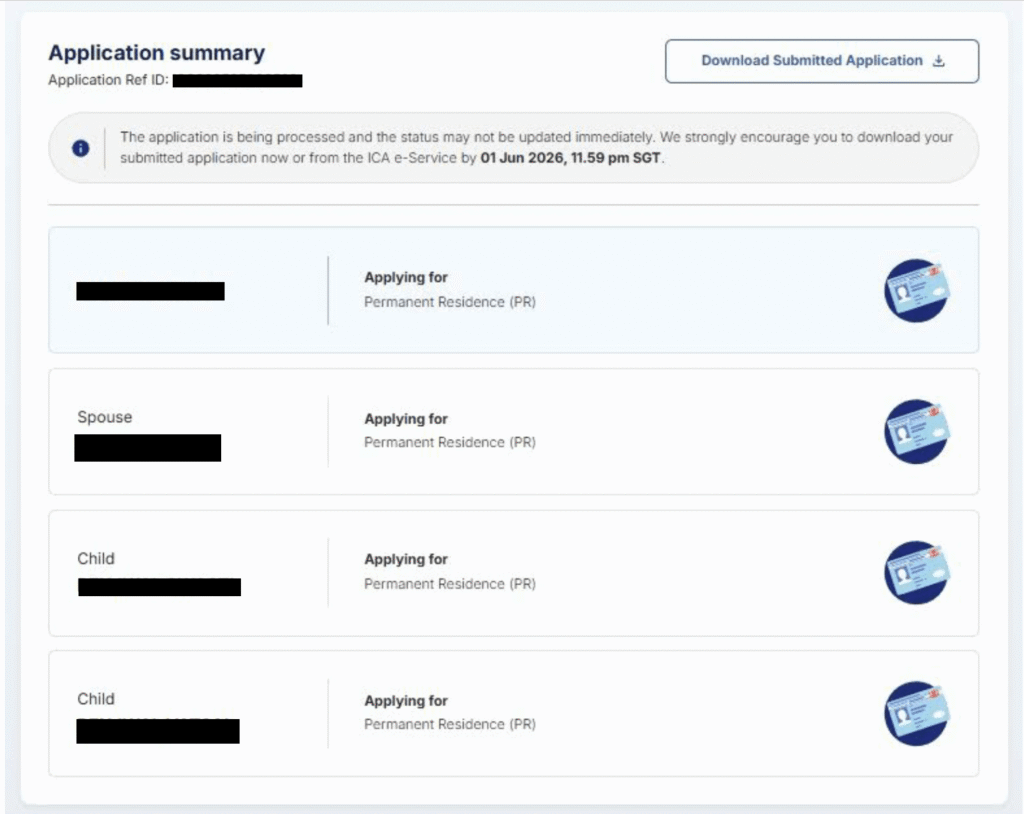
Step 6: After You Submit – What Happens Next?
The processing time for Singapore PR applications is generally expected to take around 6 months, although some applications may take longer depending on the complexity of the profile and whether ICA requires further clarifications.
During the review period, ICA may issue clarification requests or request additional supporting documents through ICA’s e-Service portal. Applicants will generally receive an email notification directing them to log in to the portal to review and respond to the request within the stated timeline.
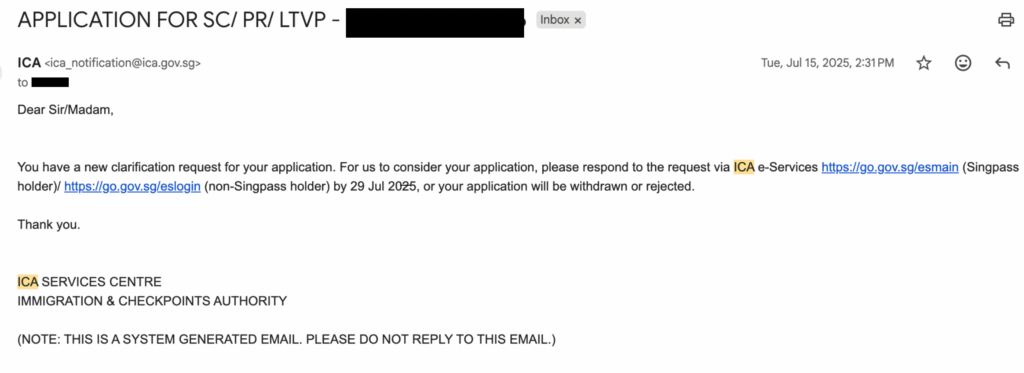
Clarification Requests
Examples of documents or information that ICA may request during processing can include:
- updated employment letters or recent payslips
- clarification relating to employment or family background
- curriculum vitae or profile information for family members
- updated financial or business-related documents
- further supporting documents relevant to the overall application
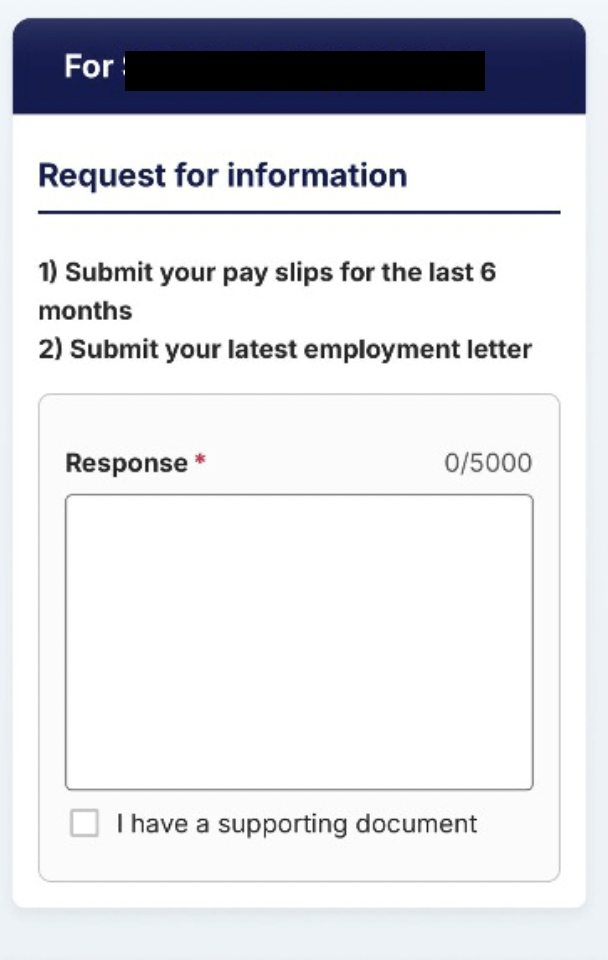
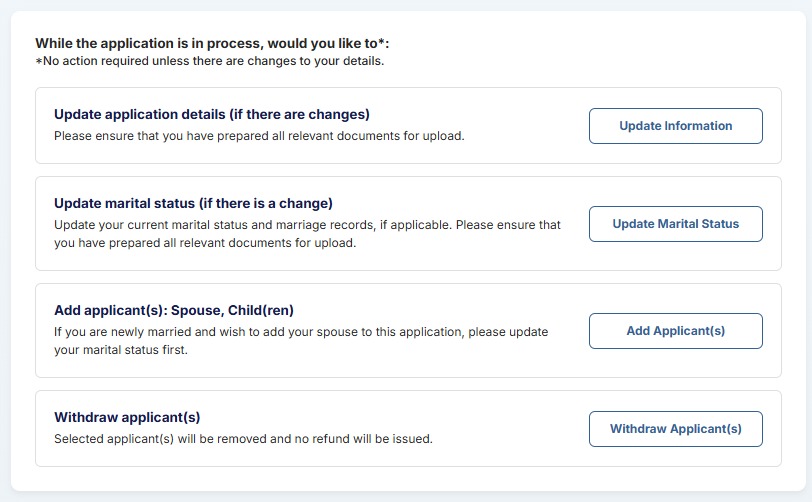
However, not all updates during the processing period originate from ICA.
During the processing period, applicants may update ICA where there have been material changes since the original submission. Depending on the nature of the change, this may be done directly through ICA’s online portal or through the appropriate ICA enquiry channels.
7: What to Do After Receiving Your PR Approval Letter
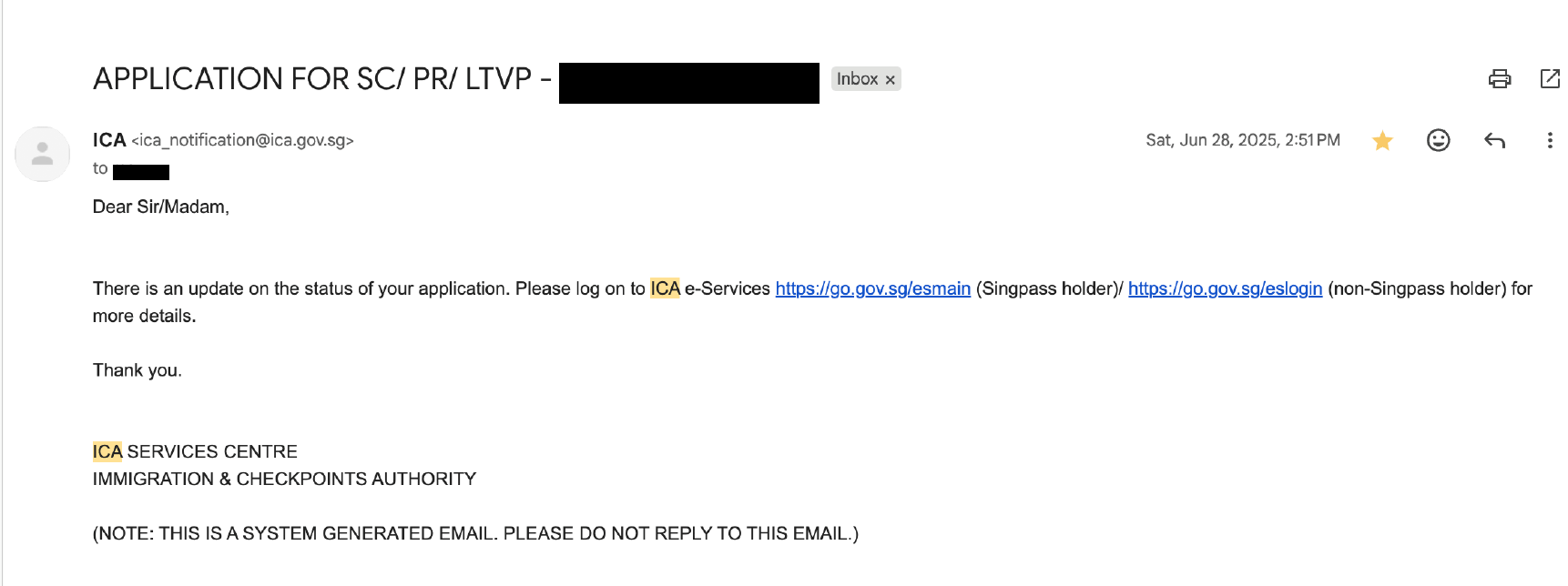
If your Singapore PR application is approved, ICA will generally send an email notification informing applicants that there has been an update to the application status.
Once logged into ICA’s e-Service portal, applicants may view the approved outcome, download the In-Principle Approval (IPA) letter, and review the next steps required to complete the PR formalities.
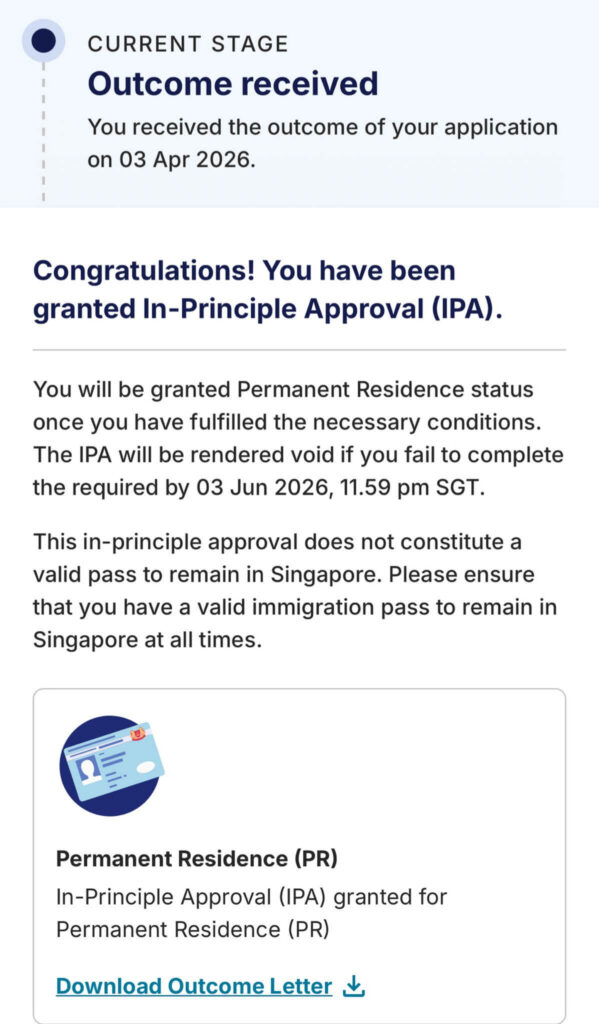
Following approval, applicants will generally need to complete the required PR formalities within the validity period stated in the IPA. This commonly includes booking the ICA appointment, reviewing the required supporting documents, completing the relevant declarations and health-related procedures, and preparing for collection of the PR card and Blue IC.
Applicants may also be required to complete the Singapore PR Journey requirements as part of the post-approval process. The IPA and ICA e-Service portal will generally contain instructions relating to appointment booking, required documents, declaration procedures, timelines, and the formalities that must be completed before the IPA validity period expires.
Step 8: If Your PR Application is Not Successful

A rejected PR application does not necessarily mean that future applications will also be unsuccessful. In many cases, applicants may strengthen their profile over time through improved employment stability, updated qualifications, stronger family circumstances, or broader long-term integration in Singapore.
Following a rejection, applicants may generally consider either:
- submitting an appeal where there are meaningful clarifications, new supporting information, or exceptional circumstances that may not have been fully reflected in the original application; or
- reapplying at a later stage once the overall profile has strengthened further.
The appropriate timing for an appeal or reapplication often depends on the applicant’s individual circumstances, the nature of the profile, and whether there have been any material improvements since the previous submission.
For guidance on whether an appeal or reapplication may be more appropriate, and how to strengthen the overall profile strategically, see our Singapore PR Rejection & Reapplication Guide.
For the latest updates and detailed requirements, always refer to ICA’s official website.
What Are the Key Tips to Strengthen Your PR Submission?
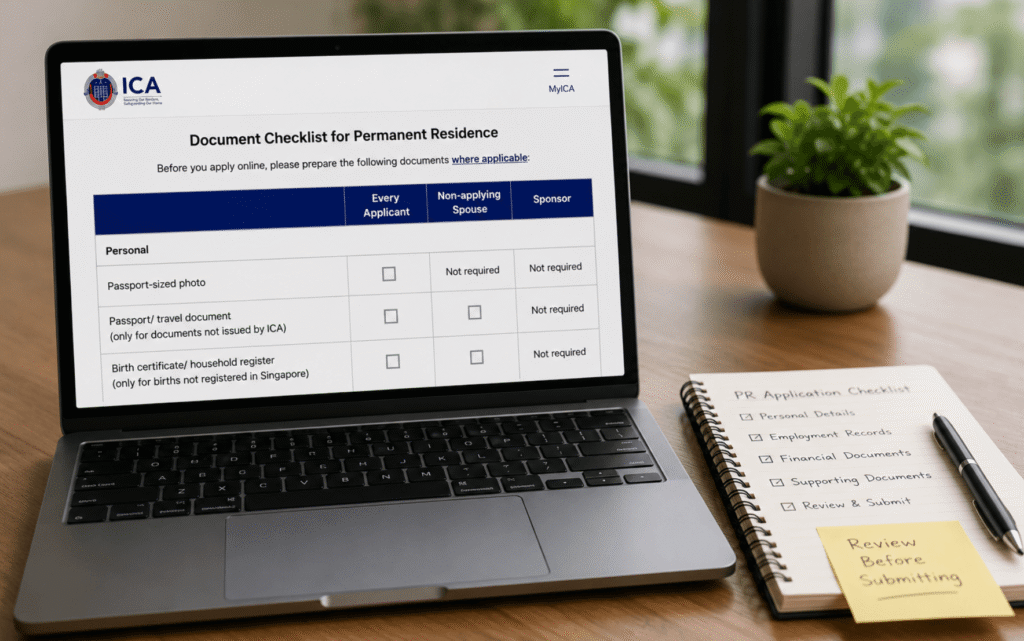
A strong Singapore PR application is not simply about uploading documents and waiting for the outcome.
In practice, ICA reviews the overall clarity, consistency, and credibility of the application as a whole. A well-prepared submission should make it easy for the reviewing officer to understand your background, employment history, family profile, and long-term circumstances in Singapore.
Here are some practical considerations before submission.
1. Keep all information consistent
Ensure that your employment history, salary details, addresses, family information, and educational records remain consistent across the application form and supporting documents.
Even relatively small inconsistencies may result in clarification requests or unnecessary delays during processing.
This becomes particularly important for applicants with:
- overseas employment history,
- self-employed or business backgrounds,
- multiple previous employers, or
- complex family circumstances.
2. Organise the application clearly
A well-organised submission is significantly easier for ICA to review.
Documents should be labelled properly and arranged logically, especially where there are:
- multiple applicants,
- overseas records,
- lengthy employment histories,
- asset or investment records, or
- business ownership structures involved.
Clear organisation also reduces the likelihood of important information being overlooked during assessment.
3. Explain unusual circumstances carefully
If there are employment gaps, salary fluctuations, business ownership arrangements, overseas family situations, or other circumstances that may not be immediately obvious from the supporting documents, a short and factual explanation may sometimes help provide context.
The explanation should remain concise, consistent, and properly supported where relevant.
4. Do not overlook the profile and achievements sections
Many applicants focus heavily on payslips and employment documents, but ICA’s PR application process now requests significantly broader background information than in previous years.
Depending on the applicant’s profile, ICA may also request or assess:
- professional memberships,
- leadership roles,
- publications,
- volunteer activities,
- business ownership,
- asset or investment records,
- awards or achievements,
- professional certifications, or
- community involvement.
Where relevant, these sections should be completed carefully and consistently with the overall application narrative.
A strong PR submission is often one that presents a coherent long-term profile rather than isolated documents in separate sections.
5. Use recent and updated records
Employment letters, salary documents, and business records should generally be recent and clearly dated.
Where there have been material changes shortly before submission, such as:
- salary adjustments,
- promotions,
- business incorporation,
- changes in employment, or
- updated family circumstances,
it is often prudent to ensure the application reflects the latest position accurately.
6. Review the entire application carefully before submission
Before paying the application fee and submitting the application, review every section carefully.
Small mistakes involving:
- names,
- passport details,
- employment dates,
- salary declarations, or
- family information
can sometimes create avoidable complications later during processing.
Applicants should also ensure uploaded documents are complete, readable, and properly labelled before final submission.
7. Continue monitoring the application after submission
Submission is not always the final stage of the process.
During the review period, ICA may request:
- clarification documents,
- updated records,
- additional supporting information, or
- updates relating to changes in circumstances.
Applicants should continue monitoring both MyICA and their registered email address throughout the processing period.
Where there are material changes after submission, such as:
- change of employer,
- salary adjustment,
- marriage,
- birth of a child,
- business incorporation, or
- changes in family circumstances,
it may be prudent to update ICA through the appropriate ICA feedback channel together with supporting documents where relevant.
8. Seek professional guidance where appropriate
Singapore PR applications are often more nuanced than many applicants initially expect, particularly where the profile involves:
- self-employment or business ownership,
- overseas employment history,
- prior rejections,
- family-based applications,
- complex financial structures, or
- uncertainty around overall profile strength.
Professional guidance may help applicants better understand:
- how ICA is likely to assess the overall profile,
- whether the timing of the application is appropriate,
- what potential weaknesses may exist, and
- how the application can be presented more clearly and strategically.
Applicants who are unsure whether their current profile may presently be viewed as relatively weak, average, or strong may also wish to first use our Singapore PR Eligibility Calculator before proceeding with submission.
The calculator provides an indicative assessment based on common PR assessment factors and practical application trends observed across different applicant profiles.
In summary, a strong PR submission is usually one that is clear, organised, accurate, and easy for ICA to assess.
Common Application Mistakes (and How to Avoid Them)

One of the most common misconceptions about Singapore PR applications is that approval depends purely on salary alone.
In reality, many applications encounter difficulties because of avoidable issues involving inconsistent records, rushed preparation, incomplete declarations, or unclear supporting information.
Over the years, ICA’s PR application process has also become significantly more detailed and documentation-driven. As a result, even relatively strong applicants may run into unnecessary complications if the application is poorly prepared.
Below are some of the more common mistakes seen in practice.
1. Treating the application as “just a form submission”
Some applicants assume the process simply involves uploading payslips and completing an online form.
In practice, ICA often assesses the overall consistency and credibility of the applicant’s background, including employment history, family profile, long-term residence, and supporting declarations.
A rushed or incomplete submission may leave important parts of the profile unclear.
2. Submitting inconsistent information
One of the most common issues involves inconsistencies across:
- employment history,
- salary declarations,
- residential addresses,
- family information, or
- previous immigration records.
Even where discrepancies are accidental, they may still result in clarification requests or unnecessary delays.
Consistency across the entire application matters more than many applicants initially realise.
3. Underestimating how detailed the PR application has become
Many applicants are surprised by the level of detail now requested within ICA’s PR forms.
Depending on the applicant’s profile, ICA may request or assess:
- historical employment records,
- family background information,
- educational history,
- business ownership details,
- asset or investment records,
- achievements,
- memberships,
- publications,
- supporting explanations relating to family or employment circumstances, or
- broader profile information beyond basic employment documents.
Applications involving overseas employment, self-employment, or complex family structures often require particularly careful preparation.
4. Ignoring the achievements or profile sections
Applicants sometimes leave sections relating to achievements, leadership roles, memberships, or community involvement largely incomplete even where relevant information exists.
While these sections alone do not determine approval, they may help ICA better understand the applicant’s broader background and long-term profile in Singapore.
5. Providing too many unrelated documents
Submitting excessive or unrelated documents does not necessarily strengthen an application.
In some cases, applicants upload large volumes of records that add little value or create unnecessary confusion during review.
A clearer and more focused submission is often more effective than an overly bulky submission.
6. Failing to update ICA after significant changes
Some applicants experience major changes after submission but do not update ICA accordingly.
This may include:
- change of employment,
- salary revisions,
- marriage,
- birth of children,
- relocation,
- business incorporation, or
- changes in sponsorship or family circumstances.
Where relevant, material updates should generally be communicated to ICA appropriately during the processing period.
7. Relying entirely on generic online advice
PR applications are often far more nuanced than simplified online discussions or “approval formulas” suggest.
Every application is assessed based on its own overall circumstances, and ICA retains broad discretion throughout the process.
Applicants should therefore be cautious about relying entirely on generic assumptions regarding salary, nationality, industry, or timelines without considering the wider context of their own profile.
Applicants who are unsure how their current profile may generally be viewed may also find it useful to first use our Singapore PR Eligibility Calculator before proceeding with submission.
In summary, many PR applications are weakened not by one major issue alone, but by a combination of smaller problems involving inconsistencies, unclear presentation, rushed preparation, or incomplete disclosures.
A carefully prepared application is usually clearer, more credible, and easier for ICA to assess.
Quick Summary: How to Apply for Singapore PR in 2026
If you prefer a quick overview, here’s the PR application process summarised in 8 key steps. (Estimated time: ~4 hours — varies with document readiness and Singpass access.)
Time needed: 4 hours
- Step 1: Gather required documents
Prepare ICA required documents (passport, certificates, 6 months’ payslips, employer letter dated within 3 months, and—if self-employed—ACRA + 3 years’ financials).
- Step 2: Submit online via ICA e-Service
Log in with Singpass on ICA e-Service, complete the form and upload all supporting documents.
- Step 3: Fill in Particulars and Upload Documents Within 7 Days
Finish your particulars and uploads within 7 days of starting the draft or you’ll need to restart the application.
- Step 4: Review and Declare the Application Within 7 Days
All applicants (main, spouse, children) must review and declare via Singpass; ICA provides login credentials where Singpass is not applicable.
- Step 5: Pay the Application Fee
Pay the non-refundable S$100 fee per applicant online before final submission.
- Step 6: Wait for the Outcome
Processing typically takes up to 6 months; respond promptly if ICA requests additional documents (e.g., CVs, updated payslips, or business records).
- Step 7: What to Do After Receiving Your PR Approval Letter
Follow your IPA instructions: book your ICA appointment, complete the health declaration, and collect your Blue IC as scheduled.
- Step 8: If Your PR Application is Not Successful
Consider whether an appeal or later reapplication is more appropriate, depending on whether there are meaningful clarifications, new supporting information, or material improvements to the profile.
Frequently Asked Questions About PR Application in Singapore
Processing typically takes up to six months, though timelines vary depending on the completeness of your submission and ICA’s workload.
Yes. Appeals should be filed within six months of the rejection. However, it is often better to reapply after strengthening your profile with updated achievements and documents.
Not necessarily. Employment Pass, S Pass, and PEP holders can apply directly. Sponsors are required for family-based categories such as spouses, parents, and children of Singapore Citizens or PRs.
ICA may request updated employment records, clarification documents, or further supporting information during processing. Applicants should respond clearly and within the stated deadline, ensuring the documents remain consistent with the original application.
Applicants may submit PR applications independently through ICA’s e-Service platform. However, many individuals choose to seek professional assistance where the application involves complex employment history, self-employment, family considerations, prior rejections, or strategic presentation concerns.
A previous rejection does not automatically prevent future approval. ICA assesses each application based on its current merits, profile strength, supporting documents, and overall circumstances at the time of submission.
How Transform Borders Can Help
“No fancy stories, no marketing spiels — just great professional standards and flexibility. Transform Borders guided us through our successful SPR journey after we had a few disappointments previously. A special shout-out to Yuan, our RM, who provided exceptional service during the whole process. Highly recommended!”
Applying for Singapore PR can feel overwhelming, particularly given the level of detail now required by ICA, including employment history, family background information, supporting documents, and profile-related declarations.
At Transform Borders, every application is personally overseen by a law professional and handled through a structured, compliant, and personalised process. As a Singapore-based immigration consultancy, we assist individuals, families, and professionals with Singapore PR applications, appeals, Employment Pass matters, and long-term residency planning.
We focus on:
Accuracy & Strategy
Presenting your profile, supporting documents, and circumstances clearly and consistently in line with ICA’s assessment framework.
Personalised Guidance
Practical advice tailored to your work pass status, family circumstances, professional background, and long-term plans in Singapore.
End-to-End Support
From application preparation and document review to appeals and post-submission guidance, we remain involved throughout the process.
Learn more about our Singapore PR Services or speak with our team to discuss your circumstances.